Artwork
Festoon of fruit
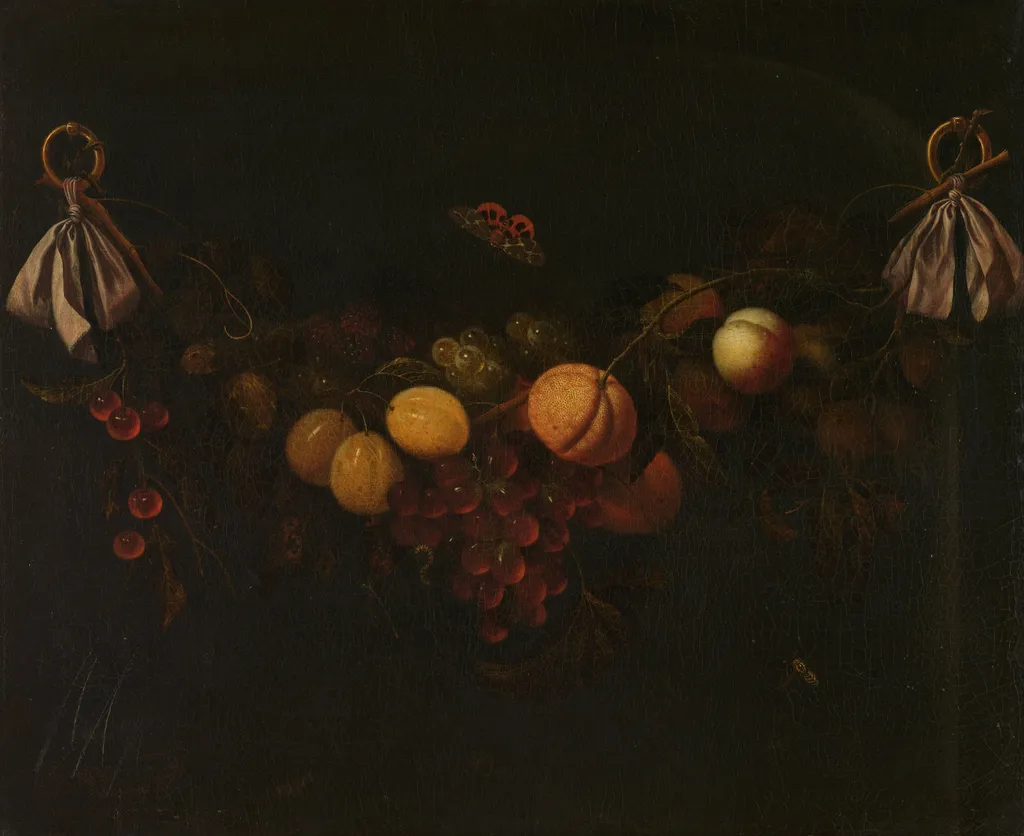
Festoon of fruit is an oil painting by the Dutch Golden Age artist Johannes Borman. It dates from 1653 and is held in the collection of the Rijksmuseum.
About this work
Overview
Johannes Borman’s 1653 oil painting titled *Festoon of Fruit* presents a still‑life composition centered on a suspended cluster of fruit. The work is part of the Rijksmuseum’s collection and exemplifies the Dutch still‑life tradition of the mid‑seventeenth century, focusing on the careful rendering of natural objects against a dark backdrop.
Subject & Meaning
The composition features a hanging bunch of grapes, a few cherries, and round, yellowish fruits resembling lemons or oranges, flanked by two dried seed pods with looped tops. The arrangement suggests a casual abundance, inviting contemplation of the transience of food and the sensory pleasures of sight and taste.
Technique & Style
Borman employs strong chiaroscuro, using deep shadows to isolate the fruit and enhance their luminous colors. The dark ground amplifies the reflective highlights on the skins, creating a subtle glow that emphasizes texture and form. The brushwork is precise, capturing the gloss of grapes and the matte surface of the dried pods.
History & Provenance
Created in 1653, the painting entered the Rijksmuseum’s holdings as part of its Dutch Golden Age collection. While specific acquisition details are limited, the work reflects Borman’s activity in the Netherlands during a period when still‑life paintings were highly prized for their technical skill and symbolic content.
Own this work as a print
Artist & collection
