Artwork
Shipping in a breeze in the Thames or the Medway
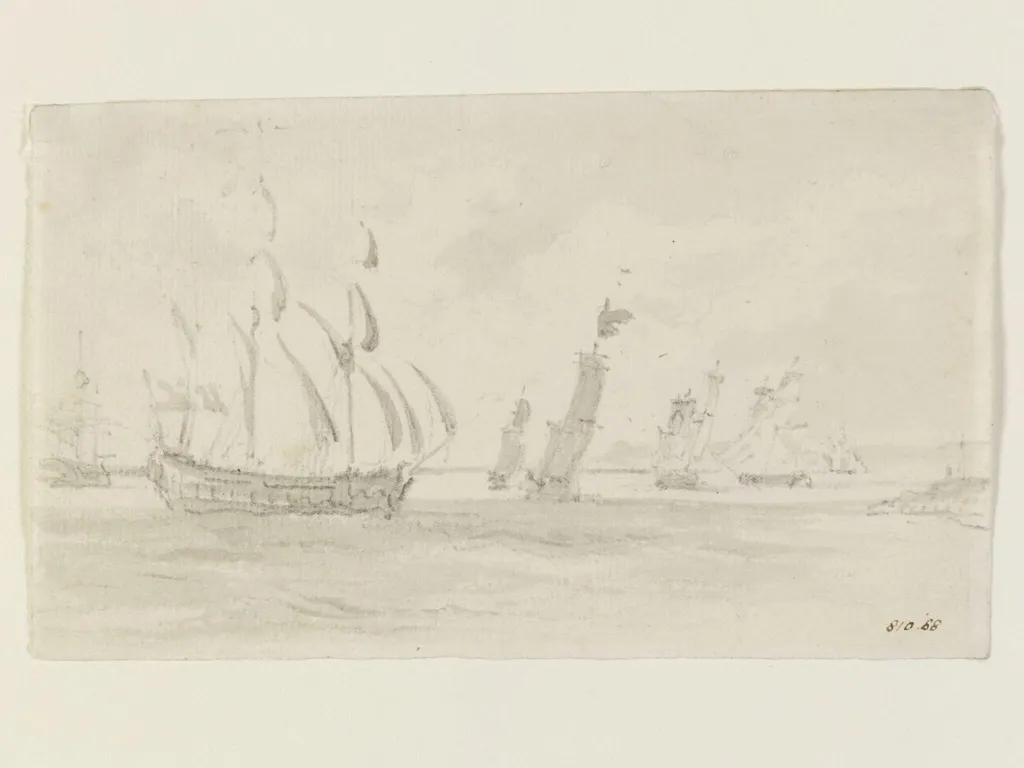
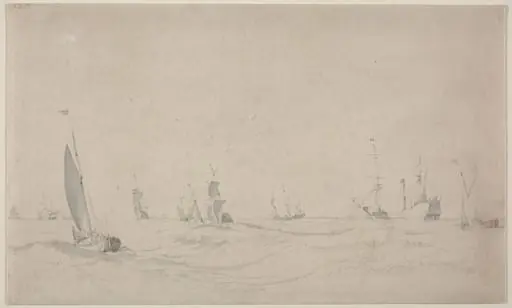
Shipping in a breeze in the Thames or the Medway is a watercolor work on paper by the Romanticist artist John Constable. It dates from 1803 and is held in the collection of the Victoria and Albert Museum.
About this work
This sketch shows a row of old sailing ships on calm water, their tall masts and billowing sails catching the wind.
This sketch shows a row of old sailing ships on calm water, their tall masts and billowing sails catching the wind. The waves are barely visible, and the boats look small against the pale background. The artist used loose, quick strokes—some lines are dark, others barely there.
Notice how the ships’ rigging and sails are drawn with confident, wavy lines, almost like dancing. The date in the corner (April 1803) suggests this was made early in the artist’s career.
Check out Romanticism to see how artists used nature and movement in their work.
Overview
Created in April 1803, this watercolour by John Constable captures a quiet maritime scene along the Thames or Medway. Executed in pencil and grey wash, the work presents a single ship with full sails in the foreground, accompanied by fainter vessels receding into the distance. The loose, rapid brushwork and minimal detail suggest it was made as an on-site observation rather than a polished composition.
Subject & Meaning
The painting depicts working sailing vessels under sail, their masts and rigging rendered with fluid, confident lines. The calm water and pale background emphasize the ships’ motion and presence, not their specific identity. This focus on everyday maritime activity reflects Constable’s interest in the natural rhythms of labor and environment, rather than romanticized or dramatic narratives.
Technique & Style
Constable employed minimal watercolour washes and sparse pencil strokes to suggest form and movement. The sails and rigging are defined by wavering, expressive lines that convey wind and tension without detailed rendering. The absence of strong shadows or depth cues reinforces the sketch-like quality, aligning with his practice of capturing fleeting impressions directly from nature.
History & Provenance
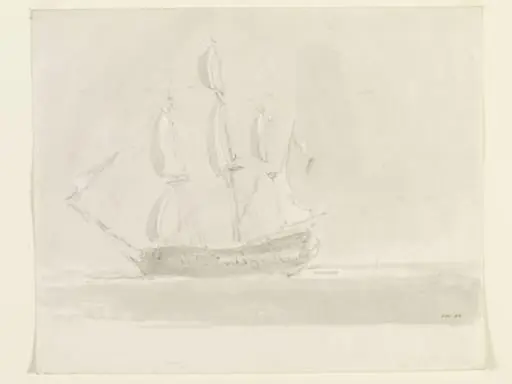
The sheet bears a date of April 1803, placing it among Constable’s earliest known works. A small pencil sketch of a single ship appears on the reverse, indicating the artist reused paper for quick studies. These works were likely made during travels along the Thames and Medway, where he observed shipping activity as part of his developing artistic practice.
Context
In early 19th-century England, watercolour sketching was a common method for recording landscapes and scenes en plein air. Constable’s approach aligned with emerging Romantic sensibilities that valued direct observation and the emotional resonance of natural phenomena, though his focus remained grounded in the ordinary rather than the sublime.
Legacy
This early study exemplifies Constable’s lifelong commitment to recording the natural world with honesty and sensitivity. Though not a finished painting, its immediacy and attention to light and motion foreshadow the observational rigor that would define his later landscapes, influencing generations of artists who prioritized direct experience over idealization.
Own this work as a print
Artist & collection
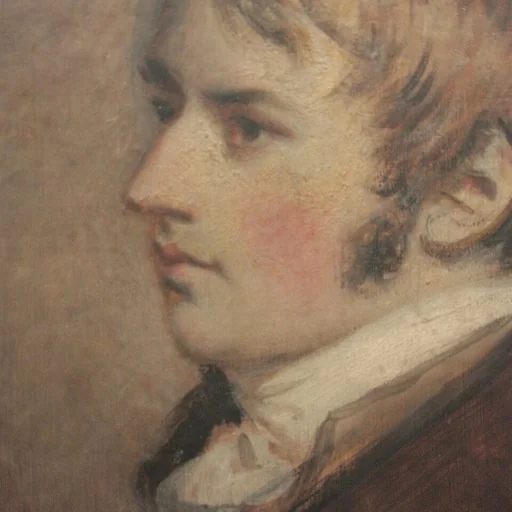
Artist
John Constable (; 11 June 1776 – 31 March 1837) was an English landscape painter in the Romantic tradition.