Artwork
Covent Garden Labourers
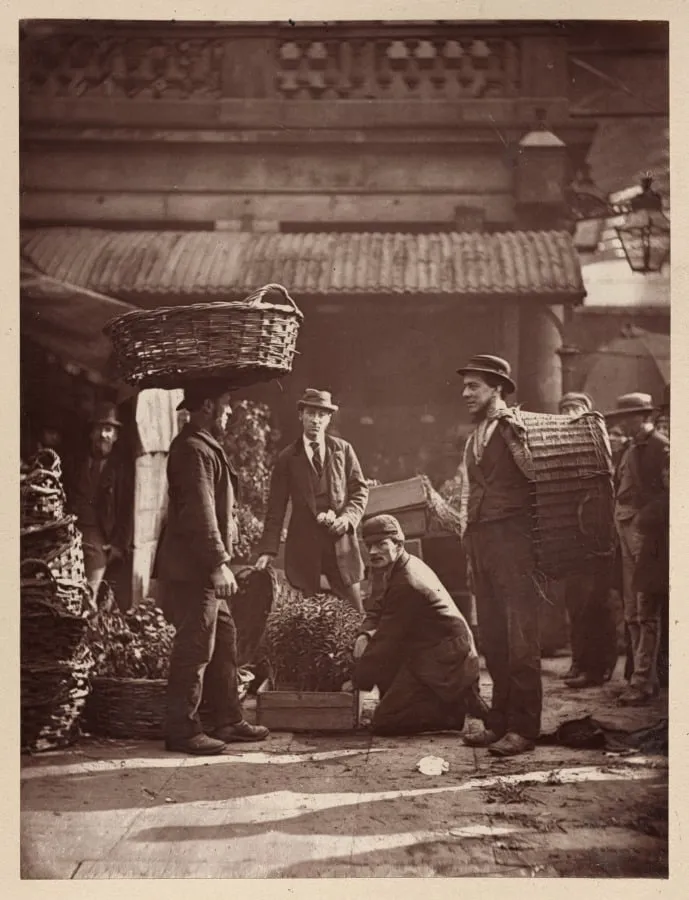
Covent Garden Labourers is a photography by the Impressionist artist John Thomson. It dates from 1877 and is held in the collection of the Cleveland Museum of Art. A black-and-white photograph captures three male laborers resting against a brick wall in Covent Garden, London.
About this work
These aren’t just any laborers—they’re the “odd-men,” paid per delivery, so rain or slow seasons meant empty pockets.
You see three men in work clothes leaning against a brick wall in London’s Covent Garden market.
These aren’t just any laborers—they’re the “odd-men,” paid per delivery, so rain or slow seasons meant empty pockets. The painting shows them waiting for the next job, hats pulled low, hands in pockets. Their tired faces tell the story of a system that kept them on the edge.
Look up more paintings of England, 19th century to see how other artists showed daily work.
Overview
A black-and-white photograph captures three male laborers resting against a brick wall in Covent Garden, London. Dressed in worn work attire, they stand idle, their postures conveying exhaustion. The image documents the daily reality of market workers who relied on piece-rate pay, with no guaranteed income during off-hours or inclement weather.
Subject & Meaning
The men depicted are "odd-men," casual laborers hired by the parcel to unload and deliver produce. Unlike salaried staff who maintained stalls year-round, their earnings fluctuated with market demand. Their stillness reflects not leisure but uncertainty—waiting for work that may not come, highlighting economic vulnerability in a system offering no safety net.
Technique & Style
The photograph employs natural light and a candid composition, emphasizing texture in fabric and brick. The men’s faces are partially shadowed by low-brimmed hats, their hands tucked into pockets, suggesting quiet resignation. The framing is unposed, avoiding theatricality, and prioritizes documentary clarity over artistic embellishment.
History & Provenance
Taken in the late 19th or early 20th century, the image originates from photographic records of London’s Covent Garden market, a hub of wholesale produce distribution. It likely belonged to a private or institutional archive documenting urban labor, later preserved as a historical record of working-class life in Victorian and Edwardian England.
Context
Covent Garden’s labor force operated under a precarious system: most workers were paid per task, with no benefits or job security. Seasonal drops in trade, weather disruptions, and competition for jobs left many in poverty. This structure contrasted sharply with the small cadre of permanent staff who managed inventory and stall operations under fixed wages.
Legacy
The photograph contributes to a broader visual archive of British laborers, offering a quiet counterpoint to idealized depictions of industry. It remains a reference for historians studying informal economies and the lived conditions of urban workers before the rise of organized labor protections.
Artist & collection
Artist
John Thomson painted Scottish landscapes in oil, focusing on the rugged terrain around the Trossachs and Selkirkshire.