Artwork
Portrait of Charles-Louis Baron de Keverberg de Kessel
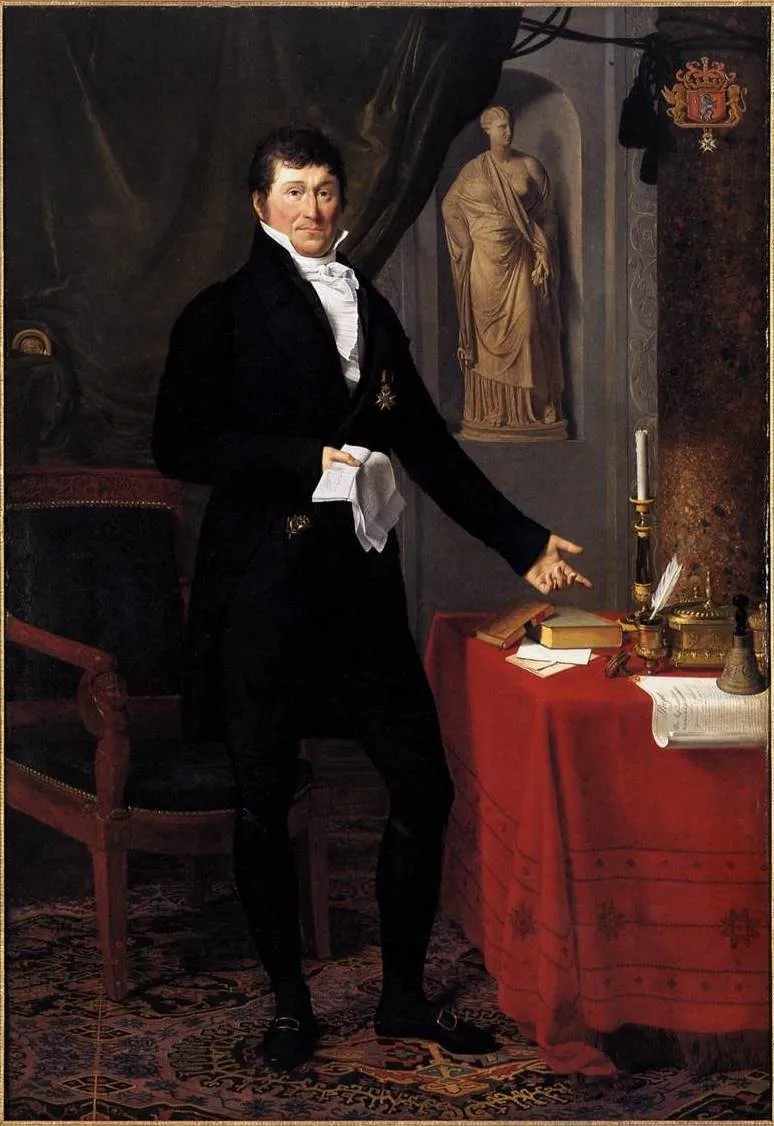
Portrait of Charles-Louis Baron de Keverberg de Kessel is an oil painting by the Neoclassicist artist Joseph-François Ducq. It dates from 1818 and is held in the collection of the Groeningemuseum.
About this work
Overview
Joseph‑François Ducq, a Flemish painter active in the early nineteenth century, completed an oil portrait of Charles‑Louis Baron de Keverberg de Kessel in 1818.
Joseph‑François Ducq, a Flemish painter active in the early nineteenth century, completed an oil portrait of Charles‑Louis Baron de Keverberg de Kessel in 1818. The canvas presents the baron in a dark suit with a white cravat, standing before a modestly illuminated interior that includes a book, a quill, a small bell and a niche containing a statue. The work is part of the Groeningemuseum’s collection.
Subject & Meaning
The sitter, identified as Charles‑Louis Baron de Keverberg de Kessel, is shown holding a folded document, an attribute that, together with the nearby book and quill, suggests a role in administration or scholarship. A small bell and the presence of a classical statue—often associated with the goddess Demeter—provide symbolic references to communication, learning, and perhaps agricultural stewardship, aligning the baron with virtues valued in the period.
Technique & Style
Executed in the neoclassical idiom, the painting employs chiaroscuro to model the figure’s face in bright light while the surrounding space recedes into shadow, a device that emphasizes the subject’s stature. Ducq’s brushwork is smooth and controlled, rendering fabrics and metal with a polished finish, while the background elements are rendered with restrained detail, reflecting the academic training he received in Bruges and Paris.
History & Provenance
Ducq, a student of the French neoclassicist Joseph‑Benoît Suvée, returned to Bruges after a period of study in Italy in 1815 and soon after took a professorship at the Bruges Academy. The portrait was likely commissioned shortly after his appointment, reflecting the baron’s social standing. It entered the Groeningemuseum’s holdings in the twentieth century, where it remains on display as a representative example of Ducq’s portraiture.
Artist & collection
Artist
Joseph-François Ducq, a Flemish historical and portrait painter, was born at Ledeghem in 1763.