Artwork
Portret van de graveur Joseph-Charles de Meulemeester aan het werk in de Loggia van het Vaticaan
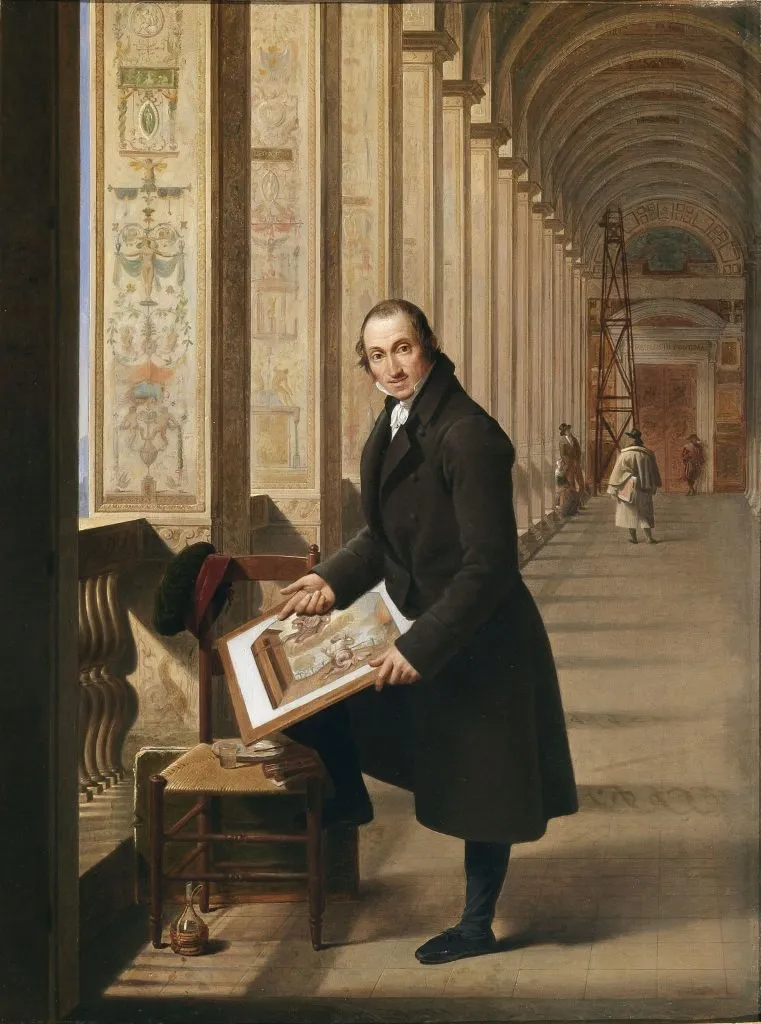
Portret van de graveur Joseph-Charles de Meulemeester aan het werk in de Loggia van het Vaticaan is an oil painting by the Neoclassicist artist Joseph-François Ducq. It dates from 1813 and is held in the collection of the Rijksmuseum.
About this work
The level of detail in the painting, particularly in the man's face and clothing, indicates that the artist was skilled in portraiture.
The painting shows a man in a long black coat, standing in a grand room with tall arches and columns. He is holding a picture frame and appears to be working on it. The room is filled with light, and the man's face is turned towards the viewer.
The man's clothing and the style of the room suggest that the painting is from the early 19th century. The level of detail in the painting, particularly in the man's face and clothing, indicates that the artist was skilled in portraiture.
This painting is a great example of the work of artist Joseph-François Ducq.
Overview
In 1813 Joseph‑François Ducq, a Flemish painter active in the early nineteenth century, completed an oil‑on‑canvas portrait titled *Portret van de graveur Joseph‑Charles de Meulemeester aan het werk in de Loggia van het Vaticaan*. The work shows the engraver Joseph‑Charles de Meulemeester positioned within the vaulted Loggia of the Vatican, and it is presently part of the Rijksmuseum’s collection.
Subject & Meaning
The composition centers on de Meulemeester, dressed in a long black coat, holding a picture frame as if engaged in his craft. His gaze meets the viewer, suggesting a dialogue between the artist and the subject and emphasizing the dignity of the engraver’s labour within a monumental architectural setting.
Technique & Style
Executed in a neoclassical manner, the painting displays the clear modelling, restrained palette and precise draftsmanship characteristic of Ducq’s training in Bruges, Paris and Italy. Fine attention to the texture of fabric, the marble arches and the play of light across the space demonstrates the artist’s skill in rendering both figure and architecture.
History & Provenance
Ducq, who earned a second grand prize in 1800 and a medal in 1810, returned to Bruges in 1815 to become a professor at the local academy. The portrait entered the Rijksmuseum’s holdings at an unspecified date, where it remains on view as part of the museum’s representation of early‑19th‑century Flemish art.
Context
Created during a period when Flemish artists were increasingly traveling to Italy, the work reflects the cross‑cultural exchange between the Low Countries and the papal states. The setting of the Vatican Loggia underscores the prestige of the location and the professional esteem afforded to de Meulemeester as a court‑appointed engraver.
Artist & collection
Artist
Joseph-François Ducq, a Flemish historical and portrait painter, was born at Ledeghem in 1763.