Artwork
The Church of San Trovaso, Venice
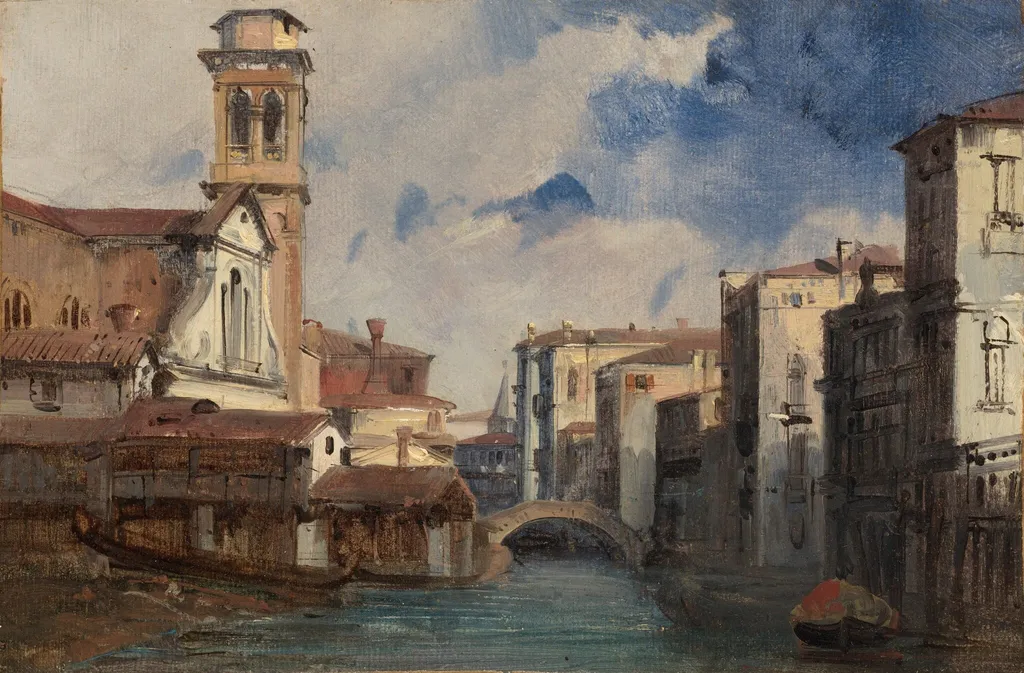
The Church of San Trovaso, Venice is an oil painting by the Romanticist artist Jules-Romain Joyant. It dates from 1830 and is held in the collection of the National Gallery of Art.
About this work
Overview
Jules‑Romain Joyant’s early nineteenth‑century work portrays a solitary gondola moving through a narrow Venetian canal beneath the white façade of the Church of San Trovaso. The composition captures a fleeting moment of sunlight shimmering on the water, while the church’s dome rises sharply against a clear sky, emphasizing the city’s tranquil waterways.
Subject & Meaning
The painting focuses on everyday Venetian life, using the lone gondola as a symbol of the city’s intimate relationship with its canals. By placing the modest vessel against the imposing yet serene church, Joyant juxtaposes the ordinary with the sacred, suggesting a quiet harmony between daily routine and spiritual presence.
Technique & Style
Joyant employed a two‑stage process, first rendering the scene on paper before adhering it to a canvas support. This method allowed rapid response to shifting light conditions, while the paper’s texture remains visible, imparting a soft, luminous quality to the water and sky. The brushwork is restrained, favoring atmospheric effects over detailed rendering.
History & Provenance
Created around 1830, the work reflects the period’s growing interest among French artists in Venetian subjects. Though specific ownership records are limited, the painting has been cited in catalogues of Joyant’s oeuvre as an example of his Italian travels and his experimentation with mixed supports during the early Romantic era.
Context
During the 1820s and 1830s, Venice attracted numerous foreign painters seeking to capture its unique light and architecture. Joyant’s depiction aligns with this trend, offering a quieter, less tourist‑filled perspective compared with contemporary grand vistas, and contributes to the broader Romantic fascination with atmospheric mood and historic locales.
Own this work as a print
Artist & collection

