Artwork
The family shields of Jan Boudaen Courten and Anna Maria Hoeufft
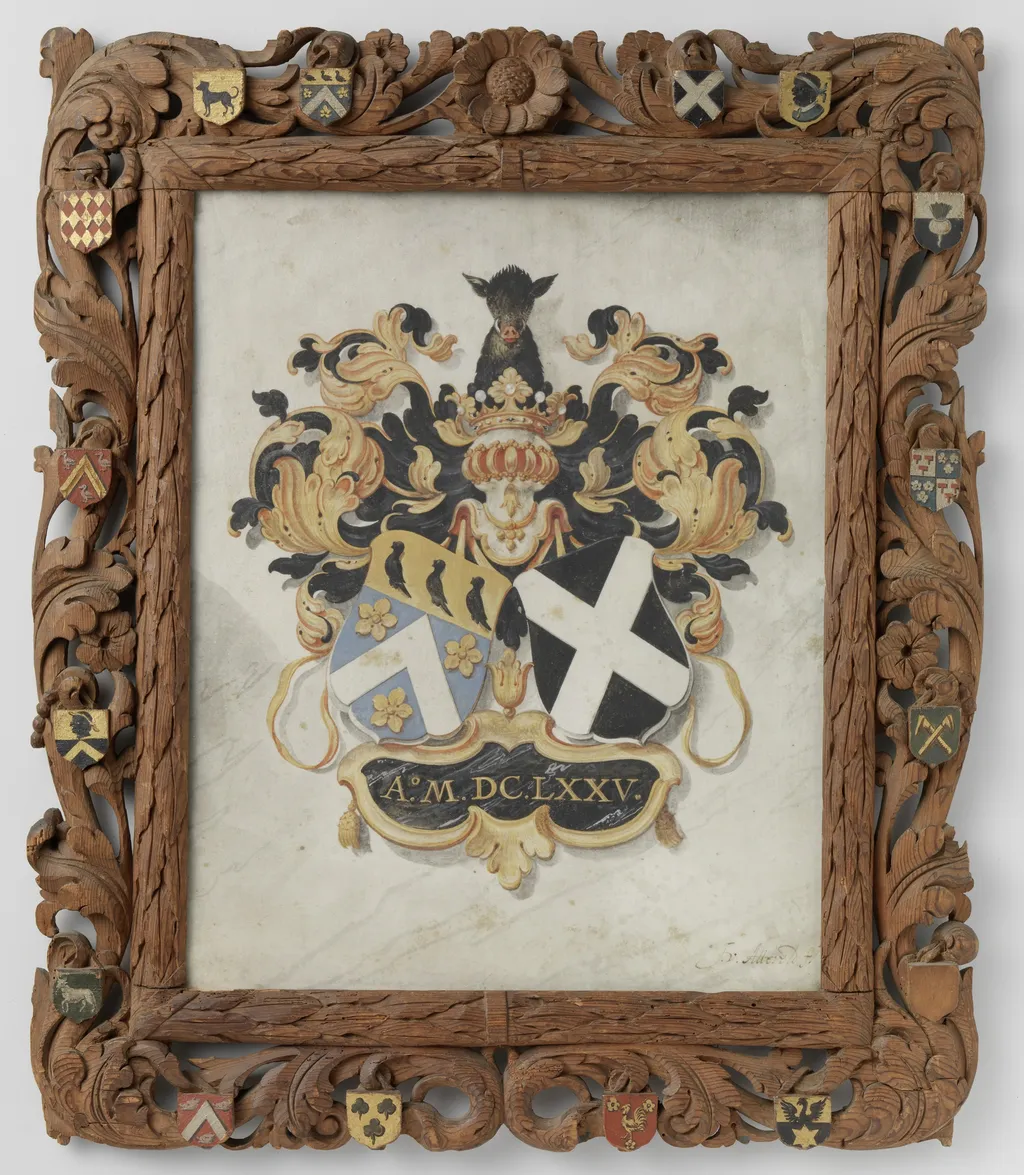
The family shields of Jan Boudaen Courten and Anna Maria Hoeufft is a watercolor painting by the Rococo painting artist Justus van Attevelt. It is held in the collection of the Rijksmuseum.
About this work
Overview
Created in 1775 by the Dutch painter Justus van Attevelt, this work presents the heraldic emblems of Jan Boudaen Courten and Anna Maria Hoeufft. Executed on a sheet of parchment, the composition is framed by an elaborately carved wooden surround that enhances the central insignia. The piece is part of the Rijksmuseum’s collection.
Subject & Meaning
The focal point is a black‑and‑white shield bearing a cross, flanked by additional heraldic motifs such as stylised flowers and animal figures. These elements function as visual identifiers of the Courten and Hoeufft families, conveying lineage, status, and the symbolic values traditionally associated with the chosen charges.
Technique & Style
Van Attevelt applied oil paint to parchment, achieving fine detail through careful brushwork that renders the intricate patterns of the shield and its surrounding ornaments. The surrounding wooden frame, carved with leaf motifs, mirrors the decorative sensibility of 18th‑century Dutch heraldic art, balancing colour contrast with a restrained palette.
History & Provenance
The painting has remained in the Netherlands since its creation, eventually entering the Rijksmuseum’s holdings where it is displayed as an example of genealogical portraiture. Its documented attribution to van Attevelt and its association with the Courten‑Hoeufft families provide a clear provenance trail from the late 18th century to the present institution.
Artist & collection