Artwork
Black-Backed Three-Toed Woodpecker
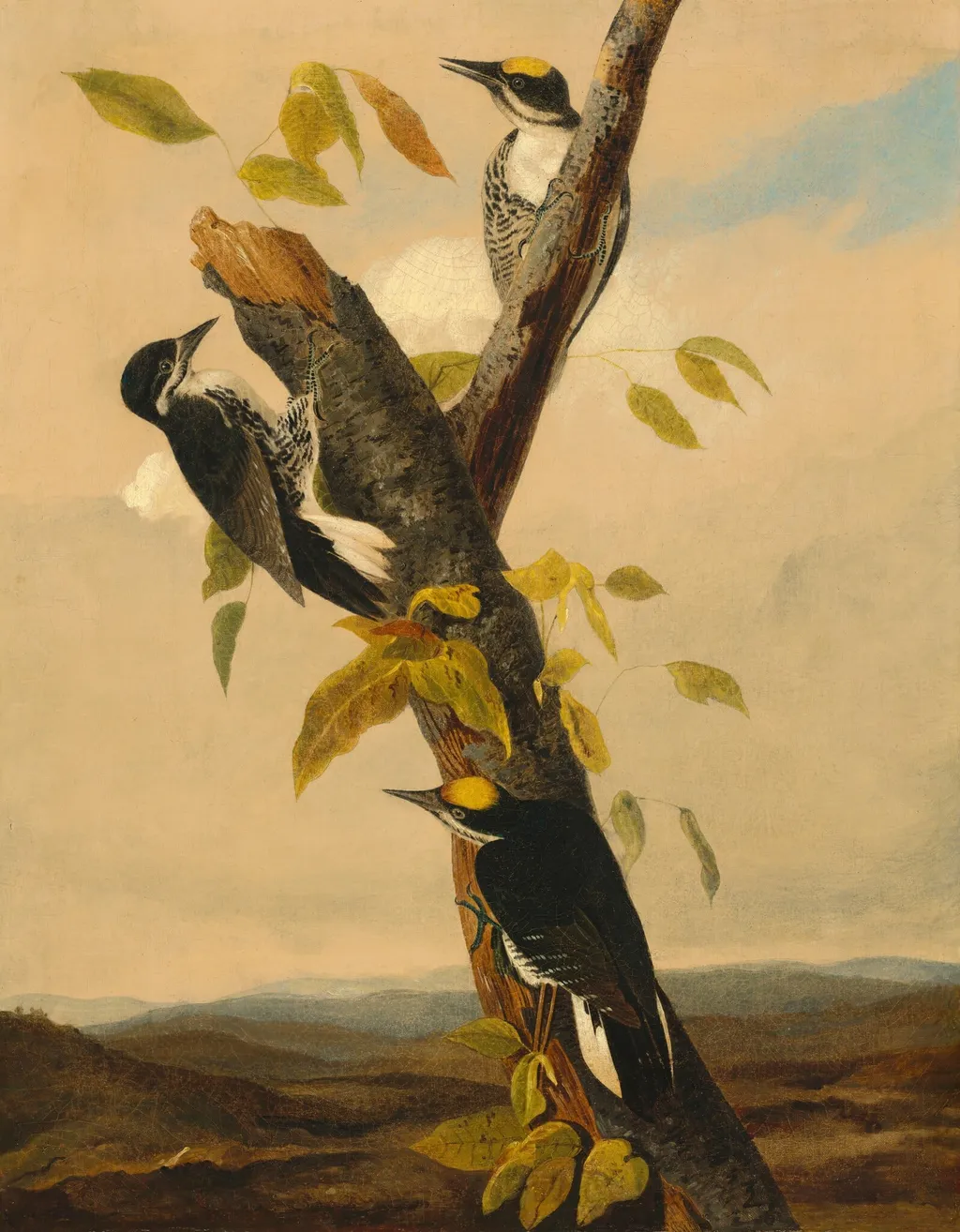
Black-Backed Three-Toed Woodpecker is an oil painting by the Romanticist artist Joseph Bartholomew Kidd. It dates from 1832 and is held in the collection of the National Gallery of Art.
About this work
Overview
Joseph Bartholomew Kidd’s 1832 canvas presents a solitary Black‑backed Three‑toed Woodpecker perched upon a pine branch. Executed in pencil and oil, the work captures the bird in a moment of stillness, its vivid red cap contrasting with the dark bark that mirrors its own black back.
Subject & Meaning
The composition focuses on the woodpecker as a study of natural form and behavior. By isolating the bird on a bare branch, Kidd emphasizes the creature’s adaptation to its arboreal habitat, inviting viewers to observe the interplay of color, texture, and the bird’s characteristic sharp claws.
Technique & Style
Kidd combines delicate pencil underdrawing with layered oil washes, allowing fine detail in the plumage and bark while preserving a soft atmospheric quality. The restrained palette and realistic rendering reflect the early‑19th‑century tradition of scientific illustration merged with a modest, observational aesthetic.
History & Provenance
Created in the early 1830s, the painting aligns with a period when European artists increasingly turned to wildlife subjects for study and documentation. While specific ownership records are limited, the work remains attributed to Kidd, whose oeuvre includes several naturalistic studies from the same decade.
Own this work as a print
Artist & collection