Artwork
The Church of Saint-Eugène (L'Église de Saint-Eugène)
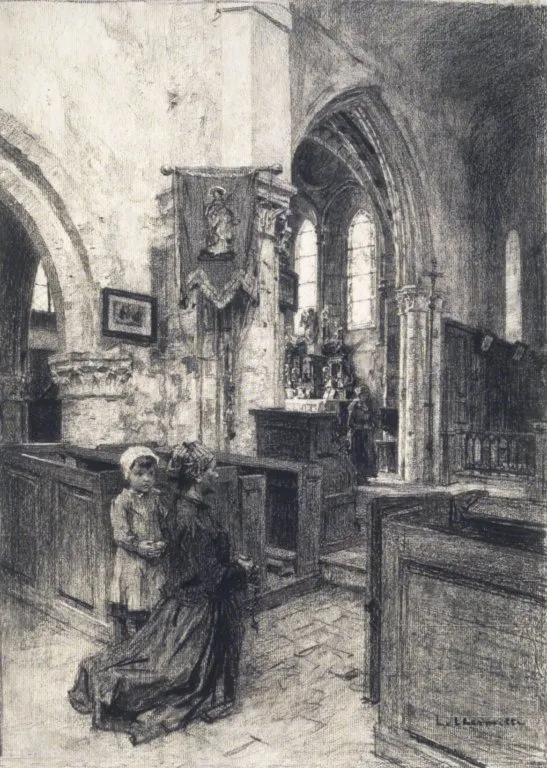
The Church of Saint-Eugène (L'Église de Saint-Eugène) is a charcoal painting by the Post-Impressionist artist Léon Augustin Lhermitte. It dates from 1892 and is held in the collection of the Brooklyn Museum.
About this work
Overview
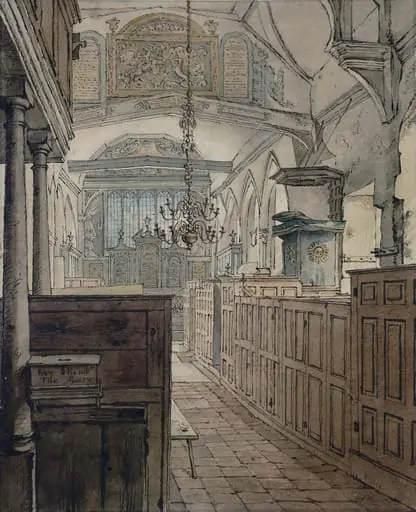
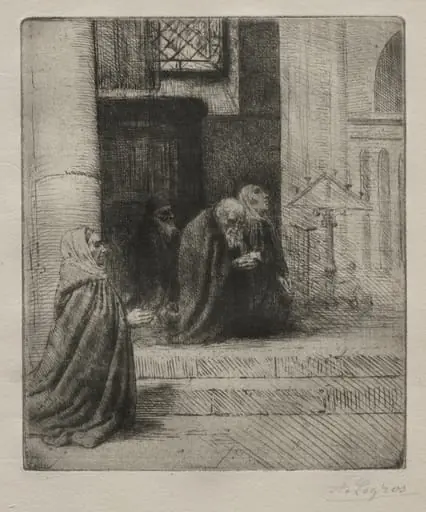
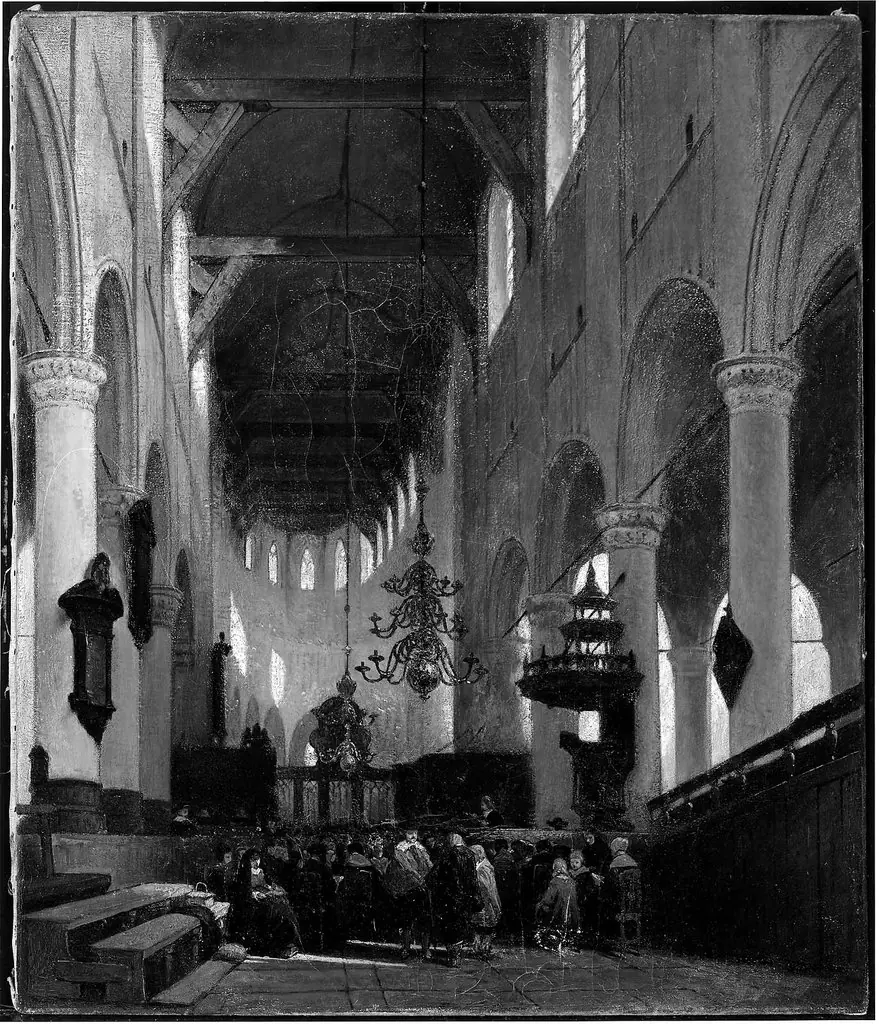
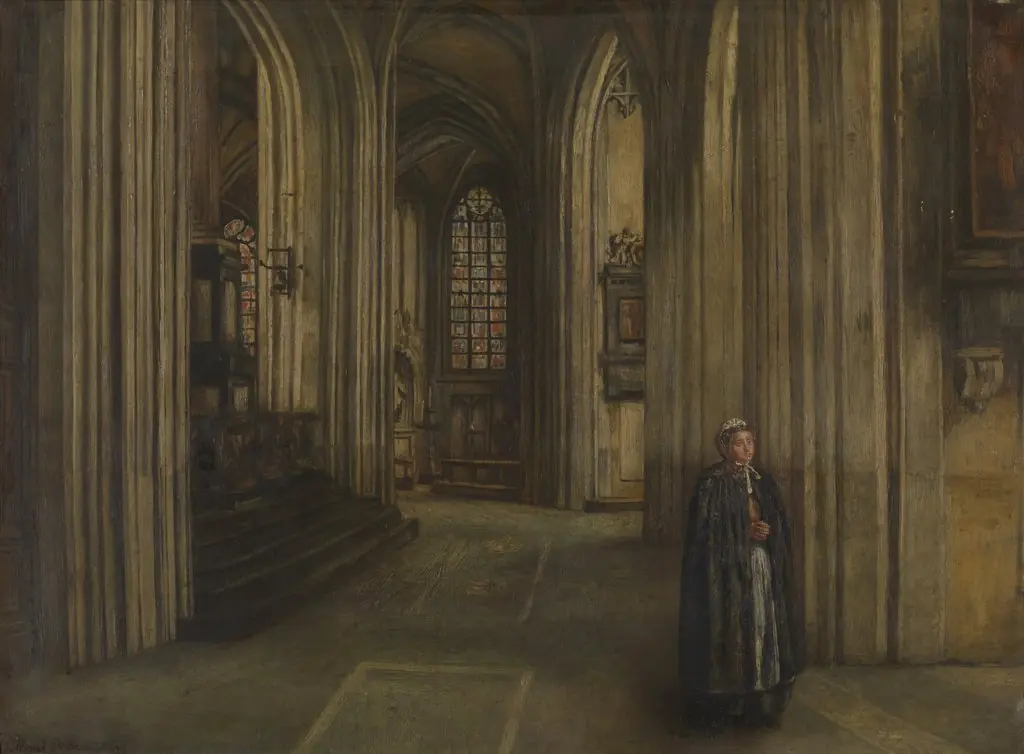
Léon Augustin Lhermitte created this charcoal drawing in 1892, capturing the interior of the Church of Saint-Eugène in Paris. Unlike his more familiar rural labor scenes, this work turns inward to a quiet sacred space. Executed with the same observational rigor, it reflects his sustained interest in ordinary human behavior, even within institutional settings like places of worship.
Subject & Meaning
The scene depicts three figures in a church interior: a woman and child kneeling in prayer, and a solitary standing figure in the background. Their postures suggest private devotion amid the stillness of the space. The absence of grand ritual or clergy shifts focus to individual piety, framing faith as a quiet, personal act rather than a public spectacle.
Technique & Style
Lhermitte employed charcoal for its capacity to render tonal gradations and surface textures. The rough stone walls are built up with layered, uneven strokes, while the floor appears smoother, contrasting with the softness of fabric and skin. The dim lighting, achieved through deep shadows and sparse highlights, enhances the hushed, contemplative atmosphere without artificial drama.
History & Provenance
The drawing entered the collection of the Brooklyn Museum in the 20th century, though its exact provenance prior to acquisition remains undocumented. It was produced during a period when Lhermitte was increasingly exploring urban and ecclesiastical subjects alongside his rural themes, suggesting a broadening of his artistic focus beyond the countryside.
Context
Created in the early 1890s, the work aligns with broader European trends in naturalism and post-Impressionist realism. While many contemporaries pursued color and light experimentally, Lhermitte retained a focus on social observation. This piece reflects a shift in his practice—turning from fields and farms to the intimate rituals of urban religious life.
Legacy
Though less known than his peasant scenes, this drawing exemplifies Lhermitte’s consistent commitment to portraying unidealized human presence. It contributes to a broader understanding of his oeuvre as one that found dignity in quiet moments, whether in barnyards or church pews, reinforcing his role as a chronicler of everyday life across varied settings.
Artist & collection
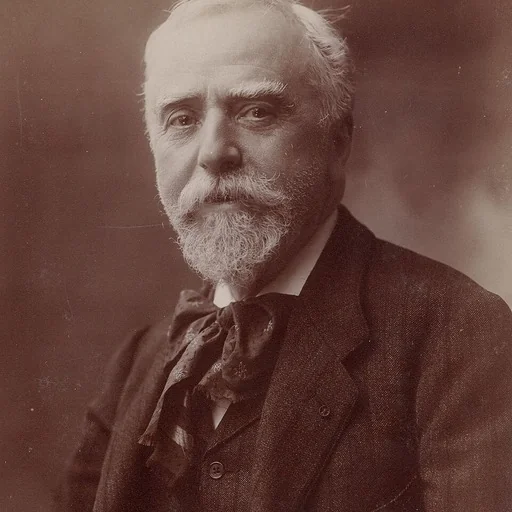
Artist
Léon Augustin Lhermitte (French pronunciation: ; 31 July 1844 – 28 July 1925) was a French naturalist painter and etcher whose primary subject matter was rural scenes depicting peasants at work.