Artwork
Passport
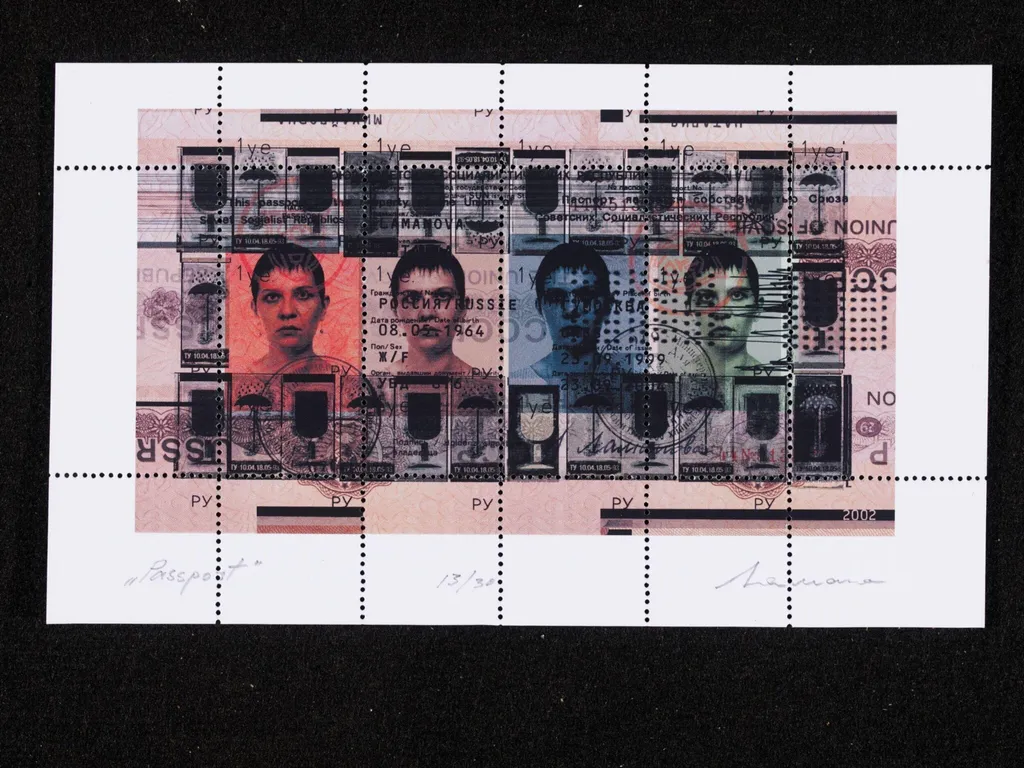
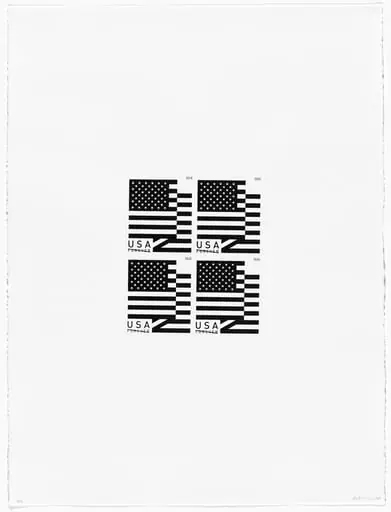
Passport is a print by Natalia Lamanova. It dates from 2002 and is held in the collection of the Victoria and Albert Museum.
About this work
But instead of landscapes or leaders, it shows the artist’s own face again and again.
This print plays with an everyday object you know well: the stamp sheet. It copies the tiny holes and clean borders of official stamps. But instead of landscapes or leaders, it shows the artist’s own face again and again.
Lamanova made stamps that look real but flip the idea of national ID on its head. Russia’s new rules after 1991 made identity papers a hot topic. She turned a stamp into a quiet protest.
Check out more work by Lamanova, Natalia next.
Overview
Natalia Lamanova, a Moscow-based artist working in graphic and digital media, created 'Passport' as a printed sheet resembling a block of postage stamps. The work mimics the perforated edges and selvedge of official stamp sheets, but replaces traditional imagery with repeated photographs of the artist’s own face. This formal mimicry subverts the function of the stamp, transforming a symbol of state authority into a personal statement.
Subject & Meaning
The repeated image of Lamanova’s face challenges the notion of identity as something controlled and issued by the state. In post-Soviet Russia, where documentation became both a tool of bureaucracy and a site of personal vulnerability, the passport emerged as a potent symbol. By replacing state-sanctioned imagery with her own likeness, Lamanova reclaims the right to self-representation, turning bureaucratic form into a quiet act of autonomy.
Technique & Style
Lamanova employs precise graphic design to replicate the visual language of official postage stamps: uniform sizing, clean borders, and perforated edges. The photographic portraits are rendered in a neutral, documentary style, mirroring the impersonal aesthetic of state-issued ID photos. The repetition across the sheet reinforces the mechanical nature of bureaucratic systems, while the consistency of the artist’s gaze introduces an unsettling intimacy.
History & Provenance
Created in the early 1990s, 'Passport' responds to the rapid institutional changes in Russia following the dissolution of the Soviet Union. As new identity documents were introduced and citizenship regulations shifted, the passport became a focal point of social anxiety. Lamanova’s work emerged from this context, reflecting the uncertainty surrounding personal identity in a newly fragmented state apparatus.
Context
In the post-Soviet era, state control over personal documentation intensified even as the legitimacy of the state wavered. The passport, once a symbol of Soviet unity, became a contested object—necessary for survival yet emblematic of surveillance. Lamanova’s work engages this tension, using the familiar form of a stamp sheet to question who has the authority to define identity and how that definition is visually enforced.
Legacy
Lamanova’s 'Passport' remains a significant example of conceptual printmaking in post-Soviet art. Its quiet subversion of bureaucratic aesthetics influenced later artists exploring identity, documentation, and institutional power. The work’s endurance lies in its restraint: it does not shout protest but instead holds up a mirror to the systems that govern visibility and belonging in modern society.
Artist & collection
Artist
Natalia Lamanova’s 2002 print Passport shows a small, square identity card floating on a plain background.