Artwork
Air Routes of the World (Night)
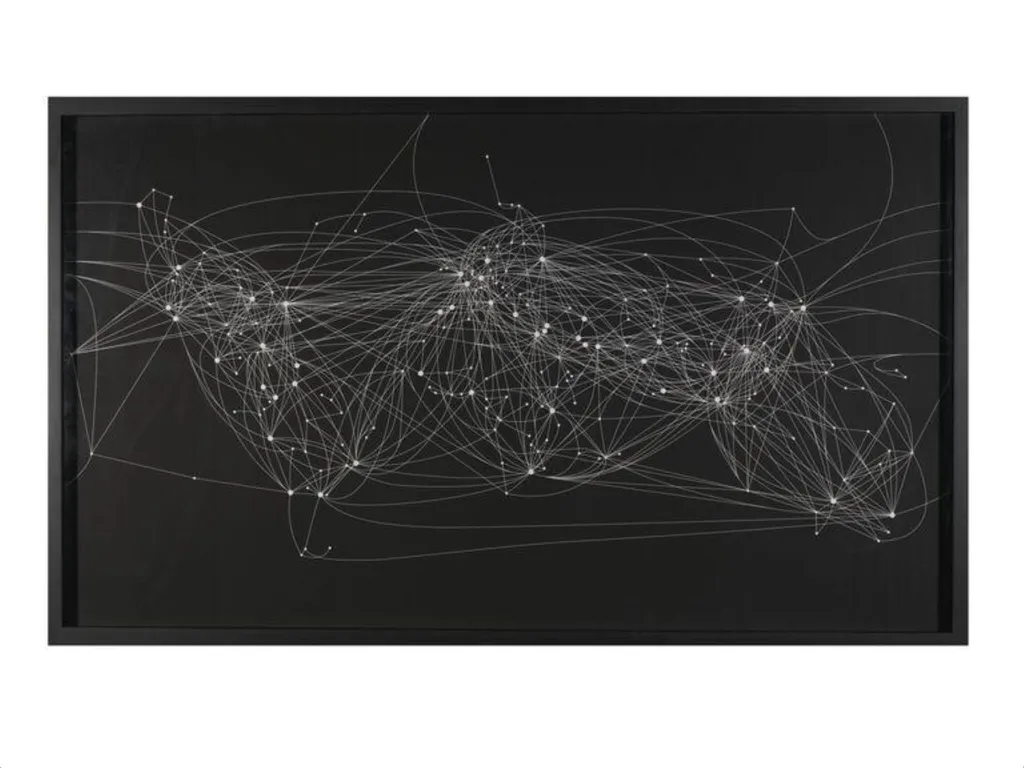
Air Routes of the World (Night) is a print by Langlands and Bell. It dates from 2001 and is held in the collection of the Victoria and Albert Museum.
About this work
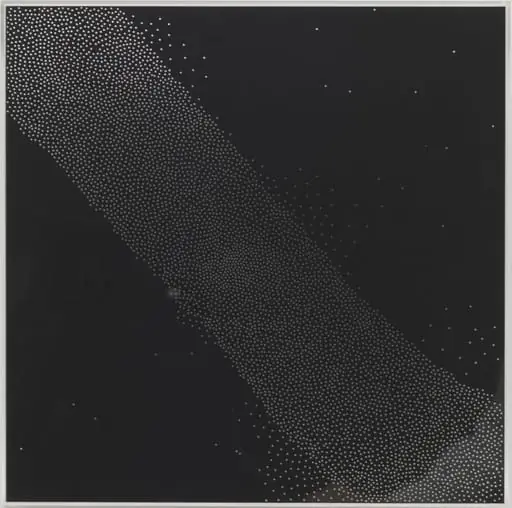
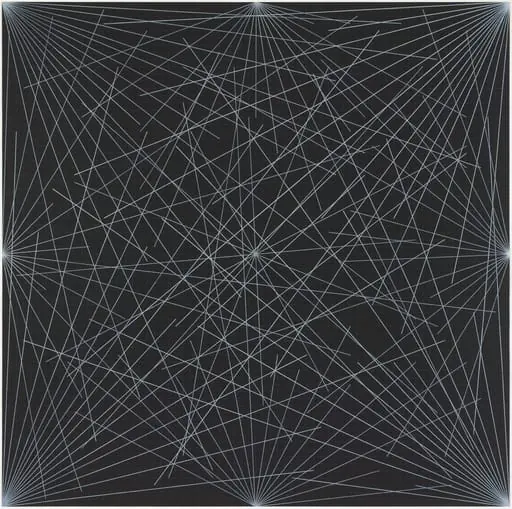
This print shows how two artists turned flight paths into a starry pattern. Made in 2001, it’s a white-on-white map built from dots for airports and lines for routes.
The artists used a pair of prints to show the same network in day and night colors. By stripping away places and borders, they let air travel create the landmarks instead.
Look up the pair of artists who made it: Langlands and Bell.
Overview
Presented on a white ground, it contrasts with its companion piece, Air Routes of the World (Day), which uses a black field to evoke daylight visibility.
Created in 2001 by Ben Langlands and Nikki Bell, Air Routes of the World (Night) is one half of a diptych that reimagines global geography through the lens of commercial aviation. The print renders the world’s air corridors as a delicate network of lines and dots, stripped of territorial boundaries and topographical detail. Presented on a white ground, it contrasts with its companion piece, Air Routes of the World (Day), which uses a black field to evoke daylight visibility.
Subject & Meaning
The work reduces the planet to its air traffic infrastructure, transforming airports into punctuations and flight paths into connecting threads. By omitting landmasses and political borders, the artists shift focus to human mobility as the defining structure of contemporary global order. The resulting pattern evokes celestial constellations, suggesting a metaphysical dimension to travel—where destinations become points of aspiration rather than physical places.
Technique & Style
Langlands and Bell employ a minimalist aesthetic, using precise, monochromatic linework to construct the network. The airports are rendered as uniform dots, while routes appear as thin, unbroken lines, creating a visual rhythm that mimics both cartographic clarity and abstract composition. The white-on-white execution demands close viewing, emphasizing subtlety over spectacle and inviting contemplation of hidden systems.
History & Provenance
The diptych emerged from the artists’ ongoing investigation into systems that organize human experience, particularly those tied to communication and infrastructure. Created shortly after the turn of the millennium, the work reflects a moment when global air travel was expanding rapidly and becoming increasingly central to cultural and economic exchange. It was produced as a limited-edition print, consistent with their broader practice in print and sculpture.
Context
In the early 2000s, globalization was accelerating, and air travel was becoming a normalized, almost invisible force shaping daily life. Langlands and Bell’s work responds to this by making the invisible network visible—not as a tool for navigation, but as a cultural artifact. The absence of traditional geographic markers underscores how air routes, rather than borders, increasingly define connectivity in the modern world.
Legacy
The diptych remains a significant example of conceptual cartography in contemporary art. By abstracting the world into a network of flight paths, Langlands and Bell anticipated later visualizations of data-driven geography. Their approach influenced subsequent artists and designers exploring infrastructure as a form of cultural mapping, establishing a quiet but enduring precedent for representing global systems through minimal visual language.
Artist & collection
Artist
Langlands and Bell make crisp, map-like prints that trace networks of human movement, like the glowing web of global air routes at night in *Air Routes of the World (Night)*.