Artwork
White Clouds and Red Trees
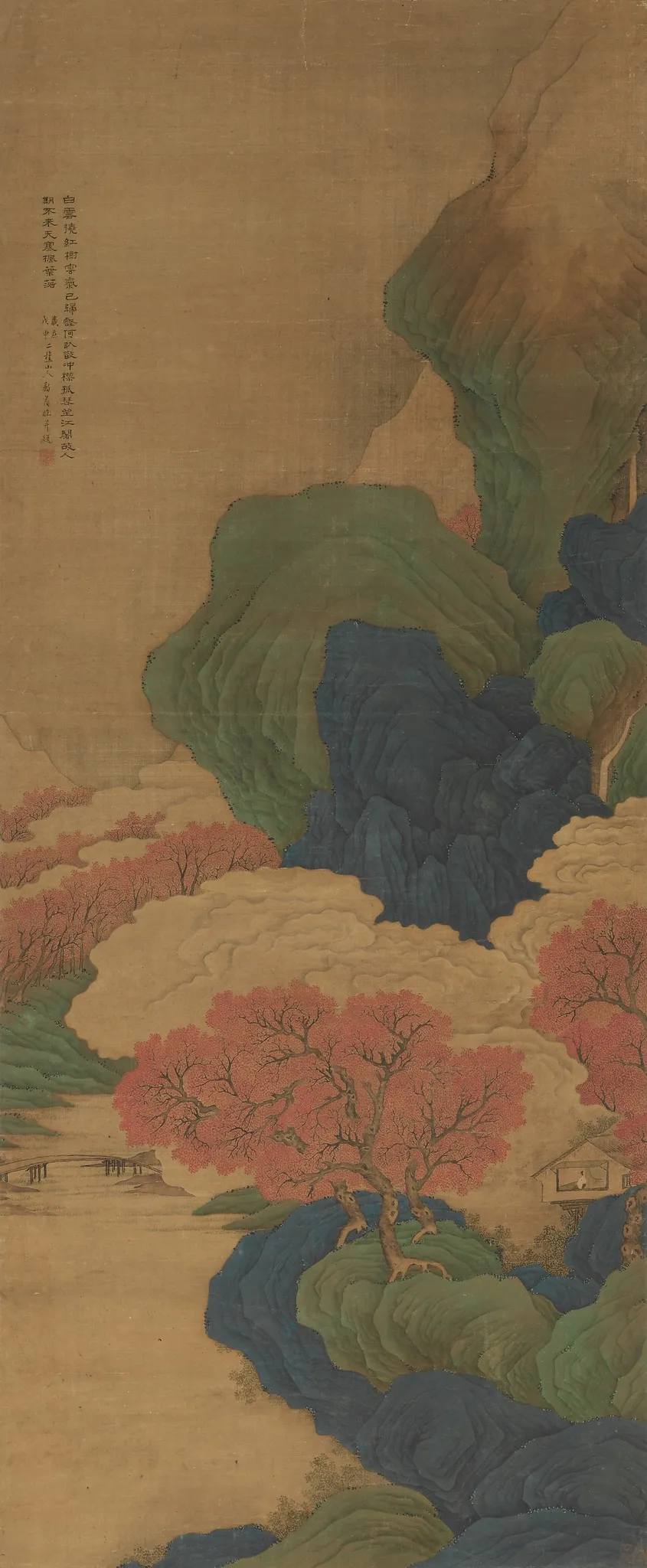
White Clouds and Red Trees is an unspecified painting by the Qing dynasty painting artist Li Jian. It dates from 1794 and is held in the collection of the Cleveland Museum of Art.
About this work
Overview
The work depicts a tranquil mountainous landscape where a winding river flows beneath a sky washed in pale yellow and blue.
White Clouds and Red Trees, painted by Li Jian in 1794, is part of the collection at the Cleveland Museum of Art. The work depicts a tranquil mountainous landscape where a winding river flows beneath a sky washed in pale yellow and blue. A solitary tree with vivid red foliage anchors the composition near the water’s edge, while distant structures and a modest bridge emerge faintly among the hills.
Subject & Meaning
The painting juxtaposes the calm of the natural environment with the striking presence of the red-leaved tree, suggesting a focal point of vitality amid serenity. The muted greens and grays of the surrounding terrain emphasize the tree’s brilliance, inviting contemplation of contrast between permanence and transience in the landscape.
Technique & Style
Li Jian employs confident, smooth brushwork that conveys both the solidity of the rocky slopes and the softness of the sky. A restrained palette of cool blues, yellows, and dark greens frames the scene, while the saturated red of the tree is rendered with deliberate intensity, creating a visual hierarchy that guides the viewer’s eye.
History & Provenance
Created in the late eighteenth century, the canvas entered the Cleveland Museum of Art’s holdings through acquisition in the early twentieth century, though specific details of its prior ownership remain undocumented. Its presence in the museum’s collection highlights the institution’s interest in East Asian landscape painting from the Qing period.
Context
The work reflects the Qing dynasty’s aesthetic preferences for literati landscapes that balance poetic atmosphere with subtle color accents. Li Jian’s emphasis on a single, vividly colored element aligns with contemporary practices of using a focal motif to convey emotional resonance within an otherwise restrained composition.
Artist & collection