Artwork
Άτιτλο
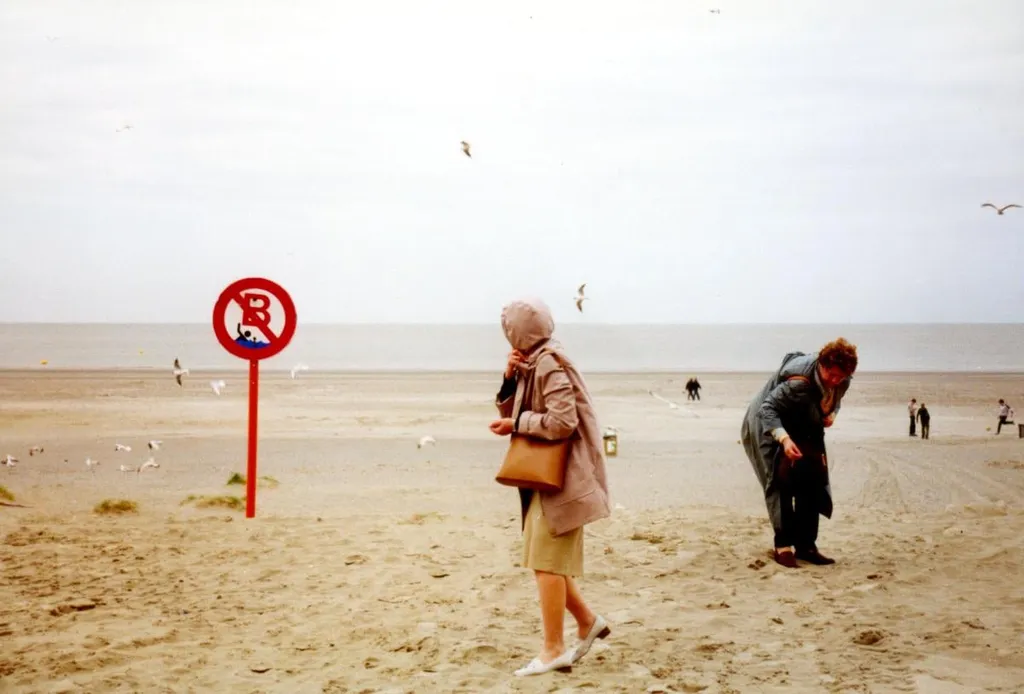
Άτιτλο is a photography by LIDA SPERELAKI. It dates from 2004 and is held in the collection of the Athens School of Fine Arts.
About this work
Overview
Created in 2004 by Lida Sperelaki, this photograph is part of the Museum of Ethnography’s collection. It captures a quiet, windswept shoreline with minimal human presence and a single regulatory sign embedded in the sand. The image conveys a sense of stillness and subtle tension between human behavior and imposed rules, without overt narrative or dramatic action.
Subject & Meaning
The sign’s presence contrasts with the visible footprints across the sand, suggesting disregard or normalization of the very behavior it seeks to prevent.
The scene depicts two individuals on an otherwise empty beach, one bending as if collecting an object, the other standing still, both seemingly unaware of a nearby sign prohibiting hooded figures from entering. The sign’s presence contrasts with the visible footprints across the sand, suggesting disregard or normalization of the very behavior it seeks to prevent. The image invites reflection on the fragility of public regulations and the quiet persistence of informal conduct.
Technique & Style
Sperelaki employs a muted, documentary aesthetic with a flat, overcast sky and low-contrast tones that emphasize texture over drama. The composition is deliberately sparse, using horizontal lines of sand and horizon to anchor the viewer’s gaze. The red sign stands as the only sharp color, drawing attention without disrupting the image’s restrained tone. The lack of waves and motion enhances the sense of suspension and quiet observation.
History & Provenance
The photograph was acquired by the Museum of Ethnography shortly after its creation in 2004. It has remained in the institution’s permanent collection since, with no record of prior ownership or exhibition beyond institutional archives. Its inclusion reflects the museum’s interest in contemporary visual responses to social norms and public space.
Context
Sperelaki’s work from this period often explores the intersection of personal behavior and institutional control in shared environments. This image aligns with broader European photographic practices of the early 2000s that examined urban and natural landscapes as sites of unspoken social contracts. The absence of crowds or conflict underscores a quieter, more pervasive form of societal disengagement.
Legacy
Though not widely exhibited outside institutional settings, the photograph contributes to ongoing discussions in visual anthropology about how rules are perceived, ignored, or absorbed into daily life. Its quiet composition has influenced later works that prioritize subtle cues over explicit commentary, reinforcing the power of understatement in visual storytelling.
Artist & collection
Artist