Artwork
Posthumous portrait of Aucke Stellingwerff, Admiral of Friesland, killed in 1665 at Lowestoft by a cannon-ball
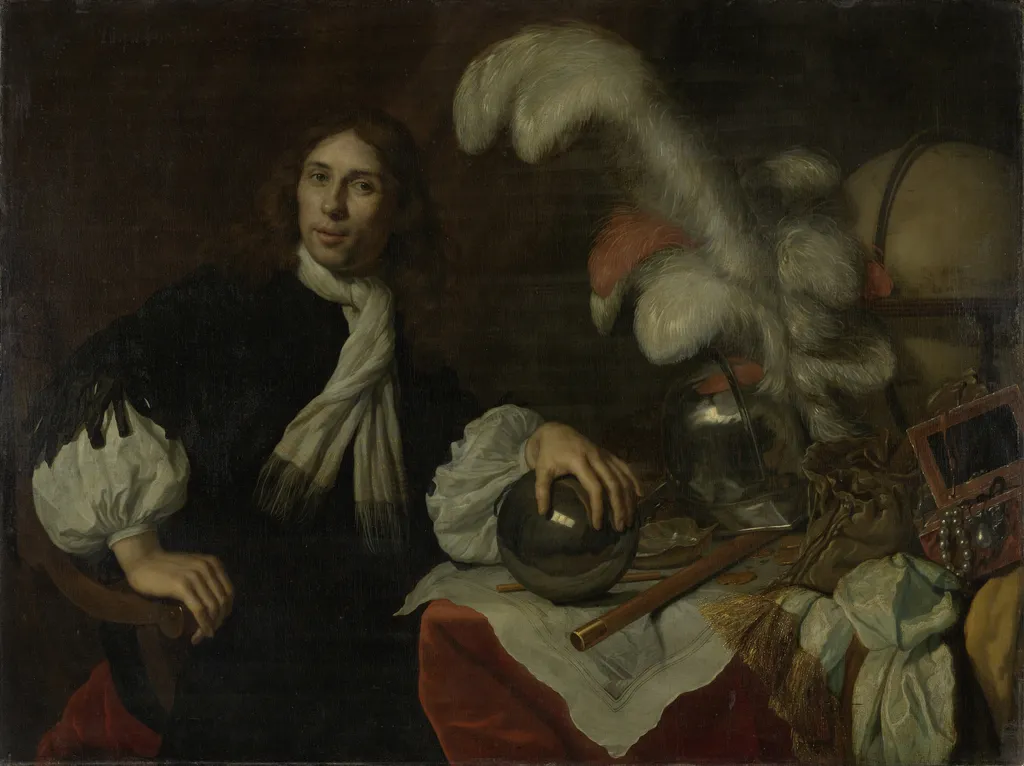
Posthumous portrait of Aucke Stellingwerff, Admiral of Friesland, killed in 1665 at Lowestoft by a cannon-ball is an oil painting by the Dutch Golden Age artist Lodewijk van der Helst. It dates from 1670 and is held in the collection of the Rijksmuseum.
About this work
Overview
Lodewijk van der Helst’s oil painting, executed in 1670, serves as a posthumous commemoration of Aucke Stellingwerff, the Frisian admiral who fell at the Battle of Lowestoft in 1665. The work resides in the Rijksmuseum’s collection, where it is displayed as a representative example of Dutch portraiture from the late seventeenth century.
Subject & Meaning
The sitter is presented seated at a table, dressed in dark garments accented by a white scarf. His right hand rests on a crystal sphere, while a helmet, sword and globe lie on the surface, symbols that underscore his naval command and broader worldly authority. The inclusion of the crystal ball hints at an intellectual curiosity beyond mere martial prowess.
Technique & Style
Van der Helst employs a restrained palette of deep tones contrasted with the luminous white of the scarf and the reflective surfaces of the crystal and metal objects. The brushwork is smooth, rendering fine details in the armor and the globe, while the overall composition balances realism with a subtle idealisation typical of Dutch court portraiture.
History & Provenance
Created five years after Stellingwerff’s death, the portrait likely functioned as a memorial for his family or civic authorities in Friesland. It entered the Rijksmuseum’s holdings as part of the museum’s acquisition of Dutch Golden Age works, where it remains catalogued under the artist’s name and the admiral’s title.
Own this work as a print
Artist & collection
