Artwork
Venus, Bacchus and Ceres with Mortals in a Garden of Love
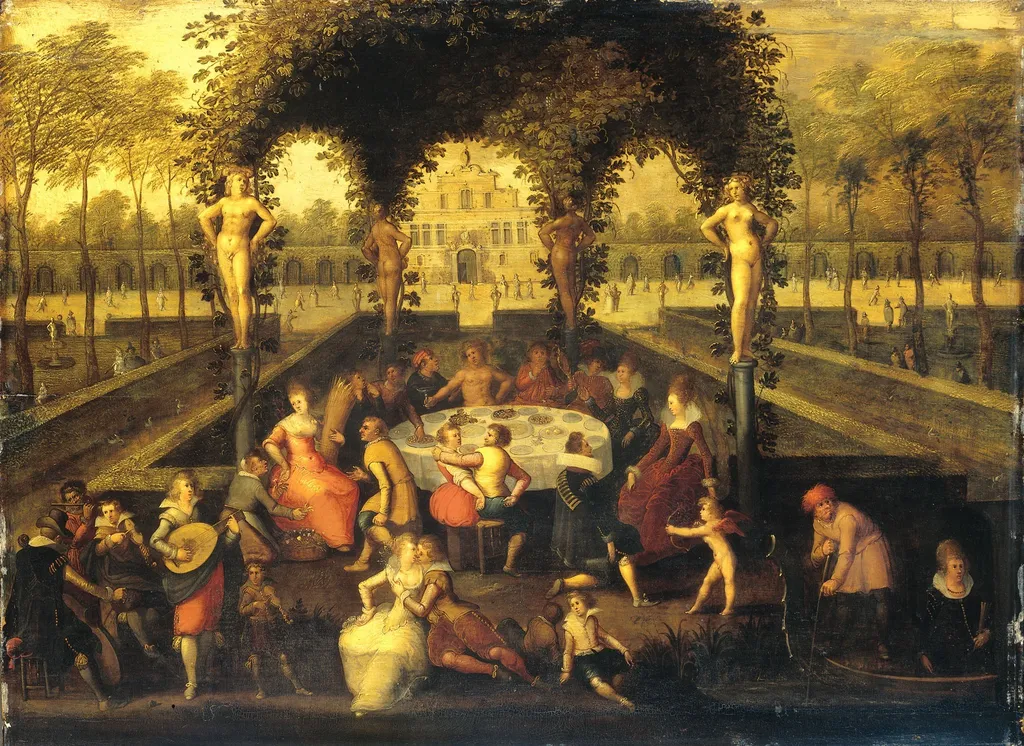
Venus, Bacchus and Ceres with Mortals in a Garden of Love is an oil painting by the Early Baroque Italian artist Louis de Caullery. It dates from 1605 and is held in the collection of the Rijksmuseum.
About this work
Overview
Louis de Caullery’s 1605 oil painting, *Venus, Bacchus and Ceres with Mortals in a Garden of Love*, presents a bustling garden scene in which mythological deities mingle with elegantly dressed revelers. The composition balances a formal banquet on the left with four nude figures on the right, all set against a luminous, golden‑toned landscape that includes a distant architectural façade.
Subject & Meaning
The work juxtaposes human courtly pleasure with divine presence: Venus, identified by a fruit basket, embodies love; Bacchus, crowned with a wreath, represents wine; and Ceres, though less prominent, alludes to abundance. Their calm observation of the mortal gathering suggests a harmonious interaction between the earthly and the mythic, a common allegorical theme in early Baroque art.
Technique & Style
Caullery employs a clear, bright palette and soft chiaroscuro to render the garden’s foliage and the figures’ textures. The spatial arrangement is organized through a central perspective that draws the eye from the banquet table to the distant building, while the figures are rendered with a smooth, almost sculptural finish characteristic of Flemish courtly painting.
History & Provenance
Created during Caullery’s active period between 1580 and 1621, the canvas reflects the artist’s involvement in the emerging Flemish tradition of depicting aristocratic gatherings. The painting entered the Rijksmuseum’s collection, where it remains part of the museum’s holdings of early Baroque works.
Context
The composition reflects the early Baroque fascination with allegory and the integration of classical mythology into contemporary social scenes. Caullery’s treatment of a garden party aligns with the period’s interest in idealized nature, courtly leisure, and the moralizing potential of mythic figures observing human behavior.
Own this work as a print
Artist & collection
Artist
Louis de Caullery, Caulery or Coulery (ca.1580–1621) was a Flemish painter who is known for his architectural scenes, city views, genre scenes, allegorical compositions, religious and history paintings.