Artwork
Massacre of the Innocents in Bethlehem
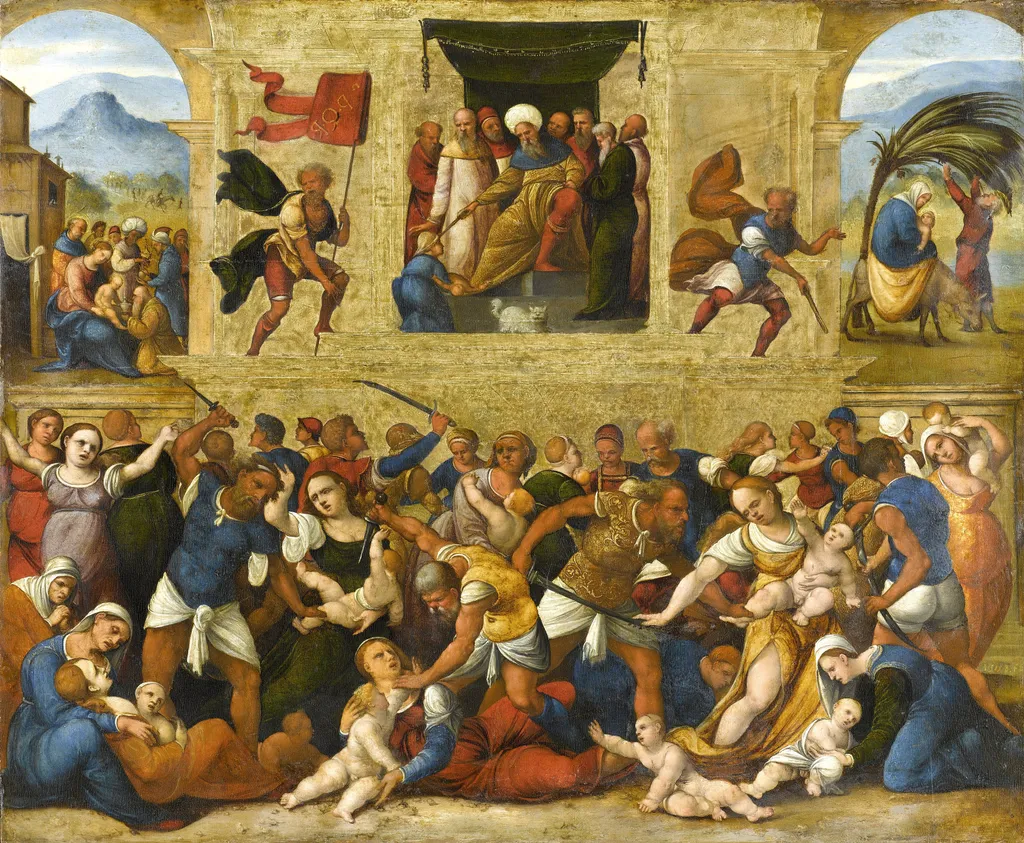
Massacre of the Innocents in Bethlehem is an oil painting by the Mannerist artist Ludovico Mazzolino. It dates from 1520 and is held in the collection of the Rijksmuseum. Created in 1520, this panel painting portrays the biblical episode known as the Massacre of the Innocents.
About this work
Overview
Created in 1520, this panel painting portrays the biblical episode known as the Massacre of the Innocents. Executed by the Italian artist Ludovico Mazzolino, the work belongs to the early 16th‑century Mannerist phase of the Renaissance. It is currently part of the Rijksmuseum’s collection, where it is displayed as a religious narrative piece.
Subject & Meaning
The composition captures the chaotic aftermath of King Herod’s order to kill newborn children in Bethlehem. Figures scramble amid a tangled crowd, with adults clutching infants in desperate attempts to shield them. The central male figure cradles a naked baby, his expression a blend of terror and resolve, emphasizing the human cost of the biblical tragedy.
Technique & Style
Mazzolino employs vivid, contrasting hues—reds, blues, yellows—to delineate the tumultuous scene, a hallmark of his Mannerist sensibility. The figures are rendered with elongated forms and exaggerated gestures, heightening the emotional intensity. Architectural arches and distant structures frame the foreground, adding depth while reinforcing the sense of disorder.
History & Provenance
Originally commissioned as a devotional panel, the work remained in private collections before entering the Rijksmuseum’s holdings in the 20th century. Its documented provenance traces back to the artist’s activity in Ferrara and Bologna, reflecting the regional patronage networks that supported Mazzolino’s religious commissions.
Context
Mazzolino worked during a transitional period when the High Renaissance gave way to Mannerism, a style marked by artificiality and complex compositions.
Mazzolino worked during a transitional period when the High Renaissance gave way to Mannerism, a style marked by artificiality and complex compositions. This painting exemplifies that shift, combining narrative clarity with stylized figures. The subject, a frequently depicted biblical massacre, allowed the artist to explore themes of suffering, protection, and divine intervention within a contemporary visual language.
Own this work as a print
Artist & collection
Artist
Ludovico Mazzolino (1480 – c. 1528) - also known as Mazzolini da Ferrara, Lodovico Ferraresa, and Il Ferrarese - was an Italian Renaissance painter active in Ferrara and Bologna.