Artwork
Easter Monday
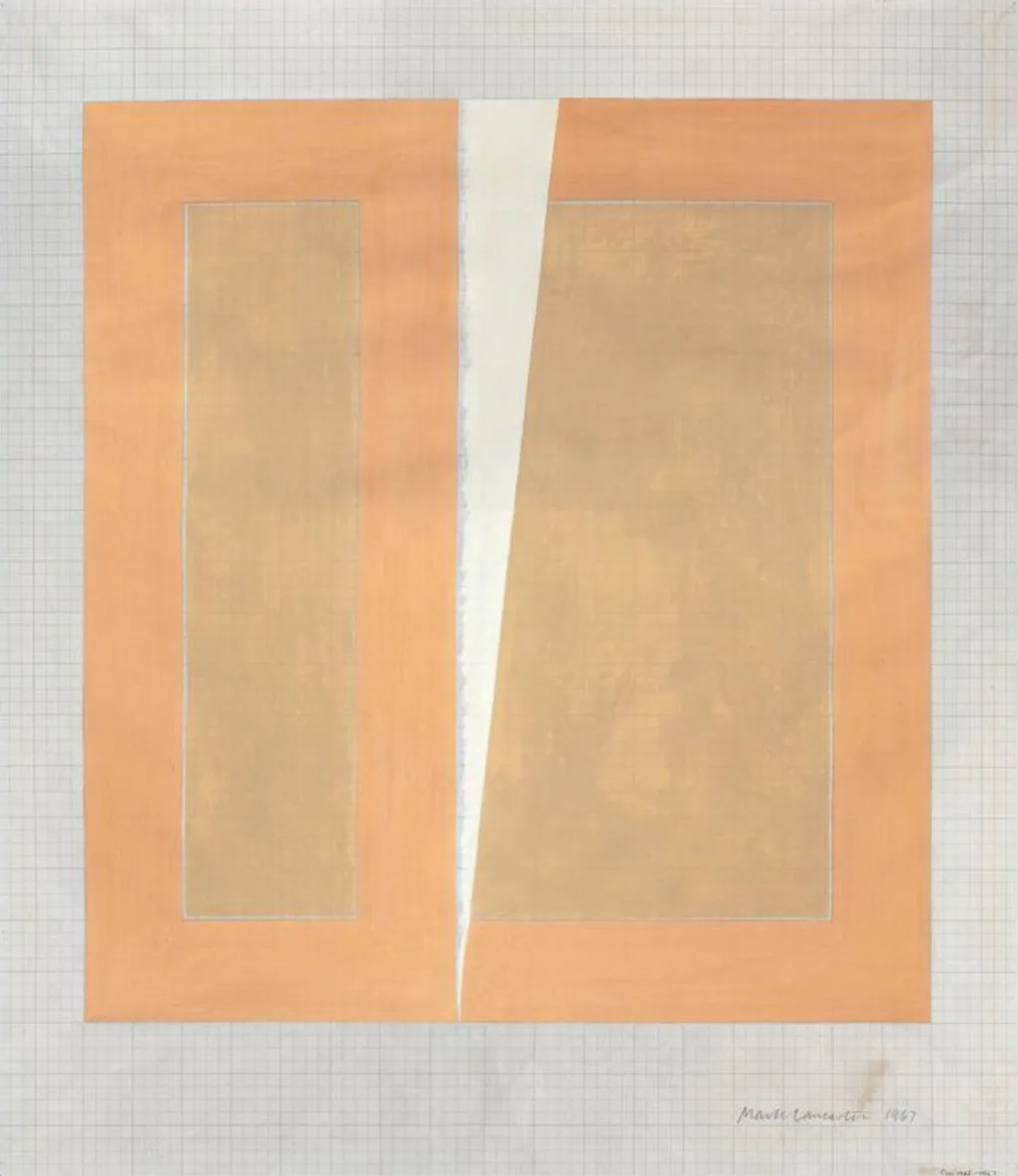
Easter Monday is a watercolor work on paper by Mark Lancaster. It dates from 1967 and is held in the collection of the Victoria and Albert Museum.
About this work
Overview
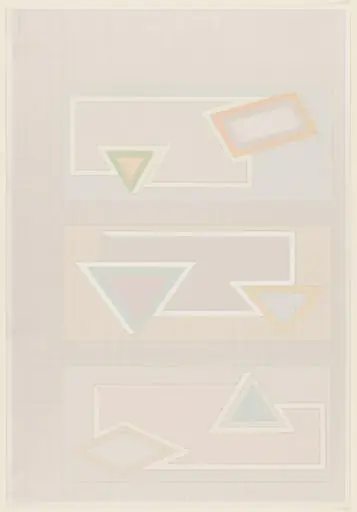
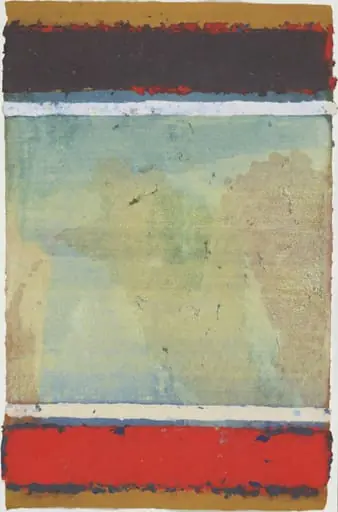
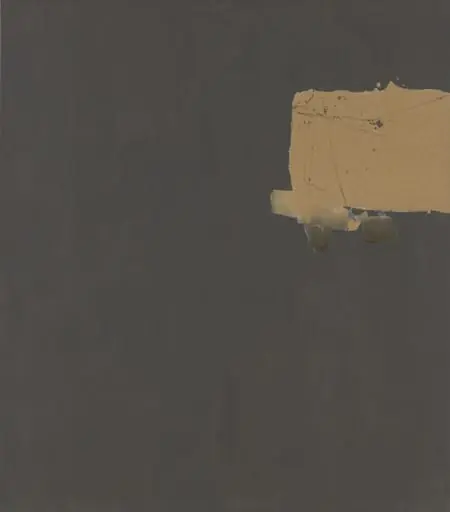
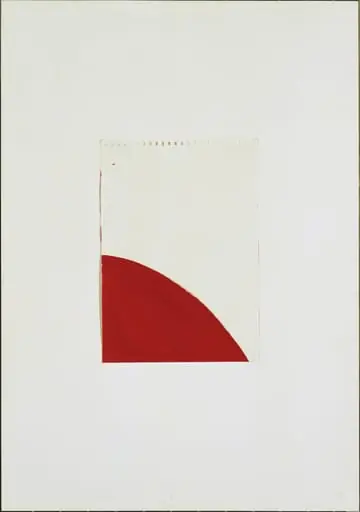
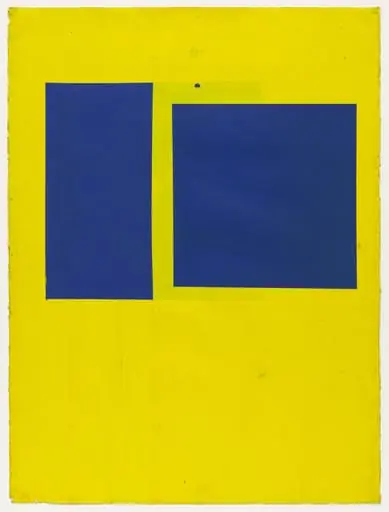
Created in 1967, this watercolour by Mark Lancaster presents a restrained composition of two peach-toned rectangles on a lightly gridded gray field. The forms are outlined in white, suggesting separation or interruption, while their uneven heights and implied edges introduce subtle asymmetry. The work’s minimalism arises not from absence, but from deliberate restraint in form and hue.
Subject & Meaning
The title 'Easter Monday' offers no direct narrative, but the work’s quiet tension between order and disruption may evoke transition—between celebration and return to routine, or between structure and fragmentation. The torn appearance of the rectangles suggests impermanence, while the grid beneath implies an underlying system, perhaps of time or measurement.
Technique & Style
Lancaster employed watercolour with precision, allowing the paper’s texture and grid to remain visible beneath thin washes.
Lancaster employed watercolour with precision, allowing the paper’s texture and grid to remain visible beneath thin washes. The peach shapes are defined by crisp white outlines, creating a sense of flatness and clarity. The irregular edges of the rectangles imply manual intervention—cutting or tearing—rather than painted contours, reinforcing a sense of deliberate, almost industrial, intervention.
History & Provenance
This work belongs to a series from the late 1960s in which Lancaster explored geometric abstraction through watercolour, often using grids and monochrome palettes. It was produced during a period when he was closely engaged with the British and American minimalist movements, though his approach retained a tactile, hand-made quality distinct from industrial aesthetics.
Context
Emerging alongside minimalist and conceptual art practices in the 1960s, Lancaster’s work responded to a broader shift toward reduction and material honesty. While contemporaries like Frank Stella or Donald Judd emphasized industrial materials, Lancaster’s use of watercolour and paper grounded his abstraction in the intimate, the ephemeral, and the personal.
Legacy
Lancaster’s watercolours from this period are recognized for their quiet innovation within minimalist discourse. By introducing subtle irregularities into geometric forms, he expanded the language of abstraction beyond pure formalism. His work influenced later artists interested in the intersection of precision and human gesture in abstract art.
Artist & collection

Artist
Christopher Ronald Mark Lancaster was a British-American artist and set designer who worked extensively with the Cunningham Dance Company.