Artwork
Madonna and Child
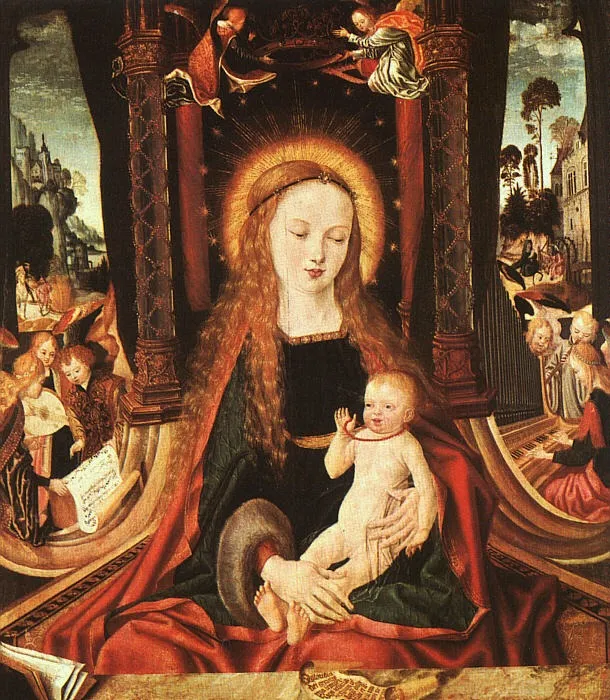
Madonna and Child is a wood painting by the Northern Renaissance artist Master of the Aachen Altar. It dates from 1500 and is held in the collection of the Bavarian State Painting Collections. Created around the turn of the sixteenth century, this panel painting presents the Virgin Mary cradling the infant Jesus.
About this work
Overview
Created around the turn of the sixteenth century, this panel painting presents the Virgin Mary cradling the infant Jesus. Executed on a wooden support, the work belongs to the late Gothic tradition that flourished in the Rhineland. It is presently housed in Munich’s Alte Pinakothek, where it forms part of the museum’s collection of Northern European religious art.
Subject & Meaning
The central figures—Mary in a richly dyed red‑gold robe and a dark mantle, and the child reaching toward her face—convey an intimate devotional moment. Surrounding them are diminutive attendants engaged in music, reading, and other gentle activities, suggesting a celestial court that underscores the sanctity of the mother‑child bond.
Technique & Style
Painted with tempera on wood, the composition relies on a luminous gold background that imparts an inner glow to the figures. Subtle modeling of light and shadow creates a modest chiaroscuro effect, while the elongated forms and decorative drapery reflect the ornamental tendencies of late Gothic visual language.
History & Provenance
The piece is attributed to the anonymous Master of the Aachen Altar, an artist active in Cologne between roughly 1495 and 1520. Though the creator’s name remains unknown, the work exemplifies the output of a workshop that supplied devotional panels to local churches and private patrons during that period.
Context
Cologne’s artistic scene at the end of the Middle Ages was marked by a network of painters who blended International Gothic elegance with emerging Renaissance influences. This painting illustrates that transitional moment, combining a courtly setting with symbolic iconography typical of the region’s devotional practices.
Artist & collection
Artist
The notname Master of the Aachen Altar is given to an anonymous late gothic painter active in Cologne between 1495 and 1520 or 1480 and 1520, named for his master work, the Aachen Altar triptych owned by the Aachen Cathedral Treasury.
