Artwork
Altarpiece with The Passion of Christ
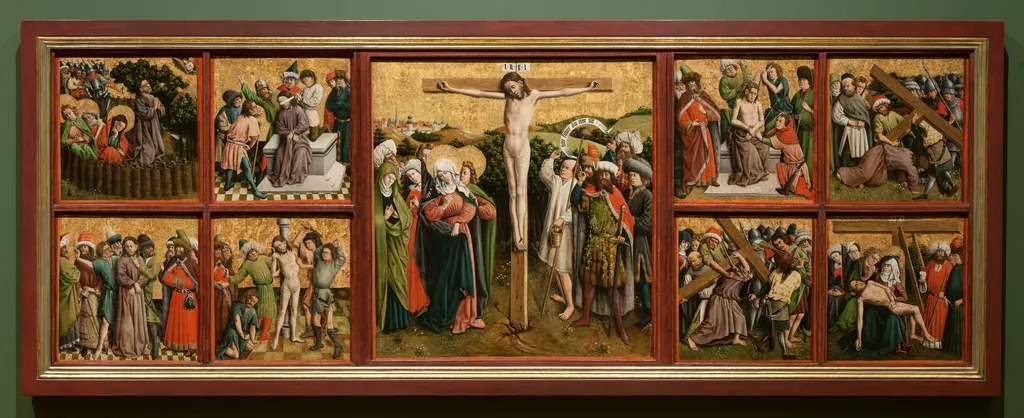
Altarpiece with The Passion of Christ is an unspecified painting by Master of the Tucher Altarpiece. It is held in the collection of the Cleveland Museum of Art.
About this work
Overview
Executed by the anonymous Master of the Tucher Altarpiece, the piece reflects the artistic activity of Nuremberg in the mid‑15th century.
Created in 1444, the Altarpiece with the Passion of Christ is a multi‑panel religious work now held by the Cleveland Museum of Art. Executed by the anonymous Master of the Tucher Altarpiece, the piece reflects the artistic activity of Nuremberg in the mid‑15th century. Its format consists of nine small scenes set within a wooden frame, each illustrating a moment from Christ’s crucifixion narrative.
Subject & Meaning
The central panel depicts the crucifixion, with Christ nailed to the cross surrounded by a crowd of onlookers, soldiers, and mourners. The surrounding eight scenes expand the story, showing figures carrying the cross, praying, and reacting to the events. Together they convey the theological emphasis on Christ’s suffering and the human responses it provoked, a common focus of devotional art of the period.
Technique & Style
The painter employed a flat application of color and precise, linear outlines, giving the scenes a storybook quality. Earthy tones—greens, browns, muted reds—dominate, while occasional bright blues and golds highlight garments. Attention to detail appears in the rendering of folded robes and facial expressions, revealing a meticulous hand within the constraints of a compact format.
History & Provenance
The work originates from Nuremberg, where the Master was active between roughly 1430 and 1450. Its name derives from the Tucher Altarpiece, a related commission originally displayed in the Augustinian church of Nuremberg before being transferred to the Tucher family in 1615. The Cleveland Museum of Art acquired the piece later, adding it to its collection of Northern Renaissance paintings.
Context
The altarpiece aligns with the visual language of early to mid‑15th‑century German painting, sharing stylistic traits with contemporaneous workshops in the region. Its narrative structure and didactic purpose reflect the devotional practices of the time, serving both as an object of veneration and as a visual aid for meditation on the Passion.
Artist & collection
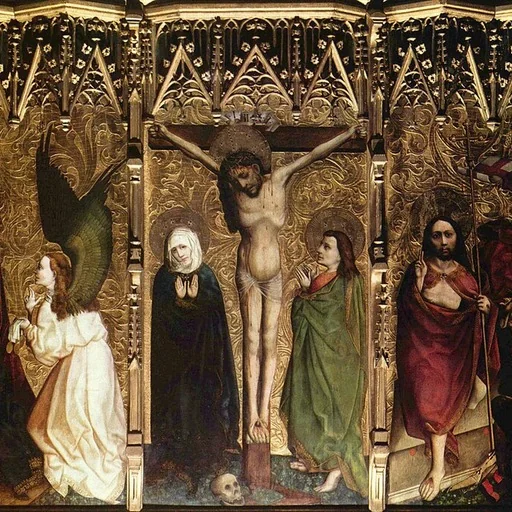
Artist
Master of the Tucher Altarpiece
The Master of the Tucher Altarpiece (fl c. 1430–1450) was a German painter active in Nuremberg. His name is derived from a painting which has been in that city's Frauenkirche since the early 19th century; this has been…
