Artwork
The Cliffs at Beg-ar-Fry, Saint-Jean-du-Doigt
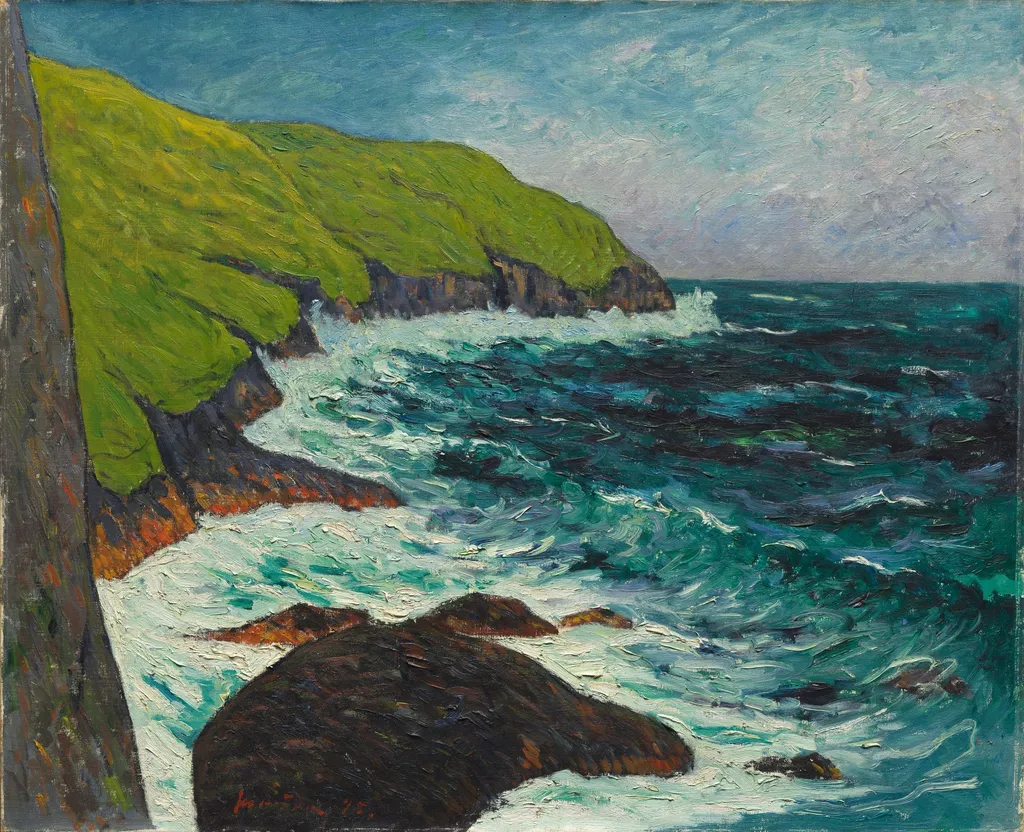
The Cliffs at Beg-ar-Fry, Saint-Jean-du-Doigt is an oil painting by the Post-Impressionist artist Maxime Maufra. It dates from 1898 and is held in the collection of the Cleveland Museum of Art.
About this work
Overview
Maxime Maufra’s 1898 oil on canvas, titled The Cliffs at Beg‑ar‑Fry, Saint‑Jean‑du‑Doigt, depicts a rugged coastal landscape. The work is part of the collection at the Cleveland Museum of Art, where it is displayed among other late‑19th‑century French paintings.
Subject & Meaning
The composition centers on a steep, verdant cliff that dominates the left side of the canvas, its silhouette cutting into a sky of muted clouds. Below, turbulent waves break against a scatter of jagged rocks, while the open sea recedes into deep blue tones, suggesting the power of nature along the Breton shoreline.
Technique & Style
Maufra employs a pronounced impasto technique, applying thick layers of paint especially on the cliffs and water. The textured brushwork creates a tactile surface that conveys the roughness of stone and the frothy motion of surf, lending the scene a sense of immediacy and vigor.
History & Provenance
Created in 1898, the painting entered the Cleveland Museum of Art’s holdings through acquisition in the early 20th century, reflecting the museum’s effort to represent French landscape painting of the period. Its provenance traces back to the artist’s native region, where he frequently painted coastal subjects.
Context
Maufra, associated with the Pont‑Aven circle, often explored the Breton coast, drawing inspiration from its dramatic light and terrain. This work aligns with the broader trend among French painters of the 1890s to capture the raw, untamed aspects of nature, moving away from idealized pastoral scenes toward more visceral representations.
Own this work as a print
Artist & collection