Artwork
Künstlers Erdenwallen (The Artist’s Earthly Pilgrimage)
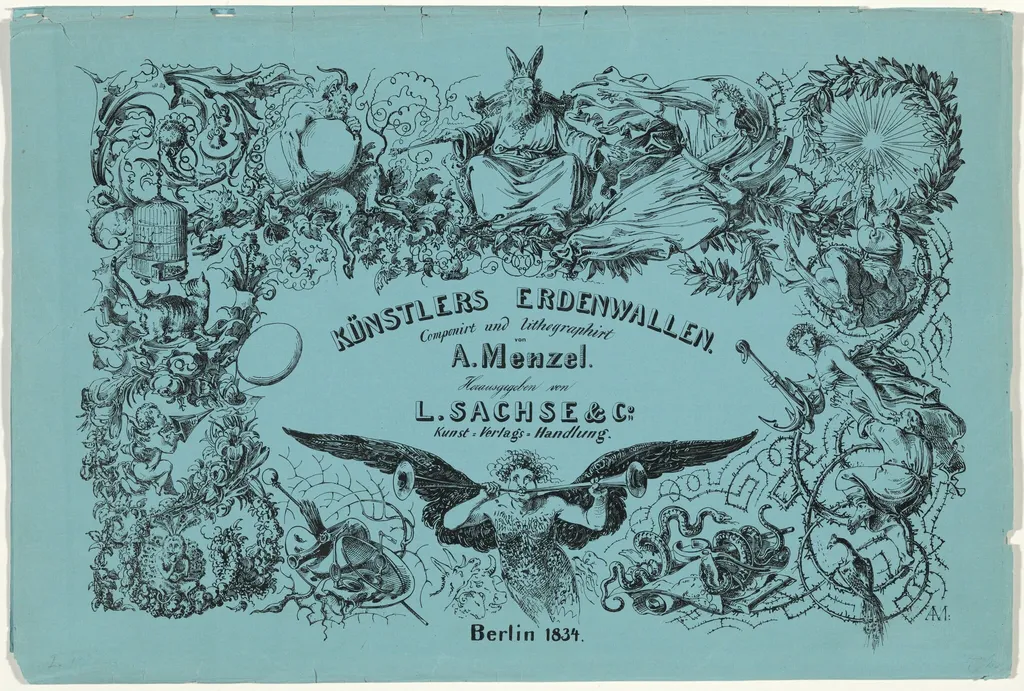
Künstlers Erdenwallen (The Artist’s Earthly Pilgrimage) is an ink print by the Romanticist artist Adolph von Menzel. It dates from 1834 and is held in the collection of the National Gallery of Art.
About this work
It’s packed with black ink drawings on a light blue background, showing musical instruments, birds, and swirling vines.
This image is a decorative wrapper for sheet music. It’s packed with black ink drawings on a light blue background, showing musical instruments, birds, and swirling vines. A rabbit peeks out from the top, and a bird holds a scroll in its beak. The text in the middle reads *"Künstlers Erdenwallen"* and credits an artist named Menzel.
The wrapper was made in 1834, likely as part of a set of six prints. The intricate designs mix nature and music, which was common in Romantic-era art. The technique used here—lithography—lets artists draw directly onto stone for prints.
Next, look up lithography to see how this process works.
Overview
Created in 1834, *Künstlers Erdenwallen* is a suite of six lithographs by Adolph Friedrich Erdmann von Menzel, printed on chine appliqué and bound within a decorative wrapper of light blue wove paper. Produced early in his career, the work reflects Menzel’s engagement with printmaking before he gained wider recognition for his paintings and drawings. The wrapper, intended as a cover for sheet music, features intricate black ink illustrations and serves as both functional packaging and artistic expression.
Subject & Meaning
The wrapper’s imagery blends natural elements—swirling vines, birds, and a rabbit—with musical instruments, suggesting a poetic connection between art, nature, and sound. A bird clutching a scroll implies the transmission of musical or poetic inspiration. These motifs align with Romantic ideals that saw creativity as a harmonious force woven into the natural world, rather than a purely human endeavor.
Technique & Style
Menzel employed lithography, a process allowing direct drawing on limestone, which enabled fine, fluid lines and tonal variation. The use of chine appliqué—thin paper adhered to a heavier support—enhanced detail and texture. The dense, intricate linework and delicate shading reflect his skill as a draftsman, while the light blue background provides a quiet contrast to the dense black ink, emphasizing the ornamental quality of the design.
History & Provenance
The set was produced in 1834 as part of a commercial publication, likely accompanying musical scores. Though the individual prints were once distributed separately, the original wrapper survives as a cohesive unit. It is now held in the National Gallery of Art, Washington, where it represents Menzel’s early experimentation with print media and his role in the German artistic milieu of the 1830s.
Context
In the 1830s, lithography was gaining popularity in Germany as a medium for both fine art and commercial publishing. Menzel’s work reflects the Romantic era’s fascination with nature, music, and symbolic imagery. The decorative wrapper aligns with contemporary practices in which artistic design extended beyond the artwork itself to encompass its presentation, blurring boundaries between utility and aesthetic expression.
Legacy
Though lesser known than his later historical paintings, *Künstlers Erdenwallen* illustrates Menzel’s foundational mastery of line and composition. The work demonstrates how printmaking shaped his visual language and contributed to his development as a chronicler of 19th-century German culture. Its survival as a complete set offers insight into the material culture of music and art in the early Romantic period.
Artist & collection

Artist
Adolph Friedrich Erdmann von Menzel was a German Realist artist noted for drawings, etchings, and paintings.

 A New Year's Greeting
 Essay on Stone with Brush and Scraper: Title Page
 Essay on Stone with Brush and Scraper
 Annabella ('Tis Pity She's a Whore)
 Title Page to Vier Nachtstücke
 A Merry Christmas and a Happy New Year
 Diana Resting after the Hunt
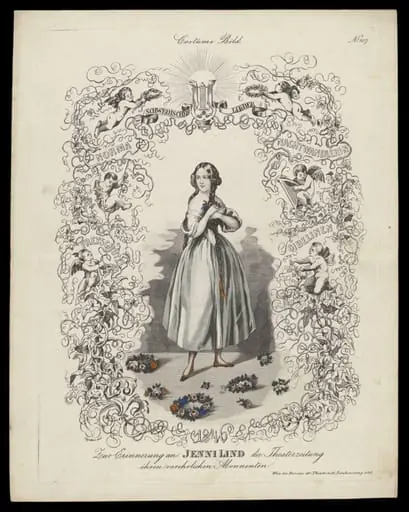 H Beard Print Collection
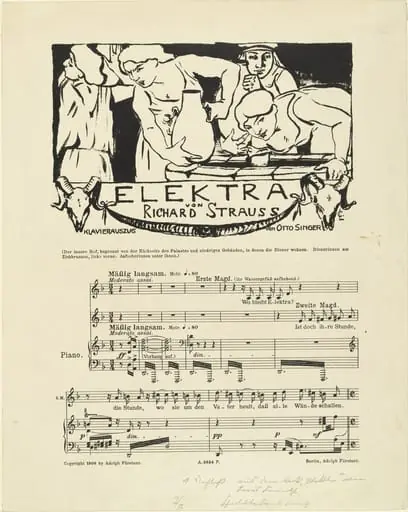 Untitled
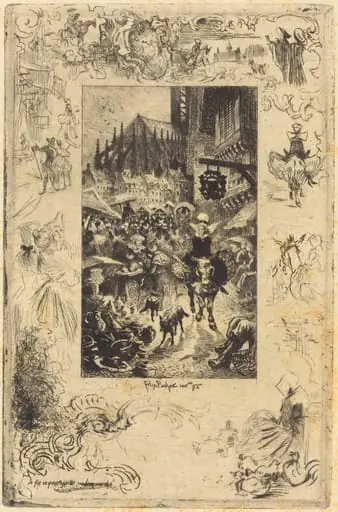 Je fis ce qu'on appelle un bon marché (I made what I would call a good bargain)
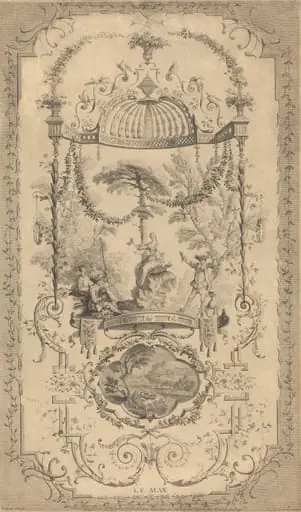 LeMay
LeMay Troilus and Cressida