Artwork
Casă veche
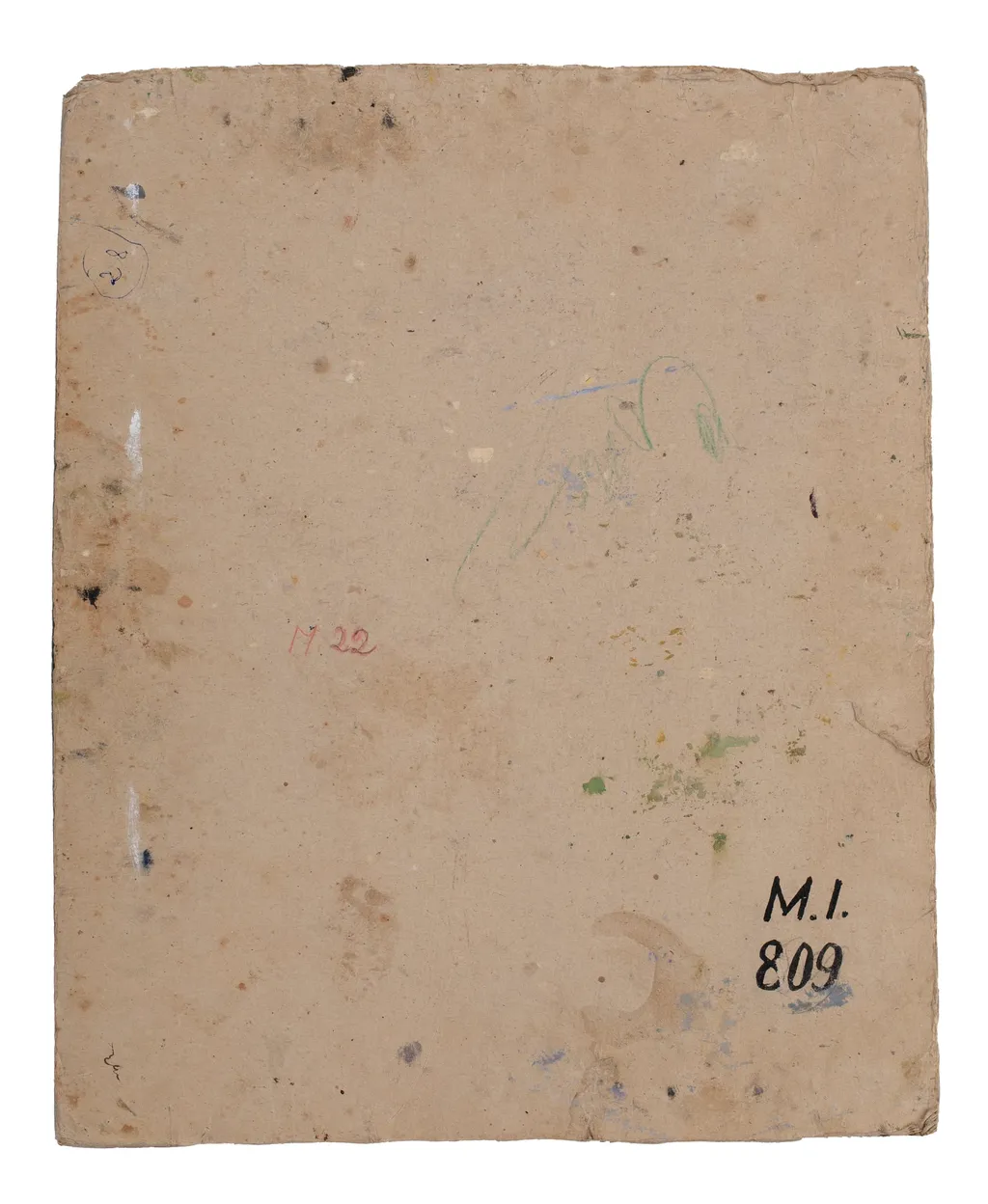
Casă veche is a print by Mihăilescu-Craiu Victor. It dates from 1949 and is held in the collection of the Moldova National Museum Complex.
About this work
Overview
Executed on thin, deteriorated paper, the work survives in a worn state—faded, stained, and partially obscured by time.
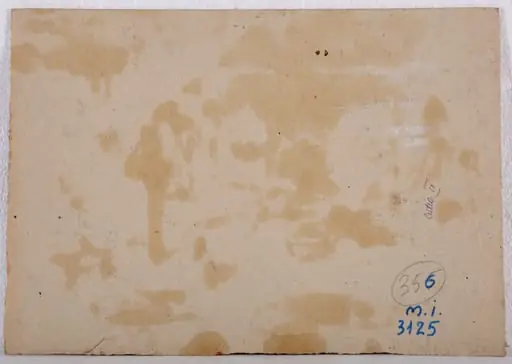
Casă veche is a fragile, hand-printed image attributed to Mihăilescu-Craiu Victor, dated around 1949. Executed on thin, deteriorated paper, the work survives in a worn state—faded, stained, and partially obscured by time. Its physical condition suggests frequent handling and inadequate preservation. Minimal visual detail remains, with only traces of architectural forms and muted pigments visible. The presence of handwritten numbers and a stamp implies institutional cataloging, likely for archival purposes.
Subject & Meaning
The subject appears to be a rural dwelling, though its form is indistinct due to degradation. What remains suggests a modest structure, possibly a traditional Romanian house, rendered with sparse lines and indeterminate shapes. The ambiguity of the image invites interpretation as a memory or record of vernacular architecture, rather than a detailed depiction. Its erosion may symbolize the passage of time or the fading of domestic histories in postwar Romania.
Technique & Style
The work employs a rudimentary printing or drawing technique, likely monochrome or limited palette, applied lightly to absorbent paper. Colors are subdued—dominated by earthy browns and greens—with no clear modeling or shading. The lines are faint and uneven, indicating either a crude printing method or the artist’s deliberate restraint. The absence of detail and the emphasis on texture over form suggest an experimental or documentary approach rather than a polished composition.
History & Provenance
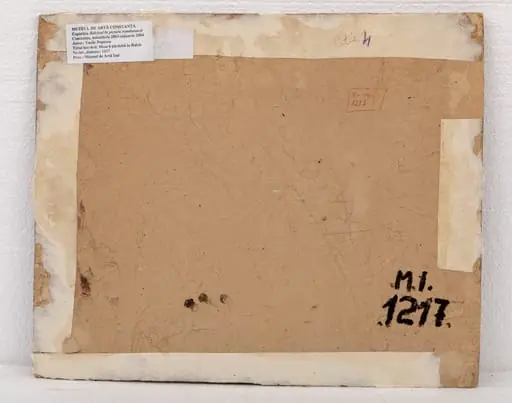
The presence of the red numerals '17.22' and the black stamp 'M.I. 809' indicates the work was cataloged, possibly by a museum or cultural institution. Its poor condition implies it was not displayed or stored under controlled conditions. The lack of documentation surrounding its creation or acquisition leaves its original context uncertain, though its material state suggests it was part of a larger, now dispersed, collection of regional studies or sketches.
Context
Created in the late 1940s, the piece emerges from a period of social and political transformation in Romania, when rural life was increasingly displaced by state-led modernization. Artists often turned to vernacular architecture as a subject, documenting disappearing ways of life. This work, though fragmentary, may reflect that impulse—preserving, even unintentionally, a visual echo of a culture in flux.
Legacy
Casă veche endures not as a finished artwork but as an artifact of preservation and loss. Its deterioration mirrors the fragility of cultural memory. While it holds little aesthetic clarity, its survival offers insight into the material practices of lesser-known artists under constrained conditions. It serves as a quiet testament to the impermanence of both physical media and the histories they attempt to record.
Artist & collection
Artist
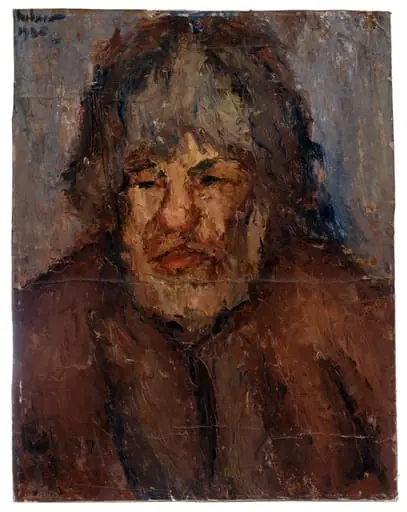
Victor M. Craiu painted Romanian landscapes and figure scenes using thick, choppy brushstrokes that give his surfaces a restless energy. In prints like *Strămoșul* and *Peisaj urban*, he layered bold autumn greens,…
 Flori de toamnă
 Natură statică
 Strămoșul
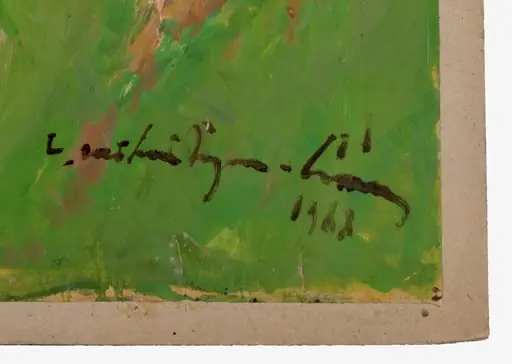 Studiu de peisaj cu un drum pe care merge o căruță trasă de cai. În prim-plan, căruța văzută din spate, dreapta. În căruță, un bărbat cu căciulă neagră și haină gri, o femeie cu batic alb și haină brun-ocru și o fetiță cu batic alb cu verde-roșu, așezată în spatele celor doi, lângă două butoaie. Drumul taie ca o diagonală lucrarea; de-o parte și de alta, iarbă. Linia orizontului foarte ridicată, după care se vede un copac verde, dealul albastru în depărtare și cerul. Semnat și datat cu brun, dreapta jos: V. Mihăilescu Craiu 1968.
 Natură statică cu flori
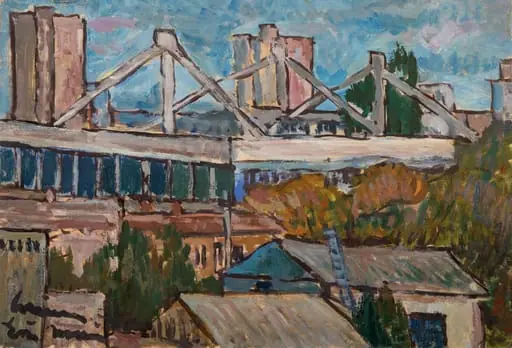 Peisaj urban; în prim-plan, acoperișuri de case și vegetație. În plan îndepărtat, o hală de producție care are pe acoperiș grinzi verticale care susțin alte grinzi de-o parte și de alta, celălalt capăt având punct de sprijin marginile construcției. Două coșuri apar în spatele halei. Colorat în gri. Tușă păstoasă. Semnat cu negru, stânga jos: Craiu.
 Peisaj industrial pe Valea Bistriței
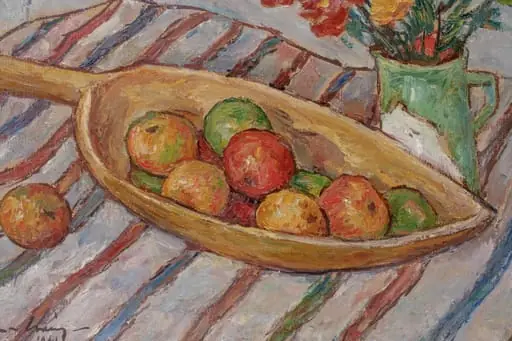 Natură moartă cu mere și flori