Artwork
Juno, Argus and Io
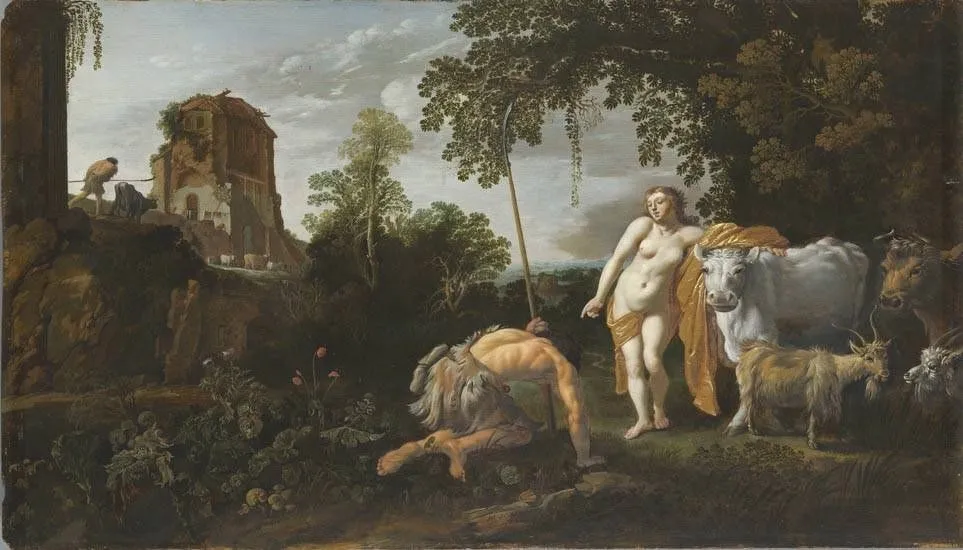
Juno, Argus and Io is an oil painting by the Dutch Golden Age artist Moses van Uyttenbroeck. It dates from 1625 and is held in the collection of the Bavarian State Painting Collections.
About this work
Overview
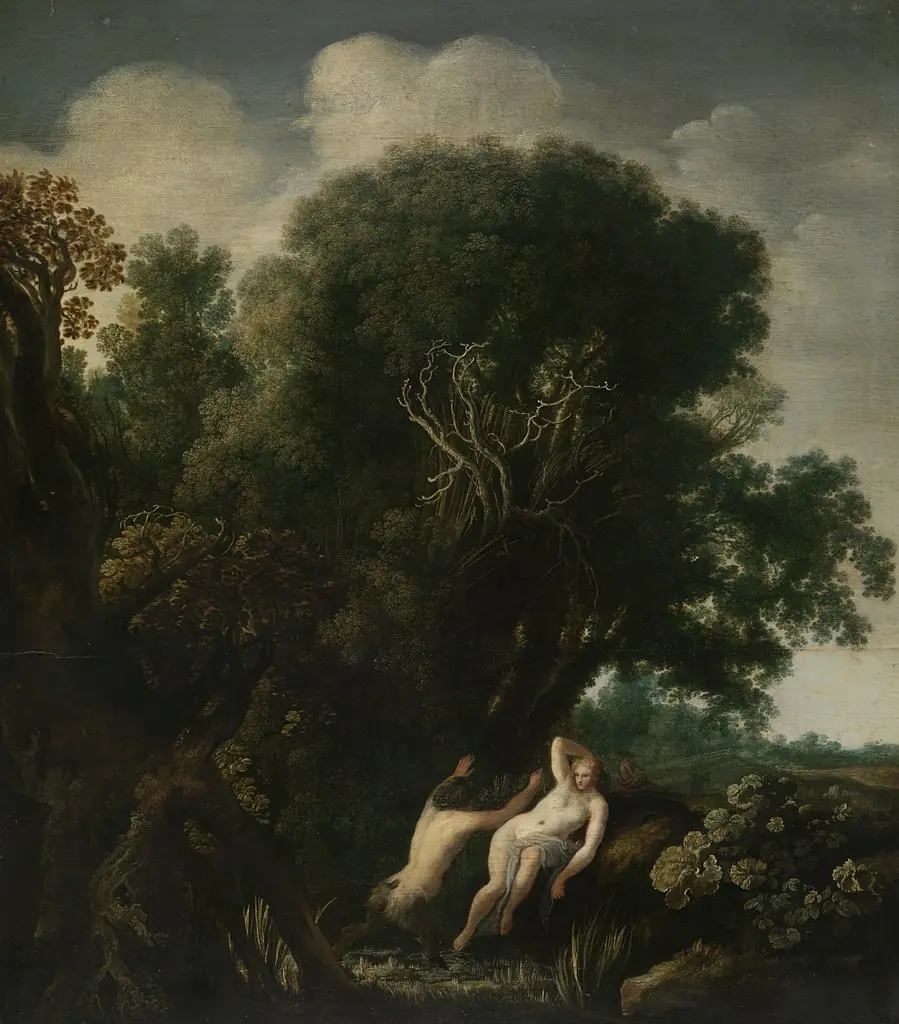
The composition centers on a golden‑clad female figure beside a cow, a kneeling male figure on the left, and a distant tower framed by foliage.
Moses van Uyttenbroeck’s oil on canvas, dated 1625, presents a compact mythological tableau now in the Alte Pinakothek. The composition centers on a golden‑clad female figure beside a cow, a kneeling male figure on the left, and a distant tower framed by foliage. The palette of muted greens, browns and grays, together with chiaroscuro modelling, gives the scene a measured depth and atmospheric ambience.
Subject & Meaning
The work visualises the episode from Ovid’s Metamorphoses in which Juno, suspecting Zeus’s affair with Io, assigns the hundred‑eyed giant Argus to guard the transformed nymph, now a heifer. The central woman represents Io, the kneeling figure is Argus, and the bovine form is Io herself, while the tower alludes to Juno’s palace, underscoring themes of surveillance, transformation and divine jealousy.
Technique & Style
Van Uyttenbroeck employs a restrained Baroque vocabulary, using layered glazes to achieve subtle tonal transitions. Light falls from the left, sculpting the figures with soft shadows that enhance their three‑dimensionality. The composition balances diagonal movement—Argus’s bent posture—with a vertical axis formed by the tower, reflecting the artist’s study of classical narrative painting and his skill in rendering texture, from fabric to animal hide.
History & Provenance
Executed in the early Dutch Golden Age, the painting entered the collection of the Bavarian state museum in the 19th century, where it remains on display at Munich’s Alte Pinakothek. Documentation traces its ownership through several private hands before its acquisition by the museum, confirming its attribution to van Uyttenbroeck through stylistic comparison and archival records.
Context
The piece reflects the period’s fascination with antiquarian subjects, particularly the moralizing tales of Roman mythology popular among Dutch patrons. Van Uyttenbroeck, active in The Hague, often blended genre conventions with mythic narratives, catering to a market that prized learned allegory. The work thus illustrates the intersection of scholarly interest and the visual drama characteristic of early 17th‑century Northern European painting.
Artist & collection