Artwork
Needlefish (Yagara)
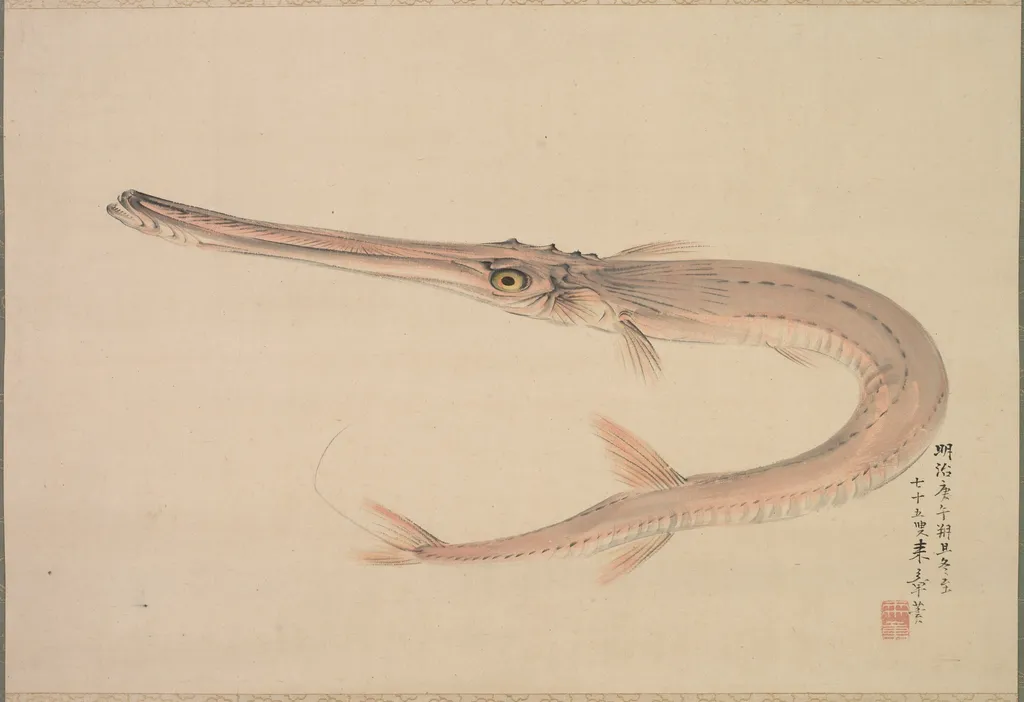
Needlefish (Yagara) is an unspecified painting by the Nihonga artist Nakajima Raishō. It dates from 1870 and is held in the collection of the Cleveland Museum of Art.
About this work
Overview
Needlefish (Yagara) is an 1870 painting by Japanese artist Nakajima Raishō. Executed in a modest palette, the work portrays a single needlefish against an unadorned beige field. The piece belongs to the collection of the Cleveland Museum of Art, where it is displayed among other works from the late‑nineteenth century.
Subject & Meaning
The composition centers on a slender needlefish, its body forming a gentle curve that suggests movement through water. The fish’s pointed snout, diminutive eye, and longitudinal dark stripes emphasize its streamlined form, inviting contemplation of the creature’s natural elegance and the quiet stillness of its environment.
Technique & Style
Raishō employs fine, controlled brushstrokes to render the fish’s texture, allowing subtle variations of light brown to convey volume. The restrained use of color—light brown against a uniform beige background—creates a calm contrast that highlights the subject without distraction. The overall approach reflects a delicate, refined aesthetic typical of Japanese painting of the period.
History & Provenance
Created in 1870, Needlefish (Yagara) entered the Cleveland Museum of Art’s holdings through acquisition in the twentieth century, though specific details of its earlier ownership remain undocumented. Its presence in an American institution illustrates the broader movement of Japanese artworks into Western collections during the Meiji era and beyond.
Context
The work emerges from a time when Japanese artists were responding to increased contact with Western markets, often producing naturalistic studies of flora and fauna for export. Needlefish, a common marine species, offered a subject that could be rendered with precision, aligning with contemporary tastes for detailed, scientifically informed depictions.
Artist & collection