Artwork
And I Saw in the Right Hand of Him that Sat on the Throne a Book Written within and on the Backside, Sealed with Seven Seals
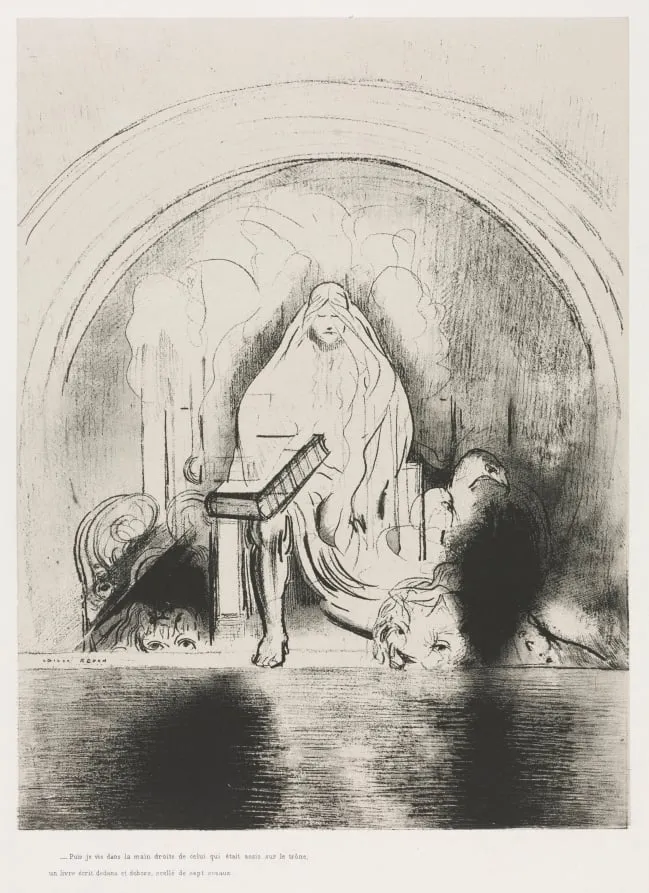
And I Saw in the Right Hand of Him that Sat on the Throne a Book Written within and on the Backside, Sealed with Seven Seals is a print by the Impressionist artist Odilon Redon. It dates from 1899 and is held in the collection of the Cleveland Museum of Art.
About this work
Overview
This lithographic print is the final entry in Odilon Redon’s series of eleven portfolios, each interpreting passages from the biblical Book of Revelation.
This lithographic print is the final entry in Odilon Redon’s series of eleven portfolios, each interpreting passages from the biblical Book of Revelation. The image depicts a luminous book suspended in space, its pages marked by seven radiant seals, surrounded by amorphous forms that evoke clouds or celestial beings. The composition conveys a sense of otherworldly revelation without narrating a specific episode.
Subject & Meaning
The work visualizes a prophetic vision described in Revelation, where a sealed book represents divine mystery. Redon selects the motif of the seven seals to symbolize the unfolding of apocalyptic events, while the surrounding ethereal shapes suggest the presence of angels or celestial forces that guard or announce the hidden knowledge. The piece invites contemplation of the unknowable rather than a literal retelling of the text.
Technique & Style
Executed in lithography, the print employs soft, blended contours that merge figure and background, a quality reminiscent of sfumato. Redon’s line work is delicate, allowing forms to appear as if they are drifting in a hazy atmosphere. The contrast between the bright seals and the muted surrounding tones creates a luminous focal point, emphasizing the book’s spiritual significance.
History & Provenance
The portfolio was published in the early 20th century by the Parisian dealer Ambroise Vollard, who had begun promoting Redon’s prints a year earlier. By this stage Redon was an established figure in the Symbolist movement, and Vollard’s involvement helped secure a broader market for the series across France and internationally.
Context
Redon’s engagement with Revelation aligns him with a tradition of artists interpreting apocalyptic scripture, notably Albrecht Dürer’s earlier woodcuts. While many predecessors rendered the scenes with dramatic realism, Redon’s approach is more suggestive, using dreamlike imagery to evoke the mystery of the prophetic vision. This reflects the Symbolist interest in inner experience over literal representation.
Artist & collection
Artist
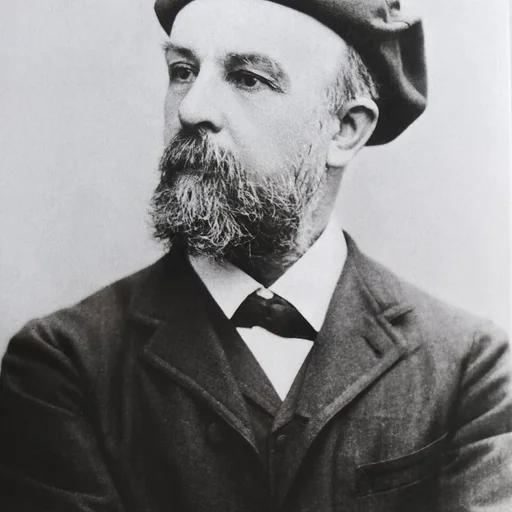
Born Bertrand-Jean Redon on 20 April 1840 in Bordeaux, the artist adopted the name Odilon from his mother, Marie-Odile.


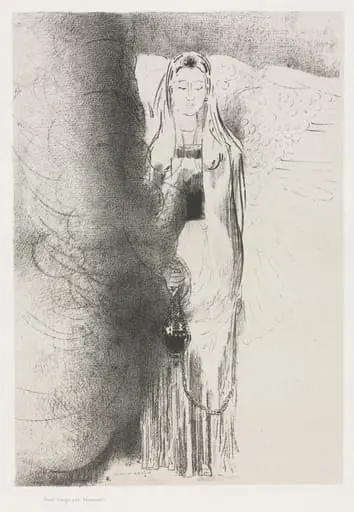 And the Angel Took the Censer
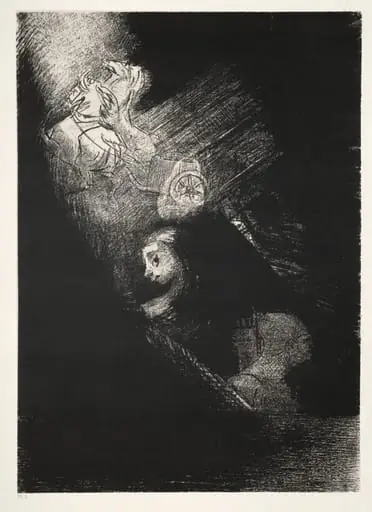 First a Pool of Water, Then a Prostitute, the Corner of a Temple, a Soldier's Face, a Chariot with Two White, Rearing Horses
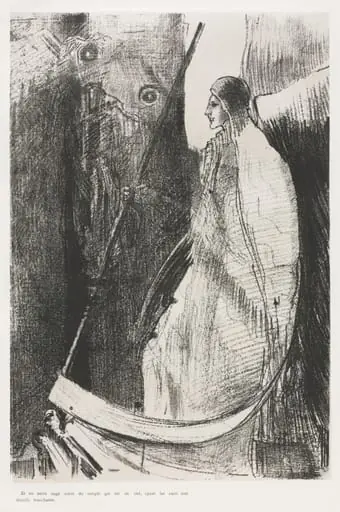 And Another Angel Came Out of the Temple which is in Heaven, and He also Having a Sharp Sickle
 Princess Maleine (The Little Madonna)
 In My Dream I Saw in the Sky a Face of Mystery
 Untitled