Artwork
Mug, Book, Biscuits, and Match
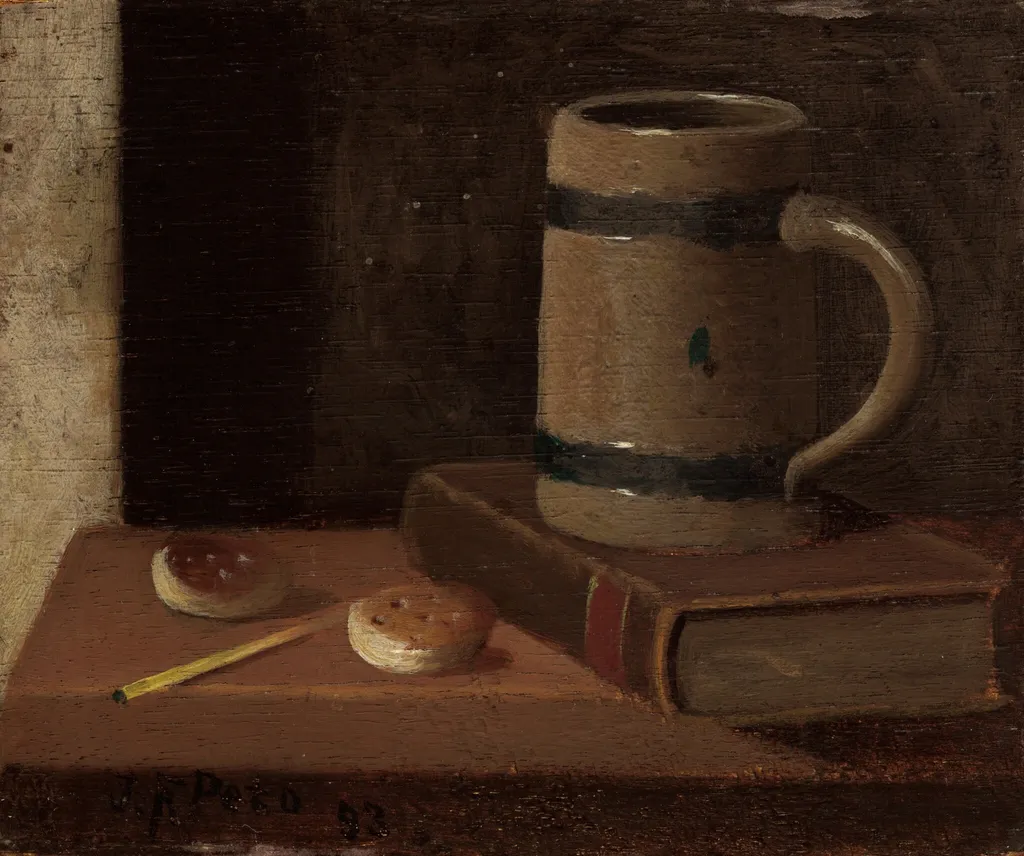
Mug, Book, Biscuits, and Match is an oil painting by the Impressionist artist John Frederick Peto. It dates from 1893 and is held in the collection of the National Gallery of Art.
About this work
Overview
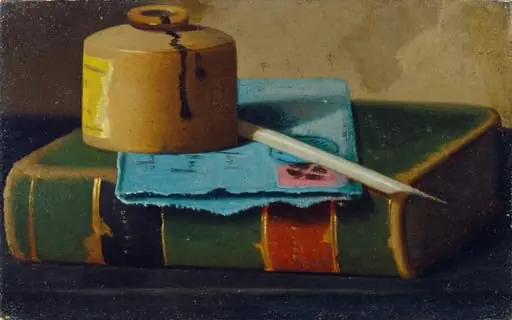
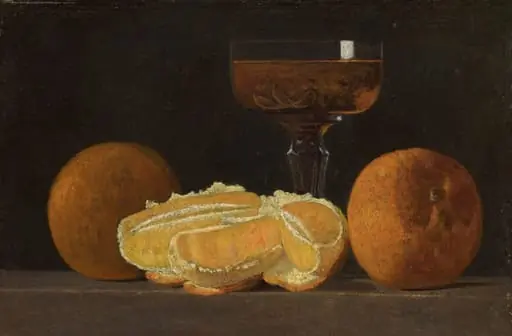
John Frederick Peto’s 1893 oil on wood, titled Mug, Book, Biscuits, and Match, presents a modest still‑life arranged on a dark wooden shelf.
John Frederick Peto’s 1893 oil on wood, titled Mug, Book, Biscuits, and Match, presents a modest still‑life arranged on a dark wooden shelf. A large brown mug, half‑filled with liquid, occupies the foreground, while two biscuits rest in a shallow dish beneath it, one split open. A solitary matchstick lies nearby, and a red cloth is partially visible beneath the dish, all rendered against a muted, shadowy background.
Subject & Meaning
The composition concentrates on ordinary household items, emphasizing their material presence rather than narrative content. By isolating the mug, biscuits, match, and cloth, Peto invites contemplation of everyday ritual—perhaps a moment of quiet refreshment—while the stark lighting isolates each object, underscoring their tactile qualities and the quiet intimacy of domestic space.
Technique & Style
Executed in oil on wood, the work employs a restrained palette and careful modeling of light to create subtle volume. Peto’s handling of paint suggests a modest impasto, especially on the mug’s rim and the biscuit crust, giving the surface a tactile surface that contrasts with the smooth, dark wood backdrop. The overall effect is one of quiet realism with a focus on surface texture.
History & Provenance
Created in 1893, the painting belongs to the later period of Peto’s career, when he concentrated on still‑life subjects. While specific ownership records are limited, the work has been documented in catalogues of American trompe‑l’œil and still‑life painters, reflecting its place within the artist’s consistent output of modest domestic scenes.
Context
Peto worked during a time when American artists often explored the visual potential of everyday objects, aligning with a broader 19th‑century interest in realism and the study of light. His focus on simple, unadorned subjects parallels the work of contemporaries who sought to elevate the mundane through careful observation and controlled composition.
Own this work as a print
Artist & collection