Artwork
Madonna and Child with the Infant St. John the Baptist and Angels
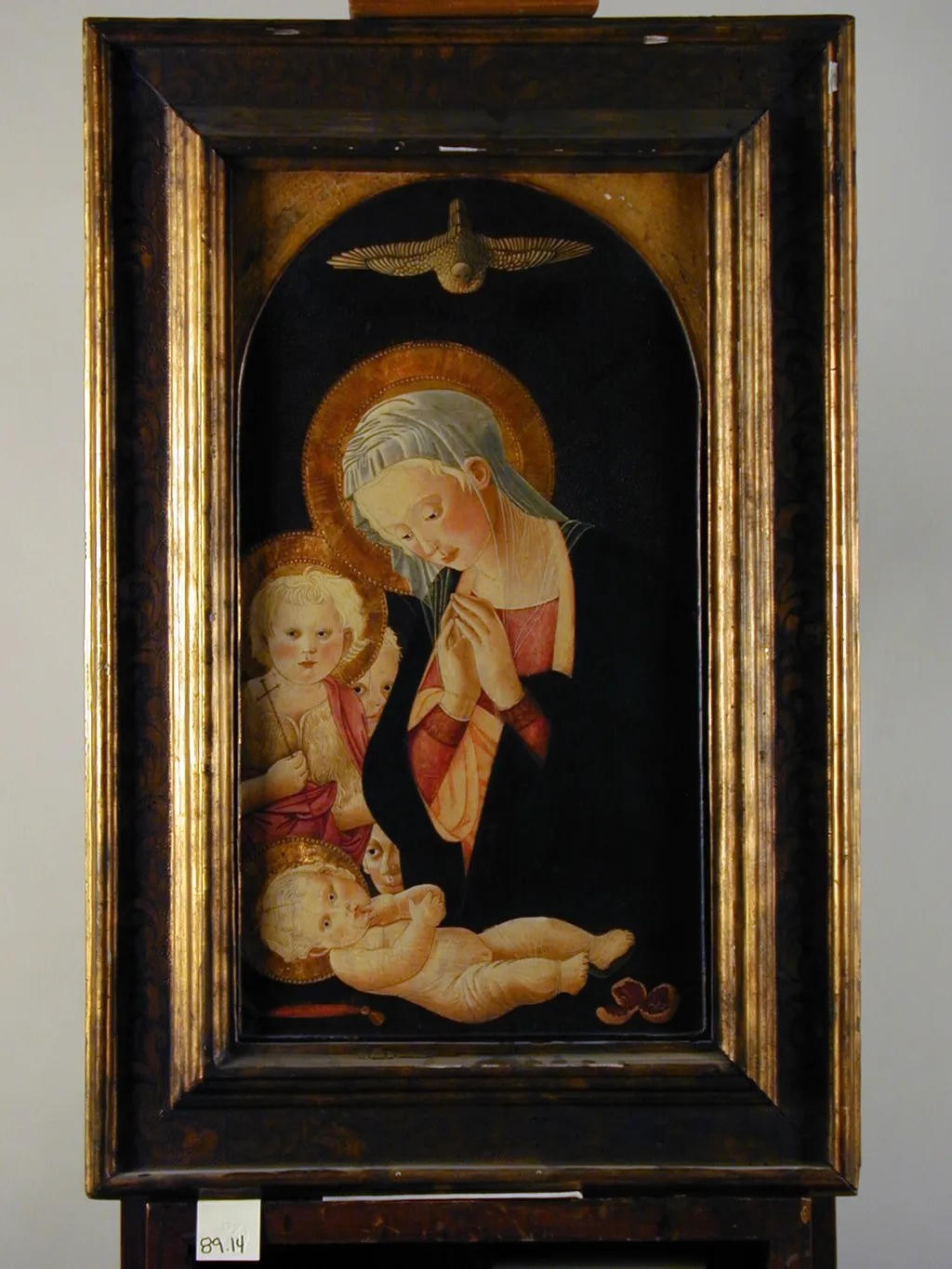
Madonna and Child with the Infant St. John the Baptist and Angels is a tempera painting by the Early Renaissance artist Pier Francesco Fiorentino. It dates from 1460 and is held in the collection of the Detroit Institute of Arts.
About this work
Overview
The composition is set against a muted, dark backdrop that accentuates a subtle golden halo surrounding the Madonna’s head.
Pier Francesco Fiorentino’s tempera work from 1460, titled *Madonna and Child with the Infant St John the Baptist and Angels*, presents a serene group portrait of the Virgin Mary cradling the infant Jesus, accompanied by a standing young John the Baptist and a pair of attendant angels. The composition is set against a muted, dark backdrop that accentuates a subtle golden halo surrounding the Madonna’s head. The painting is part of the collection at the Detroit Institute of Arts.
Subject & Meaning
The central figure, the Virgin, holds a sleeping Christ, embodying maternal tenderness, while the upright child is identified as the infant John the Baptist, a prophetic figure linked to Christ’s future ministry. The surrounding angels serve as celestial witnesses, and a small bird with outstretched wings hovers above, a conventional symbol of the Holy Spirit, reinforcing the work’s devotional intent.
Technique & Style
Executed in tempera, the painting displays the fine, linear brushwork typical of mid‑15th‑century Italian art. Fiorentino employs a restrained palette of soft, pastel robes against a deepened background, creating a gentle contrast that highlights the figures’ calm expressions. The delicate modeling of faces and the subtle gold illumination around the Madonna’s head reflect the transitional aesthetics between Gothic elegance and early Renaissance naturalism.
History & Provenance
Created in 1460, the work remained in private hands before entering the Detroit Institute of Arts, where it is currently displayed. Documentation traces its acquisition to the museum’s mid‑20th‑century collecting efforts, confirming its attribution to Fiorentino and its status as a representative example of his religious output.
Context
The painting belongs to a long tradition of Madonna and Child iconography that proliferated across Europe during the Renaissance. Fiorentino’s inclusion of the infant John and angels aligns with contemporary devotional practices that emphasized intercessory figures and the Holy Trinity’s presence, echoing similar compositions by his Florentine contemporaries.
Artist & collection

