Artwork
Pollard Willow
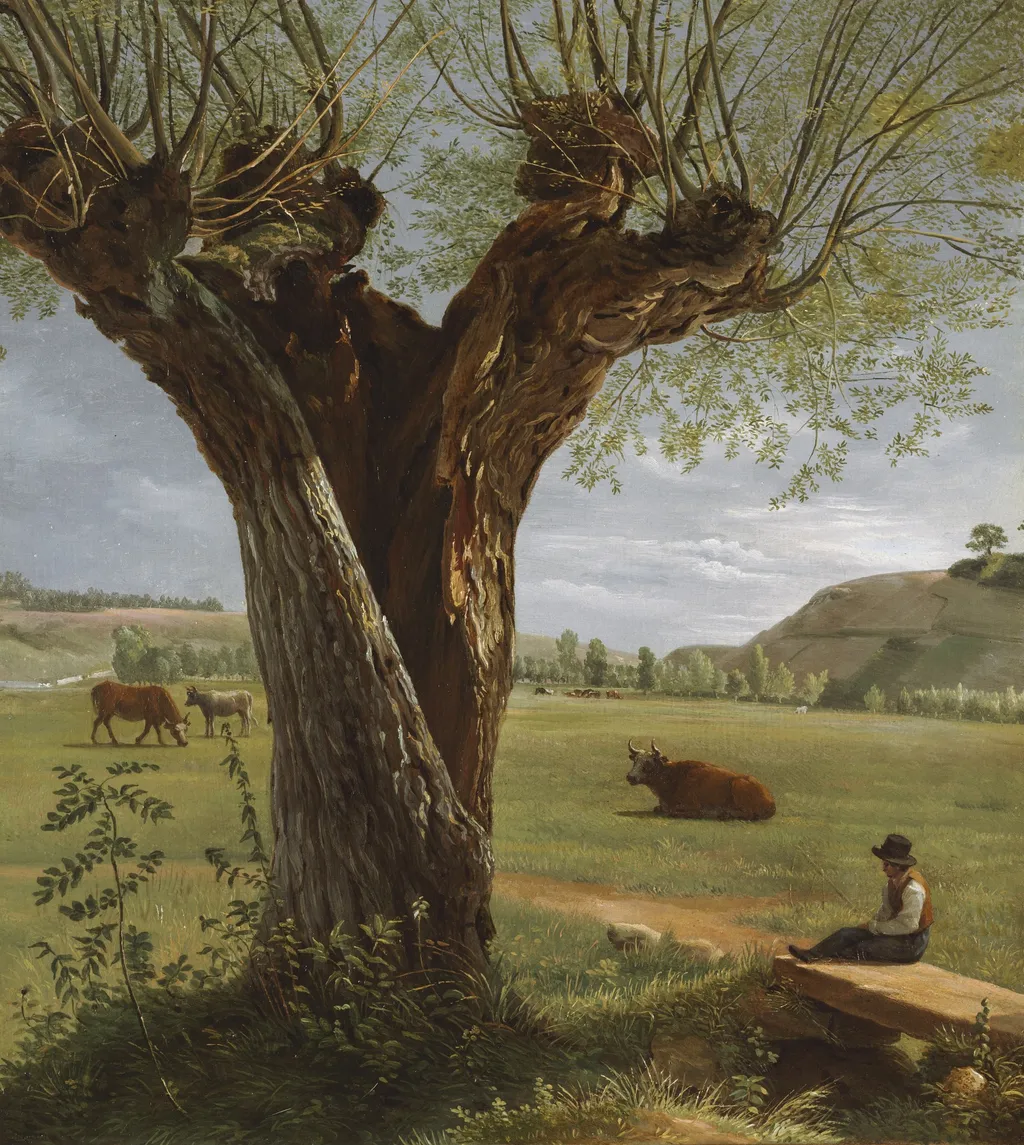
Pollard Willow is an unspecified painting by Pierre Jean Boquet. It dates from 1804 and is held in the collection of the Cleveland Museum of Art.
About this work
Overview
Created in 1804 by French painter Pierre‑Jean Boquet, *Pollard Willow* is an oil composition that presents a quiet rural scene centered on a contorted willow tree. The work is part of the permanent collection of the Cleveland Museum of Art, where it remains on display as an example of early‑19th‑century landscape painting.
Subject & Meaning
The canvas foregrounds a gnarled willow whose sweeping branches frame a solitary figure seated on a bench, suggesting a moment of repose. Beyond the tree, a low field with grazing cattle and a distant hill extends the vista, evoking a harmonious relationship between humanity and the pastoral environment.
Technique & Style
Boquet employs a restrained palette of muted greens, browns, and earth tones, allowing subtle tonal shifts to model form. Delicate chiaroscuro renders the tree’s bark and foliage with depth, while soft brushwork conveys the atmospheric haze of the background, creating a sense of stillness without overt detail.
History & Provenance
The painting entered the Cleveland Museum of Art’s holdings through a mid‑20th‑century acquisition, though its earlier ownership record is limited. Since its arrival, it has been referenced in scholarly surveys of French landscape art as a representative work of Boquet’s oeuvre.
Context
*Pollard Willow* reflects the early Romantic interest in nature’s quiet grandeur, a trend prevalent in French art after the Revolution. Boquet’s focus on a single, twisted tree aligns with contemporary explorations of individual natural forms as symbols of resilience and contemplation.
Own this work as a print
Artist & collection
