Artwork
Netherlandish Proverbs
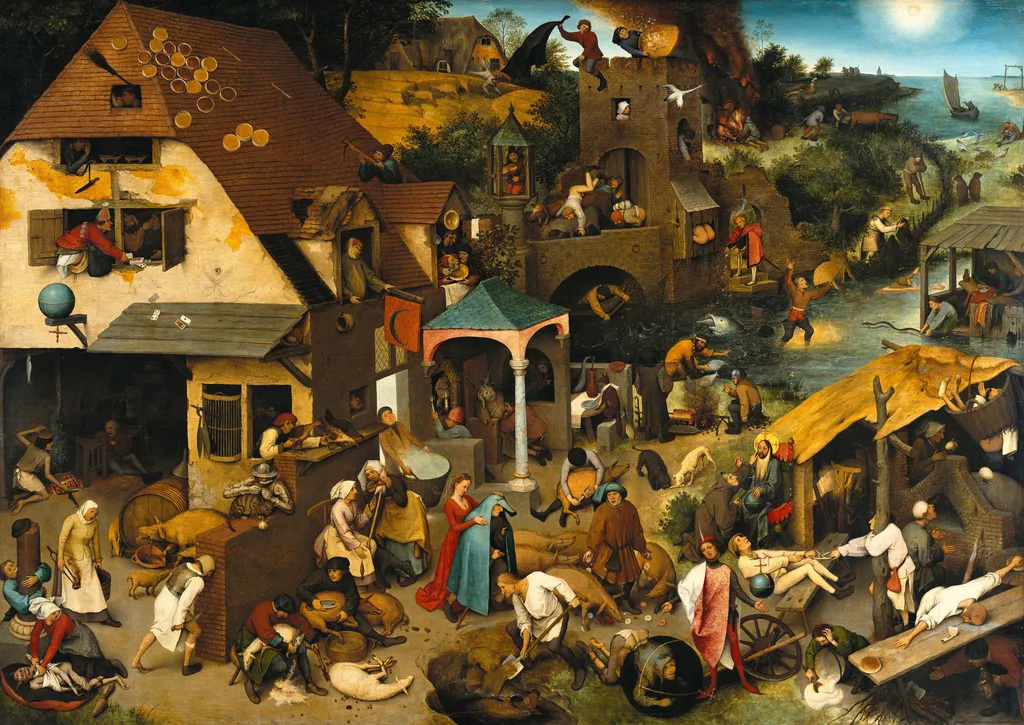
Netherlandish Proverbs is an oil painting by the Northern Renaissance artist Pieter Brueghel the Elder. It dates from 1559 and is held in the collection of the Gemäldegalerie Berlin.
About this work
Overview
Pieter Bruegel the Elder’s 1559 oil painting on oak, commonly known as Netherlandies Proverbs, presents a bustling village tableau where dozens of figures enact literal versions of contemporary Dutch sayings. The work functions as a visual catalogue of human folly, populated by ordinary activities and absurd incidents that together illustrate the era’s popular proverbs.
Subject & Meaning
Each vignette in the composition translates a proverb into a concrete scene—such as a man with his head lodged in a bucket or another being lowered into a barrel—highlighting the foolishness and moral shortcomings Bruegel associated with everyday life. The recurring use of featureless, almost mask‑like faces underscores the notion that the depicted characters represent universal types of folly rather than specific individuals.
Technique & Style
Executed in oil on a single oak panel, the painting employs Bruegel’s characteristic dense, panoramic perspective, filling the surface with minute, narrative details. The muted palette and careful modeling of figures contrast with the lively, almost comic actions, while the inclusion of thatched cottages, a windmill, and a variety of animals creates a coherent, yet bustling, rural setting.
History & Provenance
The original panel resides in Berlin’s Gemäldegalerie. Bruegel’s son, Pieter Brueghel the Younger, produced at least sixteen replicas, each varying slightly in the selection of proverbs and minor compositional elements. These copies, along with later versions, have entered numerous museum collections, extending the work’s visibility beyond its initial Flemish context.
Context
Created during the mid‑16th century, the painting reflects a broader Netherlandish interest in didactic imagery and the moralizing tradition of proverb literature. Bruegel’s focus on absurd and wicked behavior aligns with his other works that critique social customs, positioning the piece within a lineage of genre painting that blends observation with allegorical commentary.
Own this work as a print
Artist & collection
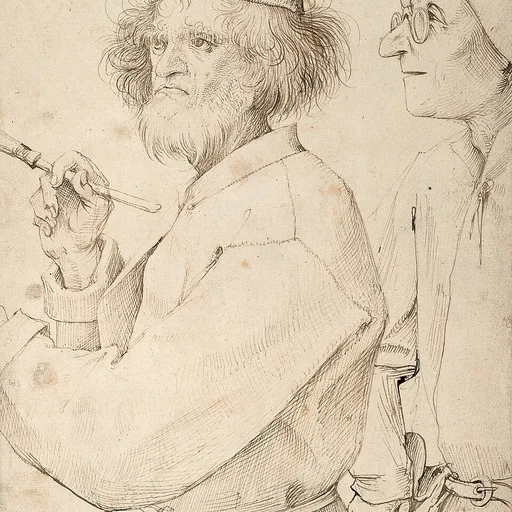
Artist
Pieter Bruegel (also Brueghel or Breughel) the Elder ( BROY-gəl, US also BROO-gəl; Dutch: ; c.