Artwork
Two Chained Monkeys
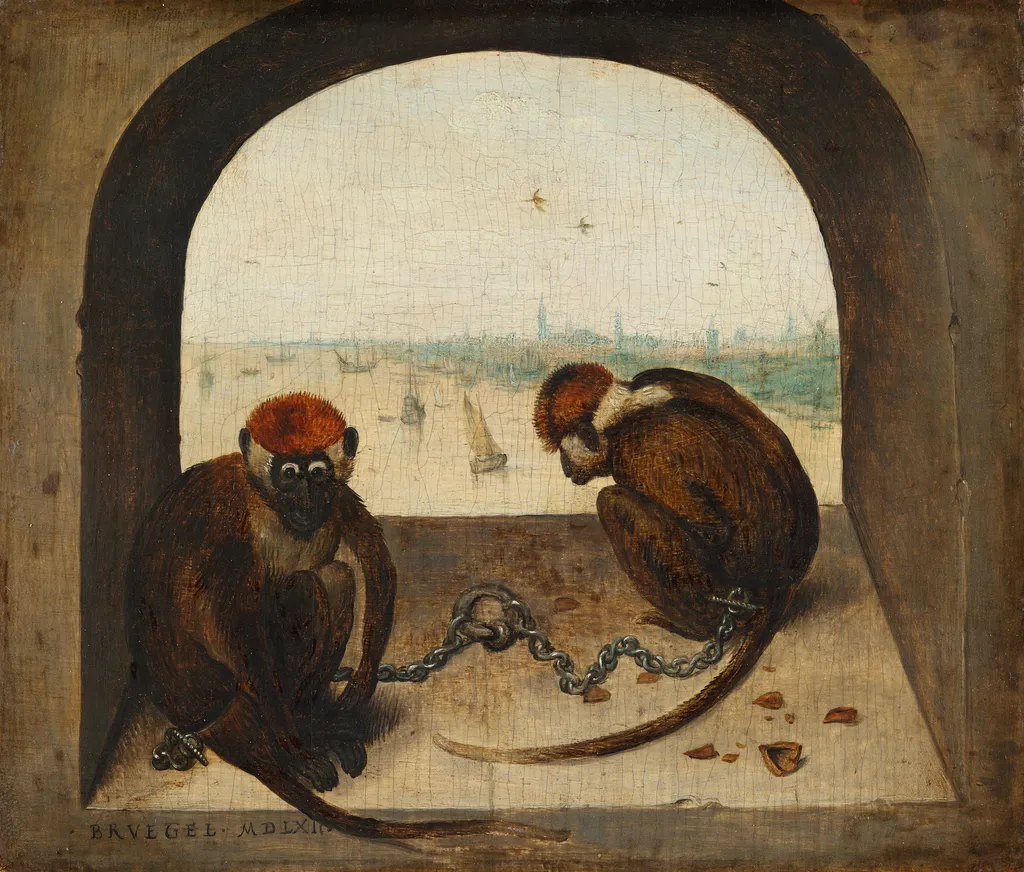
Two Chained Monkeys is an oil painting by the Northern Renaissance artist Pieter Brueghel the Elder. It dates from 1562 and is held in the collection of the Gemäldegalerie Berlin.
About this work
Overview
Created in 1562, *Two Chained Monkeys* is an oil painting by the Dutch‑Flemish Renaissance painter Pieter Bruegel the Elder. The work measures a modest size and is presently displayed in the Gemäldegalerie of the Berlin State Museums. Its composition centers on two brown monkeys with striking red fur, confined within a dark, arched frame that isolates them from a muted landscape beyond.
Subject & Meaning
The canvas presents a pair of monkeys bound to a wooden ledge by heavy chains. One animal gazes down at a broken nut shell, while the other leans forward, its chain coiled around the same support. The inclusion of the cracked shell and the restrained creatures has been interpreted as a visual allegory on the limits of freedom and the folly of excess, themes common in Bruegel’s moralizing scenes.
Technique & Style
Fine brushwork details the texture of the chains and the cracked shell, adding a tactile realism that balances the painting’s symbolic content.
Bruegel employs a limited palette of earthy browns contrasted with vivid reds to make the primates stand out against the dim interior. The forms are rendered with simple, rounded shapes, and the chiaroscuro of the dark frame heightens the sense of confinement. Fine brushwork details the texture of the chains and the cracked shell, adding a tactile realism that balances the painting’s symbolic content.
History & Provenance
After its creation in the mid‑16th century, the painting entered various private collections before being acquired by the Berlin State Museums in the early 20th century. It has remained in the Gemäldegalerie since, where it is catalogued among Bruegel’s lesser‑known works that explore animal subjects as moral symbols.
Context
*Two Chained Monkeys* belongs to a period when Bruegel frequently depicted everyday life and peasant scenes enriched with allegorical detail. While most of his oeuvre focuses on human activity, this work reflects his interest in using animal figures to comment on human behavior, a practice also evident in contemporaneous Northern Renaissance art.
Artist & collection
Artist
Pieter Bruegel (also Brueghel or Breughel) the Elder ( BROY-gəl, US also BROO-gəl; Dutch: ; c.