Artwork
Portrait of a Painter
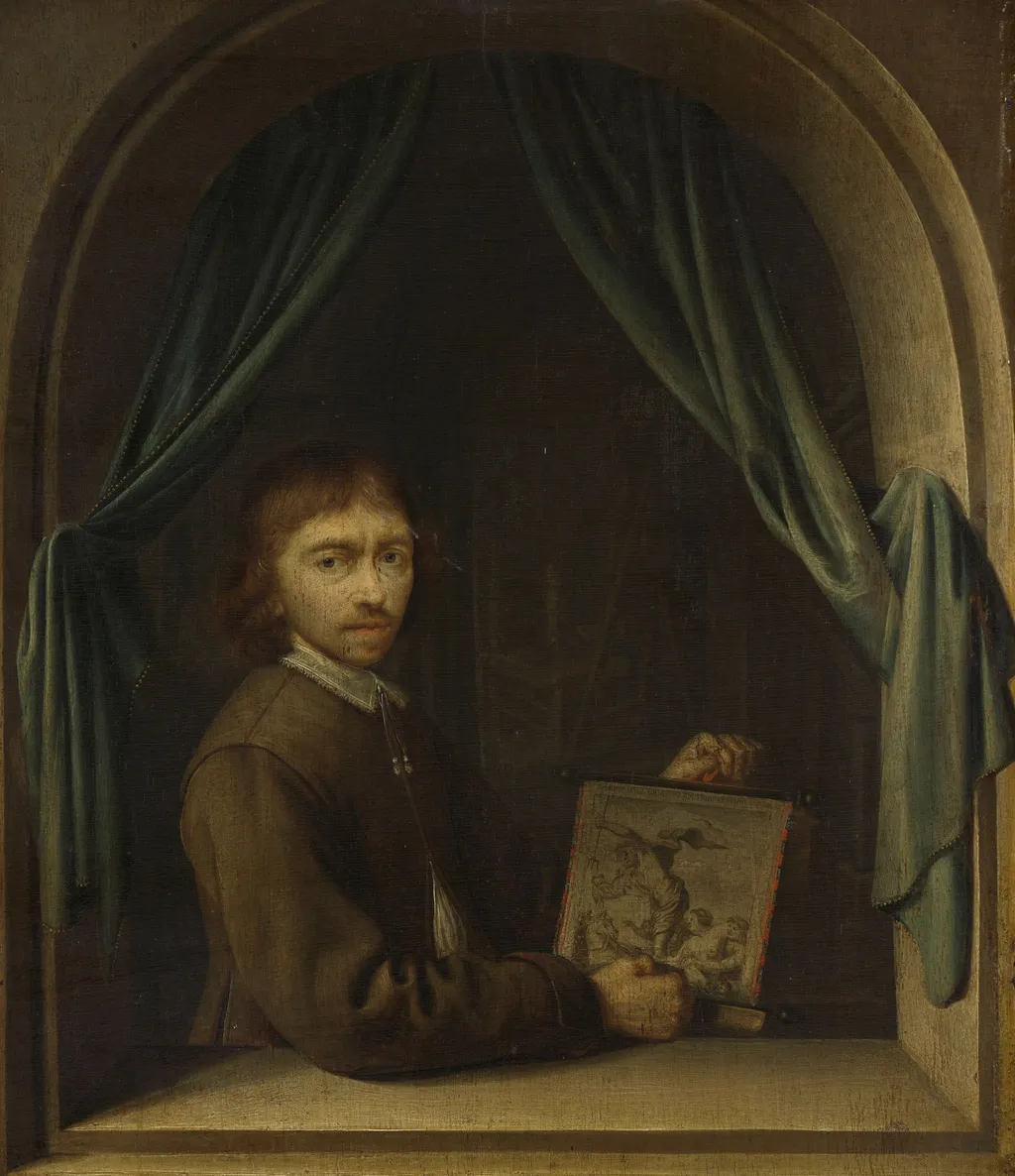
Portrait of a Painter is an oil painting by the Dutch Golden Age artist Pieter Cornelisz. van Egmondt. It dates from 1655 and is held in the collection of the Rijksmuseum. Created in 1655, this oil painting by Pieter Cornelisz.
About this work
Overview
Created in 1655, this oil painting by Pieter Cornelisz. van Egmondt is a portrait of a painter that now belongs to the Rijksmuseum’s collection. The work presents a solitary figure seated in a subdued interior, illuminated by a soft, directional light that emphasizes the sitter’s features and the objects surrounding him.
Subject & Meaning
The sitter, a man with curly red hair and a dark brown jacket trimmed with a white collar, holds an open book while his other arm rests on a windowsill. A small framed sketch on the sill depicts a figure in a dramatic pose, suggesting the subject’s engagement with artistic study and the act of creation itself.
Technique & Style
Van Egmondt employs chiaroscuro, using deep shadows in the corners of the room to contrast with the illuminated face and hands of the figure. The brushwork is smooth in the rendering of fabric and skin, while the background curtains are suggested with broader strokes, creating a sense of depth and atmospheric tension.
History & Provenance
The painting was executed in the mid‑seventeenth century and has remained in Dutch collections, eventually entering the Rijksmuseum. Documentation traces its ownership through several private hands before its acquisition by the museum, where it has been displayed as part of the institution’s Dutch Golden Age holdings.
Context
The work reflects the period’s interest in portraying artists at work, a genre that highlighted the intellectual status of painters. By situating the sitter amid books, sketches, and a study space, van Egmondt aligns the portrait with contemporary notions of the painter as a learned professional rather than a mere craftsman.
Artist & collection
Artist
This Dutch artist painted portraits in the mid-1600s, a time when artists were busy capturing the faces of traders, scholars, and artists themselves.
