Artwork
Italian Landscape
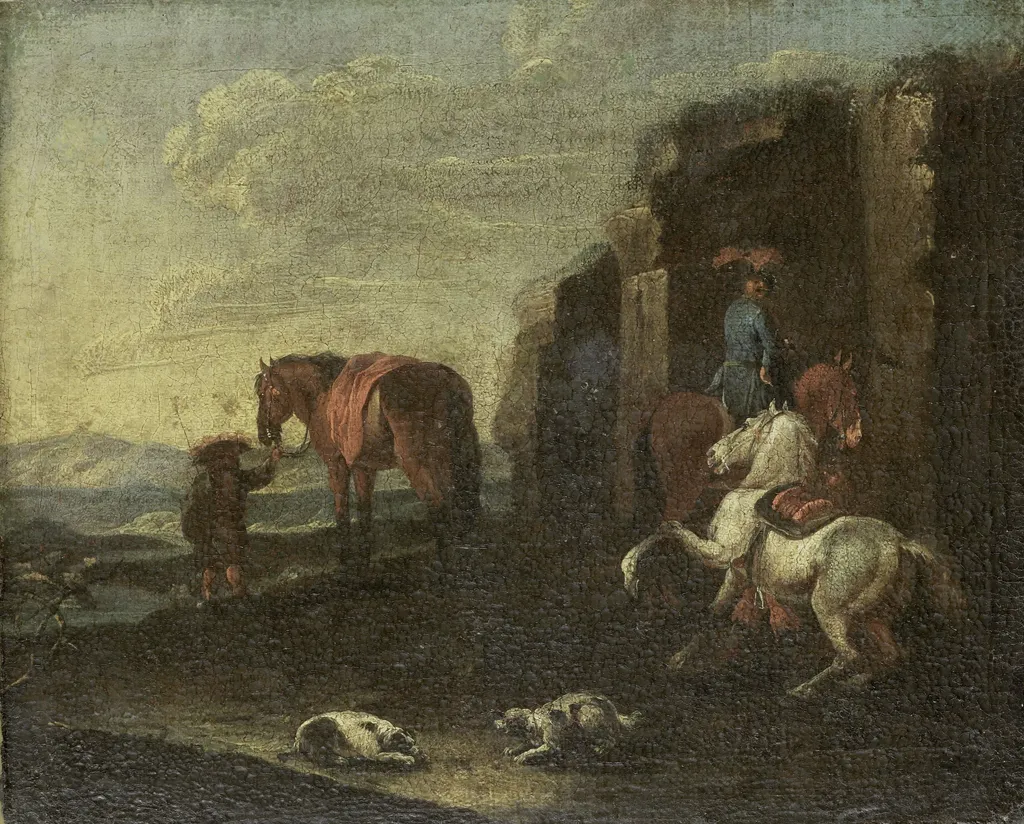
Italian Landscape is an oil painting by the Flemish Baroque painting artist Pieter van Bloemen. It dates from 1710 and is held in the collection of the Rijksmuseum.
About this work
Overview
Italian Landscape, painted in 1710 by Flemish artist Pieter van Bloemen, is an oil on canvas that depicts a tranquil rural setting. The composition centers on three horses, two of which are draped in blankets while the third is ridden by a figure in dark attire. A dog lies in the foreground and another small dog rests nearby, all set against a rocky backdrop illuminated by a subtle sky glow.
Subject & Meaning
The work combines elements of everyday life and pastoral leisure, presenting a quiet moment in the countryside. The presence of the rider, the horses, and the dogs suggests a scene of travel or a temporary stop, while the surrounding landscape conveys a sense of calm and natural simplicity.
Technique & Style
Executed in the Flemish Baroque tradition, van Bloemen employs a muted palette of soft, earthy tones and employs loose, textured brushwork to convey depth. Light is applied unevenly, creating contrasts of brightness and shadow that enhance the three‑dimensionality of the figures and the terrain.
History & Provenance
Part of van Bloemen’s series of Italianate landscapes, the painting reflects his interest in combining northern European detail with southern scenery. It entered the collection of the Rijksmuseum, where it remains part of the museum’s holdings of 17th‑ and 18th‑century Dutch and Flemish art.
Own this work as a print
Artist & collection
Artist
Pieter van Bloemen, also known as Standaart (bapt. 17 January 1657 – 6 March 1720), first name also spelled Peter or Peeter, was a Flemish painter, draughtsman and printmaker. He was a gifted landscape and animal artist…
