Artwork
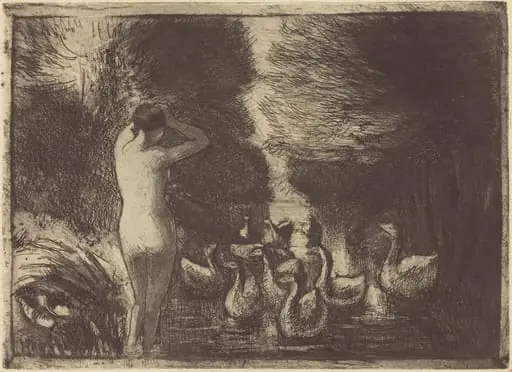
Baigneuses, gardeuses d'oies (Bathers Tending Geese)
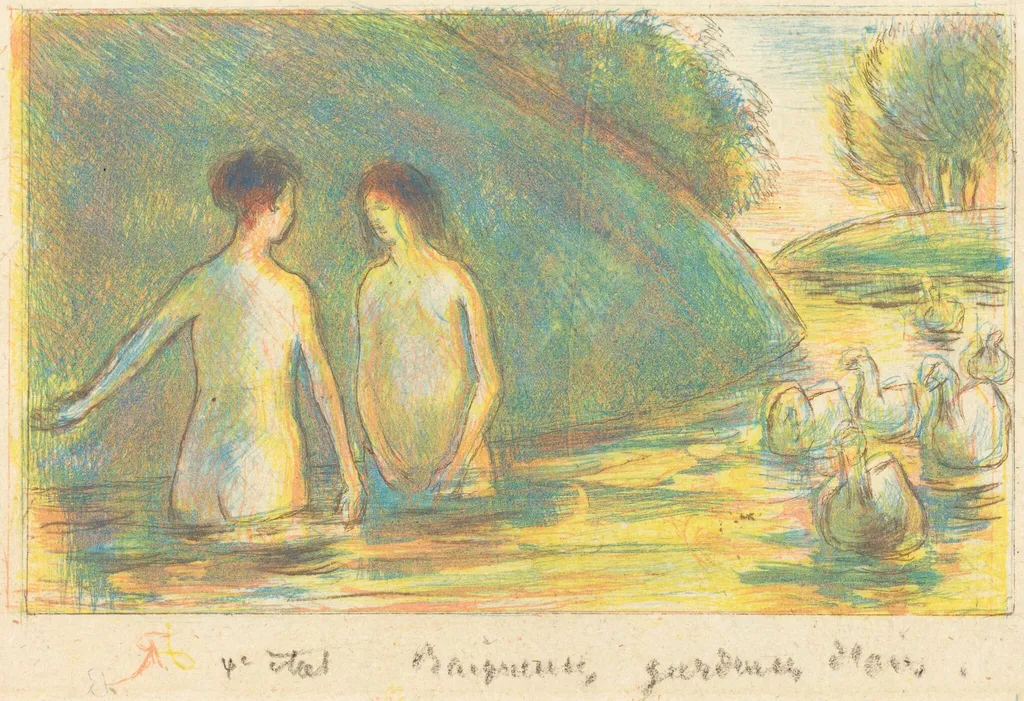
Baigneuses, gardeuses d'oies (Bathers Tending Geese) is an ink print by the Impressionist artist Camille Pissarro. It dates from 1895 and is held in the collection of the National Gallery of Art.
About this work
Overview
Camille Pissarro’s print *Baigneuses, gardeuses d’oies* (Bathers Tending Geese), executed around 1895, is a color work that combines etching, dry‑point and aquatint. The image presents a riverside scene in which several women, dressed in long flowing garments, guide a flock of geese.
Subject & Meaning
The composition depicts a quiet, pastoral activity: the figures appear to be tending the birds rather than bathing, suggesting a moment of everyday labor set within a natural landscape. The calm demeanor of the geese and the orderly arrangement of the women convey a sense of controlled harmony rather than wild spontaneity.
Technique & Style
Pissarro employs three printmaking processes. Etching creates the primary line work through acid‑etched incisions, while dry‑point adds a softer, burr‑rich edge by directly scratching the plate. Aquatint supplies broad, watercolor‑like tonal areas, allowing subtle gradations of light across the women’s dresses and the water’s surface.
History & Provenance
Produced in the mid‑1890s, the work belongs to Pissarro’s later period when he explored color printmaking more intensively. It reflects his continued interest in rural life, yet the staged quality indicates a studio conception rather than a direct plein‑air observation.
Context
Although Pissarro is renowned for his outdoor scenes, this print merges his landscape focus with a genre scene of domestic labor. The tranquil riverbank and the orderly flock echo the artist’s broader concern with the rhythms of agrarian society during the late nineteenth century.
Artist & collection