Artwork
Portrait of August Allebé
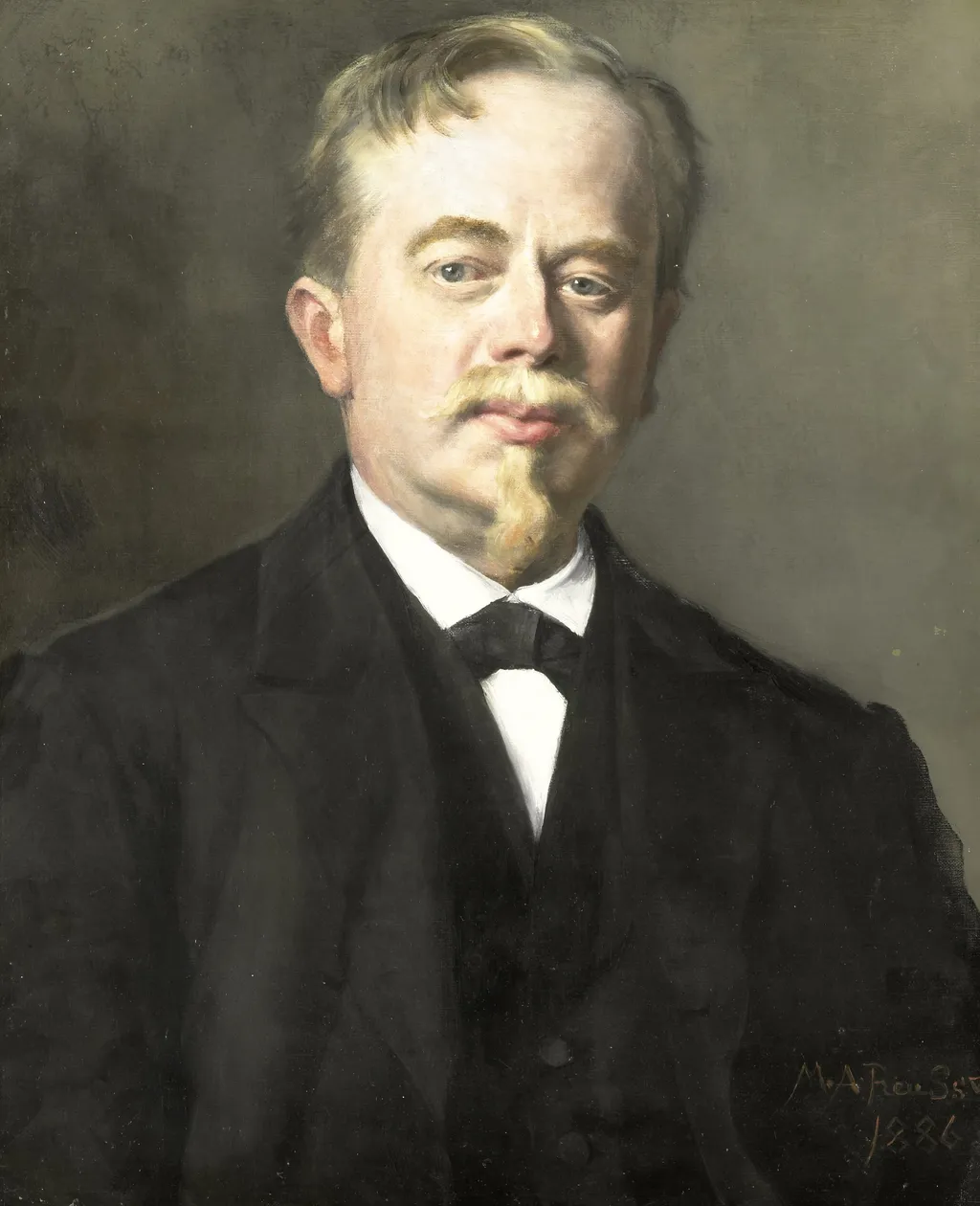
Portrait of August Allebé is an oil painting by the Impressionist artist Princess Marie Alexandrine of Saxe-Weimar-Eisenach. It dates from 1894 and is held in the collection of the Rijksmuseum.
About this work
Overview
Created in 1894, this oil portrait presents August Allebé, a noted figure in Dutch art, rendered by Princess Marie Alexandrine of Saxe‑Weimar‑Eisenach. The work is part of the Rijksmuseum’s collection, where it remains on display as an example of late‑19th‑century portraiture executed by a member of European royalty.
Subject & Meaning
The sitter, August Allebé, appears in a formal dark suit with a crisp white shirt and a black bow tie, his light hair neatly swept back and his facial hair full. His expression is composed and somewhat austere, suggesting the dignified bearing expected of an academic leader and reflecting his status within the artistic community of his time.
Technique & Style
Executed in oil, the portrait employs a restrained palette that emphasizes the sitter’s features against a plain, dark background. Brushwork is soft yet discernible, particularly around the cheekbones and forehead, lending subtle modeling to the face while maintaining a clear, realistic representation characteristic of academic portraiture in the 1890s.
History & Provenance
The painting was commissioned by Princess Marie Alexandrine of Saxe‑Weimar‑Eisenach, who was an amateur artist with a keen interest in the visual arts. After its completion, the work entered the collection of the Rijksmuseum, where it has been conserved and exhibited as part of the museum’s holdings of Dutch portraiture.
Context
At the turn of the century, portraiture served both as a record of cultural figures and as a means of reinforcing social hierarchies. This piece aligns with that tradition, depicting a leading art educator in a formal pose that underscores his professional authority while also reflecting the patronage of aristocratic artists like the princess.
Own this work as a print
Artist & collection
Artist
Princess Marie Alexandrine of Saxe-Weimar-Eisenach
She preferred paint to palace balls and kept a messy studio in The Hague, where she painted well into her seventies.
