Artwork
H Beard Print Collection
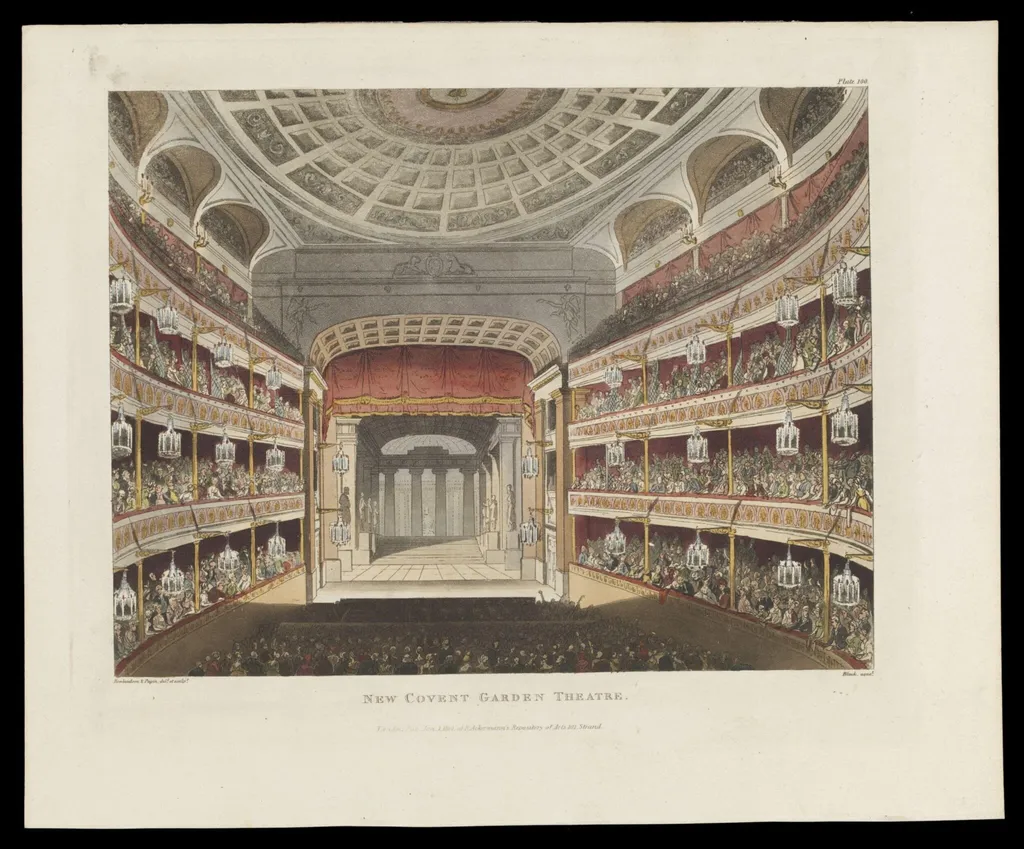
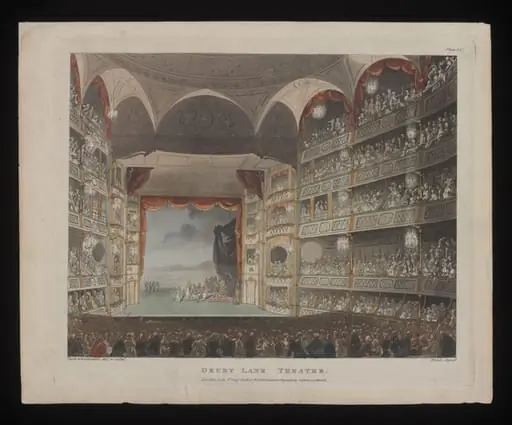
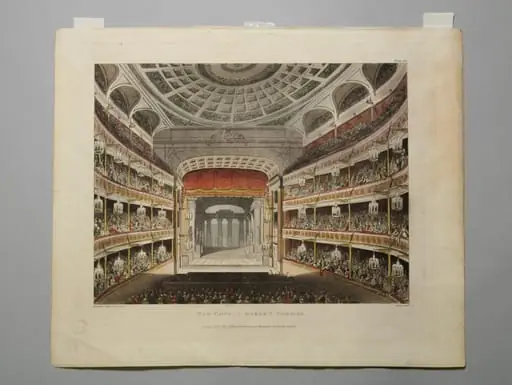
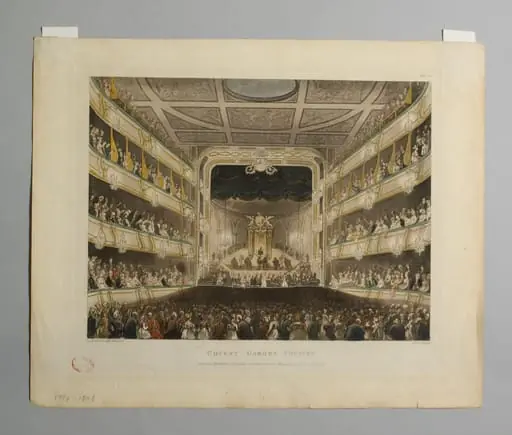
H Beard Print Collection is a print by the Romanticist artist Augustus Charles Pugin. It dates from 1 and is held in the collection of the Victoria and Albert Museum. This black-and-white print offers a detailed interior view of the New Covent Garden Theatre, completed in 1810.
About this work
It captures the rows of seats and the stage’s shape, just as people saw it then.
This print shows the inside of a theater built in 1810. It’s a black-and-white image made by a French artist who lived in Britain. The theater’s name is New Covent Garden.
The print was published by Rudolph Ackermann, a popular printseller in London. It captures the rows of seats and the stage’s shape, just as people saw it then.
Look up the Victoria and Albert Museum to see more prints like this.
Overview
This black-and-white print offers a detailed interior view of the New Covent Garden Theatre, completed in 1810. Published by Rudolph Ackermann, a prominent London printseller, it was produced as part of a series documenting contemporary British architecture and public spaces. The image reflects the visual documentation practices of the era, aiming to capture the spatial arrangement and social atmosphere of a newly opened performance venue.
Subject & Meaning
The print presents the theater’s interior as a space of public gathering, with tiered seating arranged around a proscenium stage. It reveals the hierarchical structure of audience seating, from the pit to the galleries, reflecting social stratification in early 19th-century entertainment culture. The absence of performers emphasizes the architecture itself as the subject, inviting viewers to consider the theater as a civic institution.
Technique & Style
Executed in a precise linear style typical of topographical prints, the image uses fine hatching and tonal contrast to convey depth and architectural detail. Though the artist was French, the work adheres to British conventions of documentary illustration. The composition is balanced and orderly, prioritizing clarity over dramatic effect, consistent with the era’s preference for factual representation in printed media.
History & Provenance
The print was issued by Rudolph Ackermann in 1810, shortly after the theater’s opening. Ackermann’s firm specialized in high-quality engravings of London’s cultural landmarks, often sold as part of illustrated collections. The work likely circulated among middle-class patrons interested in urban life and the arts. Copies are held in institutions such as the Victoria and Albert Museum, where they form part of a broader archive of Regency-era visual culture.
Context
The New Covent Garden Theatre was one of several venues built to meet growing public demand for theatrical entertainment in early 19th-century London. Its design followed the standard proscenium-arch model, replacing an earlier structure destroyed by fire. This print aligns with a broader trend of documenting urban renewal and public spaces, reflecting both civic pride and the commercialization of visual culture during the Regency period.
Legacy
As a record of a short-lived theater—demolished in 1856—the print serves as a primary source for understanding the physical and social dimensions of early Victorian performance spaces. Its preservation in museum collections underscores its value as historical evidence rather than artistic expression. It continues to inform studies on theater architecture, audience behavior, and the role of print in shaping public memory.
Artist & collection

Artist
Augustus Charles Pugin was a French-born British artist, architectural draughtsman and writer.