Artwork
Moses and the Burning Bush
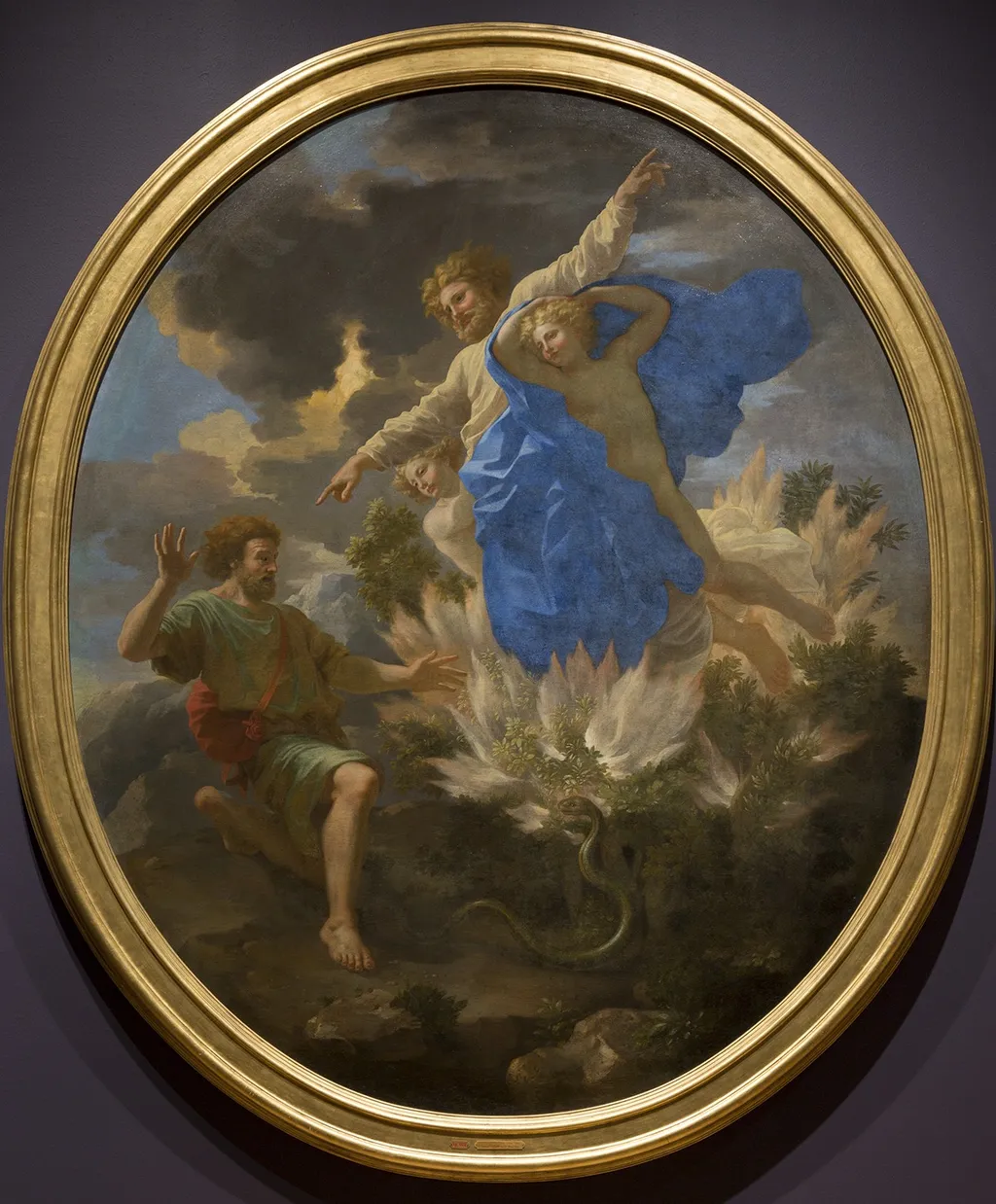
Moses and the Burning Bush is an oil painting by the Flemish Baroque painting artist Nicolas Poussin. It dates from 1641 and is held in the collection of the Statens Museum for Kunst.
About this work
Overview
Above, two winged angels hover in the sky; one points downward toward Moses, while the other extends a hand in a gesture of divine communication.
Nicolas Poussin's 'Moses and the Burning Bush,' executed in 1641, depicts the biblical moment from Exodus where God reveals himself to Moses through a bush that burns without being consumed. The composition is structured with classical clarity, placing the kneeling figure of Moses in the lower left foreground on rocky terrain. He gestures toward the miraculous bush, which glows with an intense, supernatural light that contrasts with the surrounding dark, stormy clouds. Above, two winged angels hover in the sky; one points downward toward Moses, while the other extends a hand in a gesture of divine communication. Poussin employs a restrained palette dominated by earth tones and deep blues, punctuated by the fiery oranges of the bush and the ethereal light of the divine presence. The painting exemplifies the artist's mature style during his Roman period, characterized by rigorous intellectual planning, balanced geometry, and a focus on narrative clarity over emotional excess. This work reflects Poussin's deep engagement with Stoic philosophy and his desire to elevate religious subjects through the formal principles of antiquity, establishing a standard for French classical painting.
Subject & Meaning
The painting captures the moment of divine revelation when Moses, startled and reverent, observes the miraculous flame. Two winged beings hover above, one gesturing toward the prophet and the other extending a hand, suggesting celestial guidance. The scene emphasizes the intersection of the human and the divine, underscoring themes of obedience and revelation.
Technique & Style
Poussin employs a pronounced chiaroscuro, contrasting the bright, almost supernatural glow of the bush with the surrounding darkness and stormy clouds. Figures are rendered in flowing robes of blue, green, and gold, their drapery modeled with careful gradations of light. The composition balances dramatic illumination with a controlled, classical arrangement typical of the artist’s mature period.
History & Provenance
Painted in the early 1640s, the work entered the Statens Museum for Kunst’s holdings in the 20th century, though earlier ownership records are sparse. Its presence in a national museum underscores its value as a representative example of Poussin’s religious narrative paintings.
Context
The subject derives from Exodus, where God appears to Moses in a bush that burns yet remains intact. Poussin, a leading figure of French classicism, often revisited biblical stories, infusing them with rational composition and measured emotion. This piece reflects the period’s interest in dramatizing scriptural moments through controlled theatricality.
Artist & collection
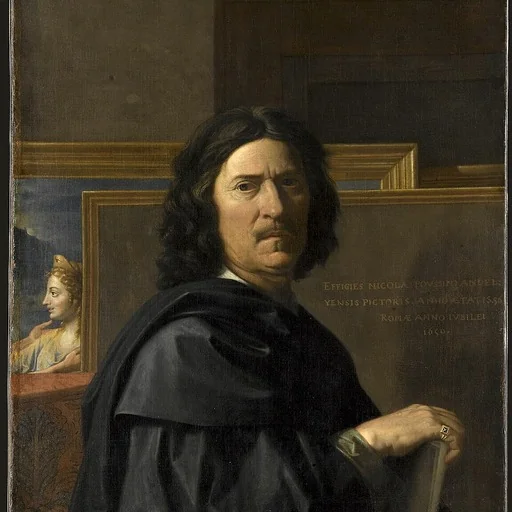
Artist
Nicolas Poussin (UK: , US: , French: ; June 1594 – 19 November 1665) was a leading painter of the classical French Baroque style, although he spent most of his working life in Rome.