Artwork
Archäologe in der Kirche von Valeria
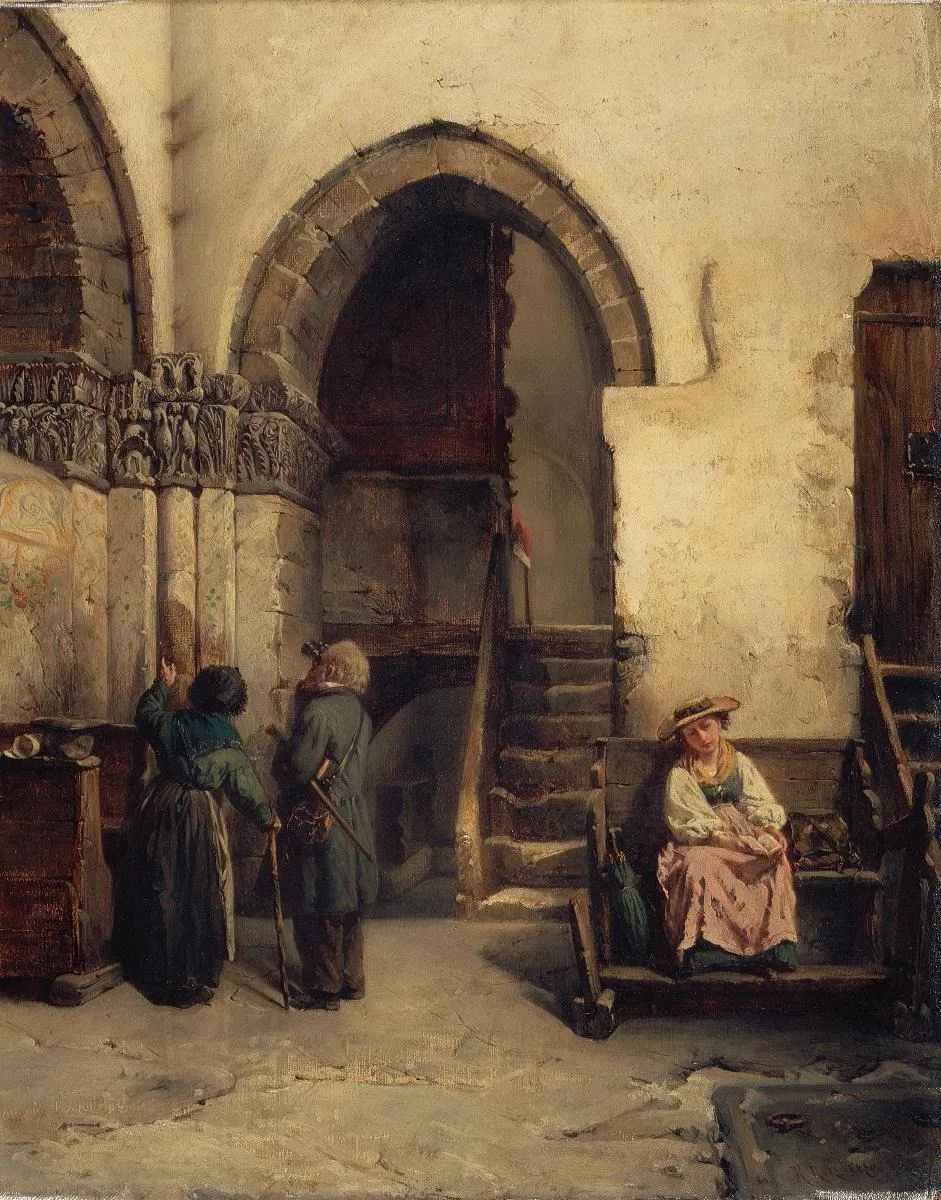
Archäologe in der Kirche von Valeria is an oil painting by Rafael Ritz. It dates from 1870 and is held in the collection of the Kunsthaus Zürich.
About this work
Overview
Ritz, associated with the Düsseldorf School and known for his detailed depictions of Alpine life, rendered the scene with quiet precision.
Painted in 1870 by Swiss artist Rafael Ritz, this oil-on-canvas work portrays an archaeologist within the interior of a historic church. Ritz, associated with the Düsseldorf School and known for his detailed depictions of Alpine life, rendered the scene with quiet precision. The painting resides in the Kunsthaus Zürich collection, reflecting its significance in 19th-century Swiss art. Its subdued tone and architectural focus align with the period’s interest in scholarly and historical subjects.
Subject & Meaning
The scene centers on a solitary archaeologist, possibly engaged in study or documentation, surrounded by figures in period attire. The setting—a stone-walled church—suggests a space where antiquity and faith intersect. The figures’ stillness and the absence of dramatic action convey contemplation rather than spectacle. The work implies a reverence for historical inquiry, positioning the archaeologist as a quiet witness to layered cultural heritage.
Technique & Style
Ritz employed careful brushwork to render the texture of aged stone and the soft fall of ambient light across surfaces. Subtle gradations in tone, particularly on faces and architectural details, suggest an awareness of chiaroscuro without overt theatricality. The palette is restrained, dominated by earth tones and pale stone hues, reinforcing the calm, introspective mood. Details in clothing and stonework are rendered with observational accuracy, typical of the Düsseldorf School’s emphasis on realism.
History & Provenance
Rafael Ritz, born in Brig in 1829 and active in the Swiss Alps, completed this work during a period when archaeological interest was growing in Europe. The painting entered the Kunsthaus Zürich collection in the late 19th or early 20th century, likely through acquisition or donation. Its preservation reflects institutional recognition of Ritz’s contribution to Swiss genre painting, though it remains less widely known than his Alpine landscapes.
Context
In the late 19th century, European intellectuals increasingly turned to archaeology as a means of understanding national and cultural identity. Churches, as repositories of ancient artifacts and architecture, became symbolic sites of historical continuity. Ritz’s depiction aligns with this trend, portraying scholarly activity within sacred spaces—a quiet nod to the intersection of faith, history, and emerging scientific inquiry in post-Enlightenment Europe.
Legacy
Though Ritz is better known for his landscapes, this painting offers a rare glimpse into his engagement with intellectual themes. It remains a quiet example of how Swiss artists contributed to broader European discourses on heritage and preservation. Its presence in a major Swiss museum ensures its continued accessibility, serving as a reference for studies on 19th-century genre painting and the visual culture of archaeology.
Artist & collection
Artist
Maria Joseph Franz Anton Raphael Ritz, nicknamed Alpen-Raphael or Walliser-Raphael (17 January 1829, in Brig, Canton of Valais – 11 April 1894, in Sion) was a Swiss genre and landscape painter, associated with the Düsseldorf School.