Artwork
Three Horses and Four Grooms

Three Horses and Four Grooms is an unspecified painting by the Ming dynasty painting artist Ren Renfa. It dates from 1324 and is held in the collection of the Cleveland Museum of Art.
About this work
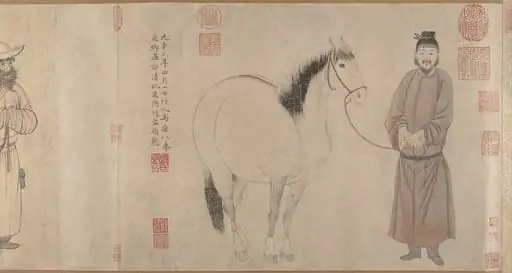
You see three horses standing close together, each a different color, while four grooms in loose robes hold their reins.
You see three horses standing close together, each a different color, while four grooms in loose robes hold their reins.
Ren Renfa worked for the Mongol court, so these horses aren’t just animals—they’re symbols of power and status. The painting mixes careful brushwork with a sense of movement, like the horses could step forward any moment.
If you like this, look up *china, yuan dynasty (1271-1368)* to see more art from this time.
Overview
Three Horses and Four Grooms, a Yuan‑dynasty painting by Ren Renfa, portrays three differently coloured horses standing together while four attendants in loose robes hold their reins. Executed in ink and subtle colour, the composition balances a compact grouping of figures with a sense of latent motion, suggesting the horses could step forward at any moment.
Subject & Meaning
The work presents horses not merely as animals but as emblems of elite authority, reflecting Ren’s service to the Mongol court. The presence of multiple grooms underscores the logistical care required for such prized mounts, reinforcing the association between equine power and the status of their owners.
Technique & Style
Ren draws on the revivalist trends championed by Zhao Mengfu, echoing the Song master Li Gonglin’s structural approach to equine form. The delicate colouration of the horses follows the Tang tradition of Han Gan, while the brushwork combines precise line with a fluid handling that conveys both solidity and potential movement.
History & Provenance
Ren Renfa (c. 1254‑1327) was a court painter under the Mongol Yuan dynasty, a period when Chinese scholars sought to re‑engage antiquarian aesthetics. The painting likely originated as a court commission, intended to display the power of the ruling elite through the visual language of prized horses.
Context
Created during a time when Yuan artists revived earlier Song and Tang models, the piece reflects a broader intellectual effort to reconcile native Chinese artistic heritage with the tastes of the Mongol rulers. Its synthesis of scholarly tradition and courtly symbolism illustrates the cultural hybridity characteristic of Yuan visual culture.
Artist & collection

Artist
Ren Renfa (1254–1327), courtesy name Ziming (子明), pseudonym Yueshan Daoren, was an expert of irrigation works, artist, and a government official of the Yuan dynasty. He was born in Qinglong Town, Songjiang.