Artwork
The Layette
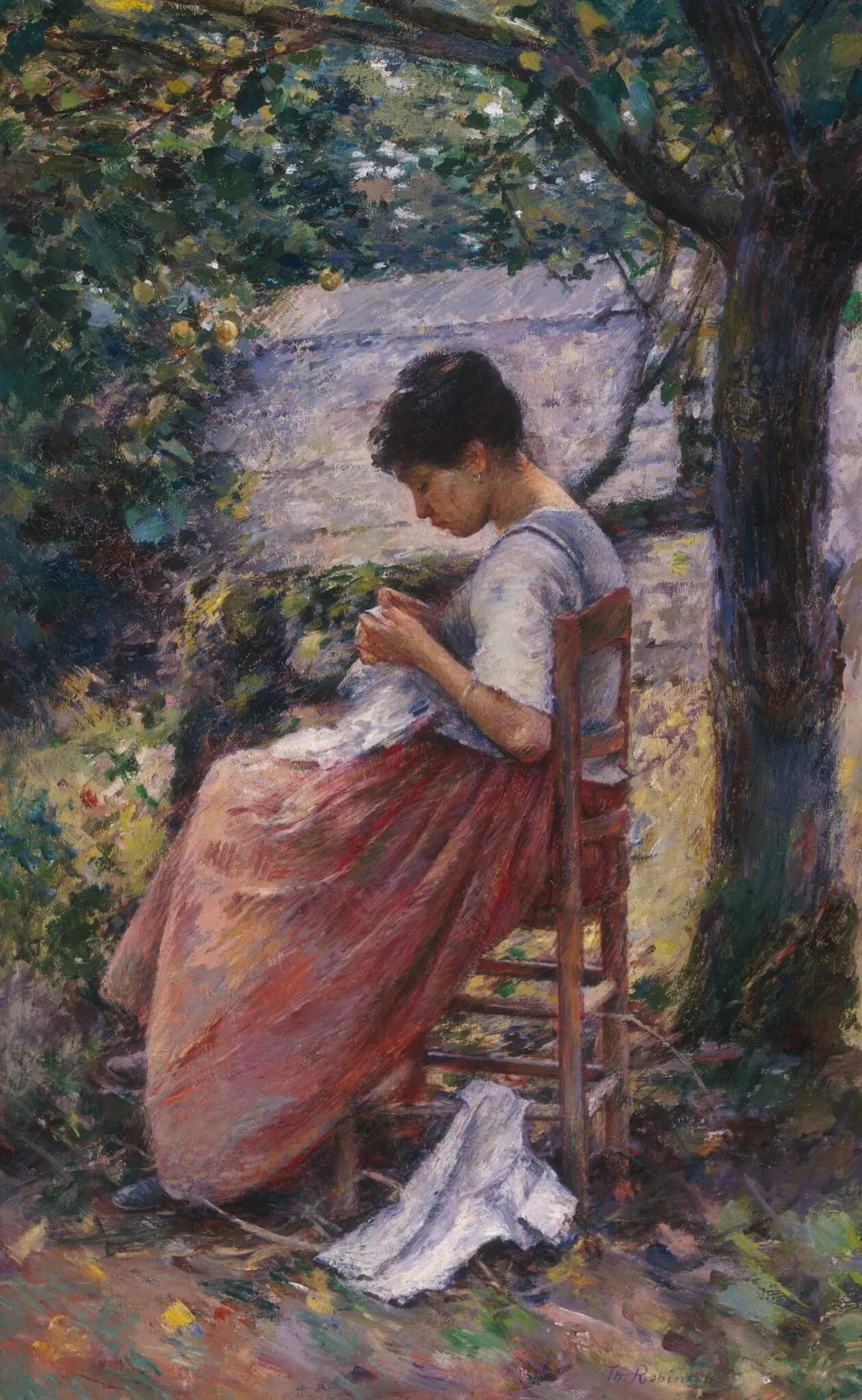
The Layette is an oil painting by the American Impressionist artist Theodore Robinson. It dates from 1892 and is held in the collection of the National Gallery of Art.
About this work
Overview
The Layette, painted by Theodore Robinson in 1892, is a significant example of American Impressionism that merges domestic intimacy with an outdoor setting.
The Layette, painted by Theodore Robinson in 1892, is a significant example of American Impressionism that merges domestic intimacy with an outdoor setting. The work depicts a woman seated on a wooden chair amidst lush greenery, engaged in the meticulous task of sewing a white garment, likely part of a layette for an infant. She wears a white blouse and a long reddish-brown skirt, her dark hair pulled back as she concentrates on her needlework. Robinson executes the scene with the characteristic loose brushwork and attention to light effects associated with the Impressionist movement, capturing the dappled sunlight filtering through the foliage onto the figure and the fabric. Created during the height of Robinson's career, shortly after his time studying in France under Monet, the painting reflects his ability to translate the French Impressionist aesthetic into an American context. The composition balances the stillness of the domestic chore with the vibrancy of the natural environment, avoiding rigid academic formalism in favor of a spontaneous, atmospheric approach. This work stands as a testament to Robinson's role in introducing Impressionist techniques to the United States, focusing on the quiet dignity of everyday life rendered through a modern, light-filled lens.
Subject & Meaning
The work captures a moment of focused labor, emphasizing the intimacy of personal craft amid nature. The woman's absorbed posture and the modest setting suggest themes of diligence and the harmony between everyday activity and the surrounding environment, inviting viewers to reflect on the quiet dignity of ordinary tasks.
Technique & Style
Robinson employs muted tones and soft brushwork to convey the subtle interplay of light and shadow on foliage and fabric. The delicate handling of color and the precise rendering of textures—such as the sheen of the woman's clothing and the leafy backdrop—demonstrate his careful observation of atmospheric effects.
History & Provenance
Created by American painter Theodore Robinson in 1892, The Layette reflects his interest in integrating domestic subjects with Impressionist sensibilities. While specific ownership records are limited, the painting remains a representative example of Robinson’s late‑19th‑century oeuvre, illustrating his development of a nuanced, naturalistic approach to genre scenes.
Own this work as a print
Artist & collection