Artwork
The port of Kos
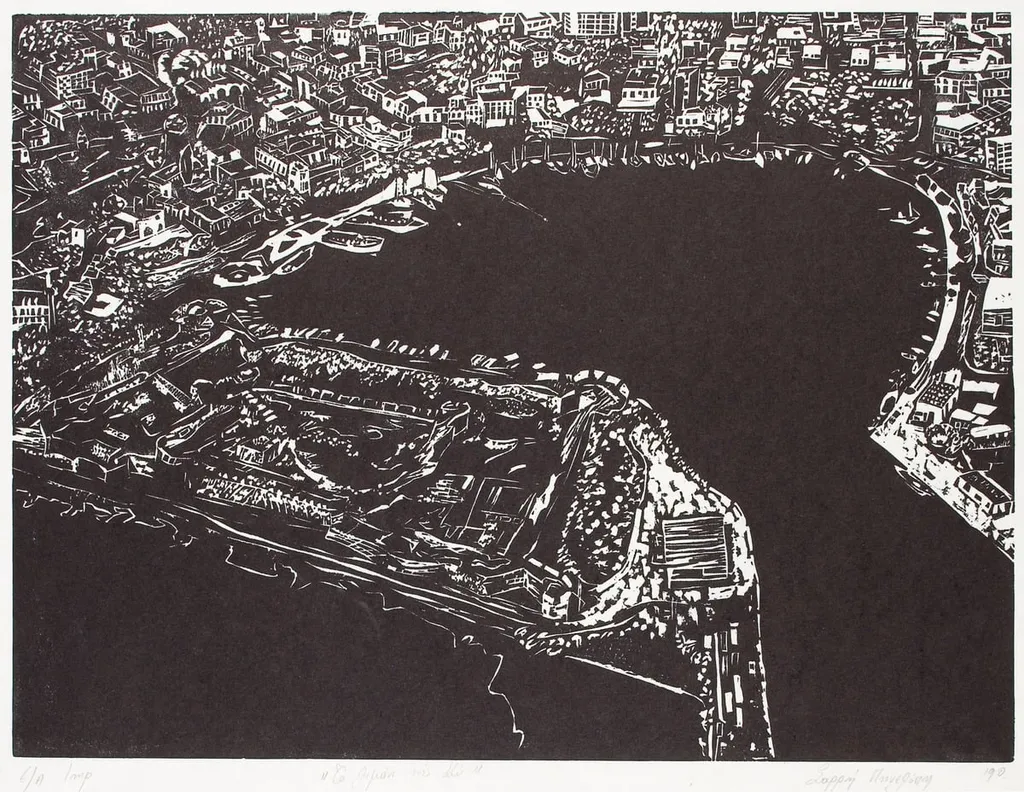
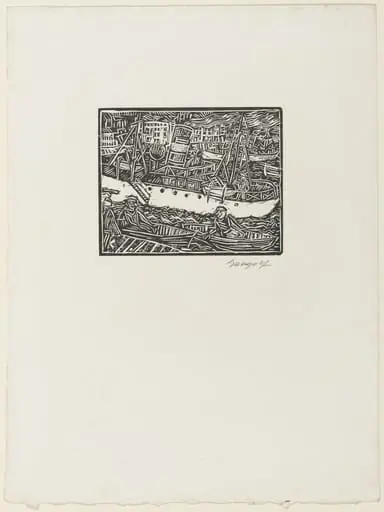
The port of Kos is a print by Sarri Penelope. It is held in the collection of the Athens School of Fine Arts. This black-and-white print depicts the harbor town of Kos from an elevated perspective.
About this work
Overview
The composition emphasizes architectural density, with tightly packed buildings lining the shore and narrow pathways weaving between them.
This black-and-white print depicts the harbor town of Kos from an elevated perspective. The composition emphasizes architectural density, with tightly packed buildings lining the shore and narrow pathways weaving between them. Ships are clustered near the docks, and a prominent pier extends into the water. The image relies entirely on contrast between white lines and a solid black ground, eliminating gradation or texture to create a graphic, almost schematic quality.
Subject & Meaning
The scene captures the functional rhythm of a Mediterranean port, highlighting its role as a hub of commerce and movement. The absence of human figures directs focus to the infrastructure—buildings, vessels, and the pier—as the true subjects. The flattened, diagrammatic style suggests an interest in urban organization rather than narrative or emotion, possibly reflecting a topographical or administrative intent.
Technique & Style
The artist employed a strict two-tone palette: crisp white lines on an unmodulated black field. There is no shading, texture, or perspective distortion, resulting in a bold, linear clarity. This approach resembles cartographic drafting or woodcut printing, prioritizing legibility and structural definition over atmospheric depth. The method recalls early modern engraving traditions that favored precision over realism.
History & Provenance
The work originates from a period when detailed harbor views were often produced for navigational or commercial records. Though the specific artist and date are unconfirmed, the style aligns with 18th- or 19th-century European topographical prints made for maritime authorities or travelers. Its preservation suggests it was valued as a document of regional infrastructure rather than fine art.
Context
In the broader tradition of maritime imagery, this print stands apart from romanticized seascapes or painterly depictions. Instead, it belongs to a category of functional illustrations used in port planning, trade documentation, or military surveys. Its starkness reflects a practical aesthetic common in technical drawings of the time, where clarity outweighed artistic embellishment.
Legacy
Though not widely exhibited as fine art, this print contributes to the study of historical urban form and maritime infrastructure. Its graphic economy influenced later illustrators working in cartography and architectural rendering. The absence of chiaroscuro, as noted, underscores its distinction from painterly traditions, positioning it instead within the lineage of precise, utilitarian visual records.
Artist & collection
Artist