Artwork
'Procedure for John'
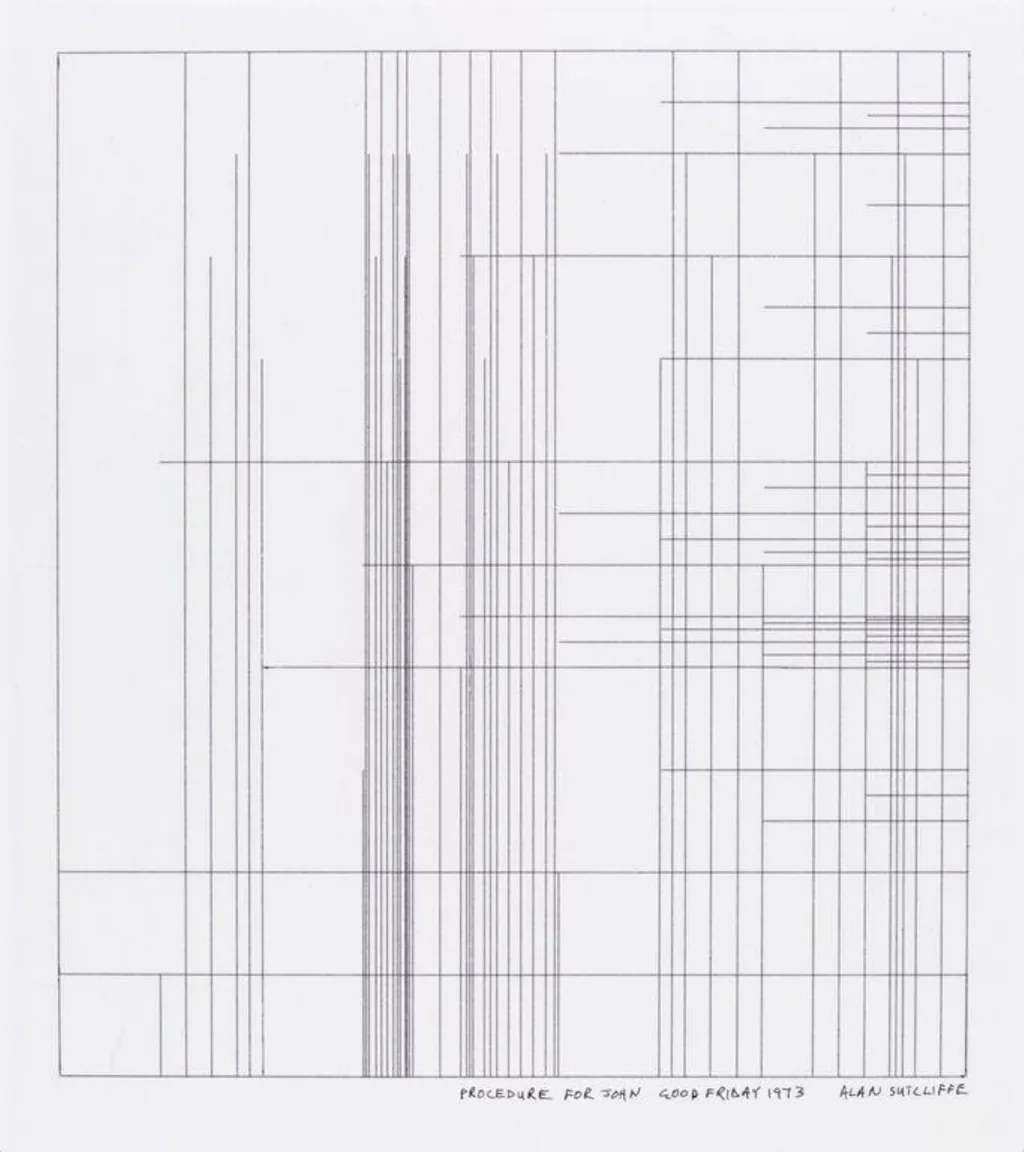
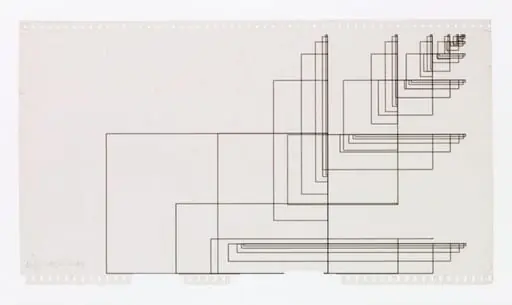
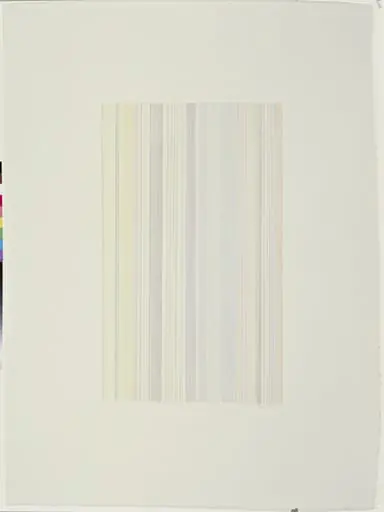
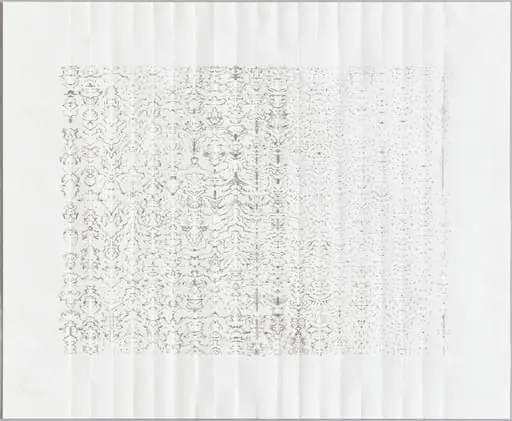
'Procedure for John' is a drawing by Alan Sutcliffe. It dates from 1973 and is held in the collection of the Victoria and Albert Museum. Created in 1973, this computer‑generated drawing by Alan Sutcroft was presented to his colleague John Lansdown.
About this work
This is a 1973 computer drawing by Alan Sutcliffe. It’s abstract and made with a very early computer tool. Sutcliffe used math rules to make the shapes, not his hand.
The piece was a gift for John Lansdown, a friend he worked with for years. Sutcliffe later wrote about simple math rules that create surprising patterns.
Look up the artist Sutcliffe, Alan.
Overview
Created in 1973, this computer‑generated drawing by Alan Sutcroft was presented to his colleague John Lansdown. The work consists of intersecting rectangles of differing proportions, produced by an early algorithmic process rather than manual drawing.
Subject & Meaning
The image visualises the ‘Skip and Divide’ algorithm, a rule that repeatedly subdivides a line segment into an increasing number of parts. By translating that one‑dimensional concept into a plane, Sutcliffe explored how simple mathematical instructions can yield complex, unintuitive patterns.
Technique & Style
Using a computer program written in the early 1970s, the algorithm calculated the positions of horizontal and vertical lines, generating a grid of rectangles whose sizes vary according to the underlying rule. The result is an abstract, purely geometric composition without any hand‑drawn elements.
History & Provenance
Both Sutcliffe and Lansdown were founding members of the Computer Arts Society, established in 1968. Sutcliffe served as the Society’s first chairman, while Lansdown acted as secretary. The drawing was produced as a personal gift marking their collaborative years within the organization.
Context
The piece belongs to the early phase of computer art, when artists with technical backgrounds—Sutcliffe studied mathematics at Bristol and worked for International Computers Limited—began experimenting with algorithmic generation. It reflects the Society’s interest in exploring how computational processes could expand visual practice.
Artist & collection
Artist
The Computer Arts Society (CAS) was founded in 1968, in order to encourage the creative use of computers in the arts.