Artwork
The Good Shepherd
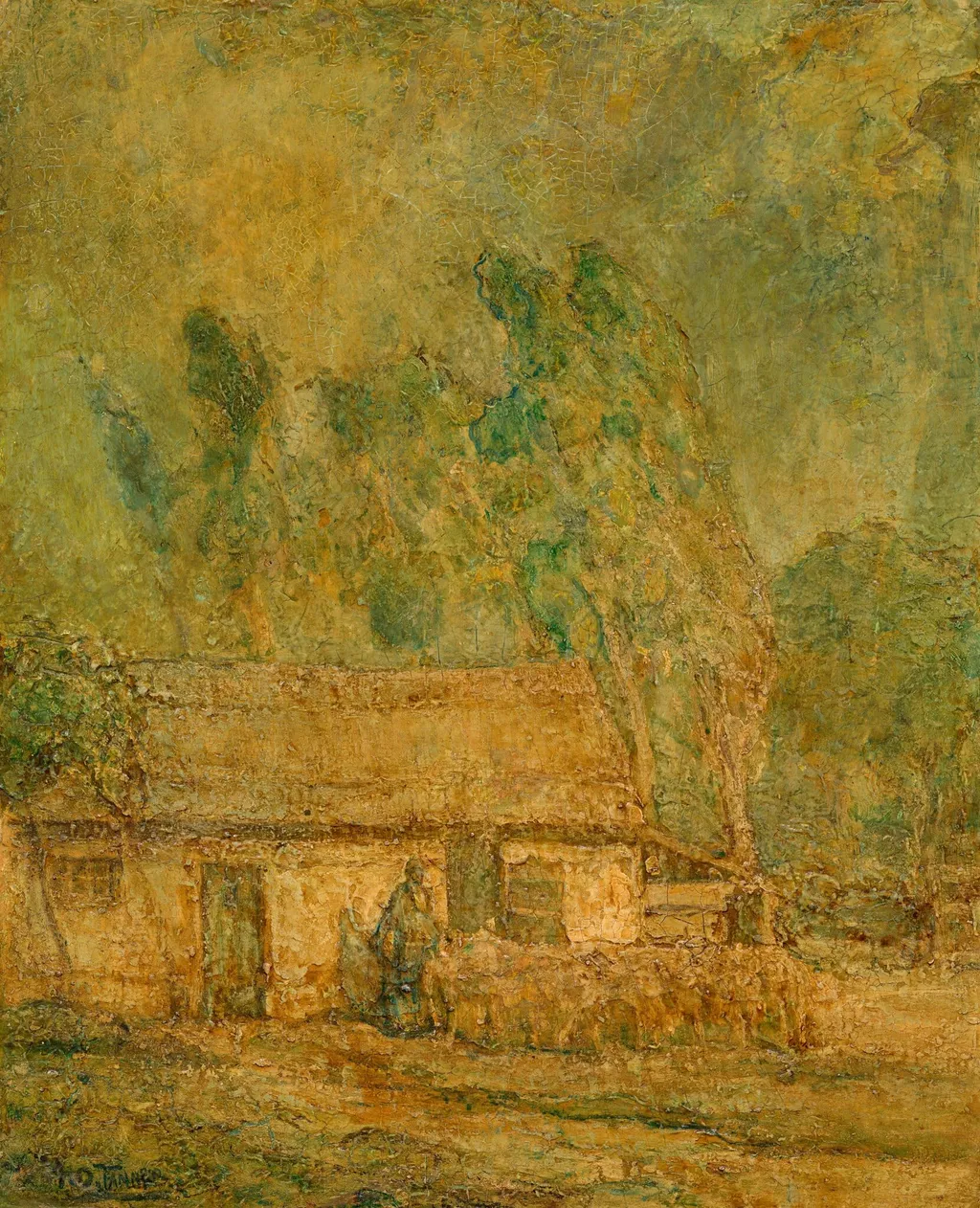
The Good Shepherd is an oil painting by the Realist artist Henry Ossawa Tanner. It dates from 1918 and is held in the collection of the National Gallery of Art.
About this work
Overview
Created circa 1918, *The Good Shepherd* is an oil painting executed on canvas that has been adhered to a particle board support. The work belongs to the realist tradition and presents a solitary figure overseeing a flock within a gently rolling countryside.
Subject & Meaning
At the center of the composition a lone shepherd attends to a group of sheep, suggesting themes of guidance and care. The pastoral setting, with its low stone wall and modest doorway, reinforces the notion of a quiet, protective environment.
Technique & Style
Tanner employs a muted palette of yellow‑green sky and softened earth tones, rendering the landscape with a dream‑like, slightly faded quality. Thick, uneven brushstrokes give the surface a tactile, textured appearance, while the handling of paint creates a sense of both immediacy and atmospheric distance.
History & Provenance
The painting was produced during Tanner’s long residence in France, where he had studied at the Académie Julian and become integrated into French artistic circles. It reflects the period when the artist, an African‑American, achieved his first international recognition.
Context
Tanner’s work often merged biblical or spiritual subjects with realistic settings, and *The Good Shepherd* continues this approach by placing a traditionally symbolic figure within a tangible, everyday landscape. The piece reflects his ongoing interest in the interplay between the sacred and the mundane.
Own this work as a print
Artist & collection

Artist
Henry Ossawa Tanner (June 21, 1859 – May 25, 1937) was an American artist who spent much of his career in France.