Artwork
Pierrot in Criminal Court
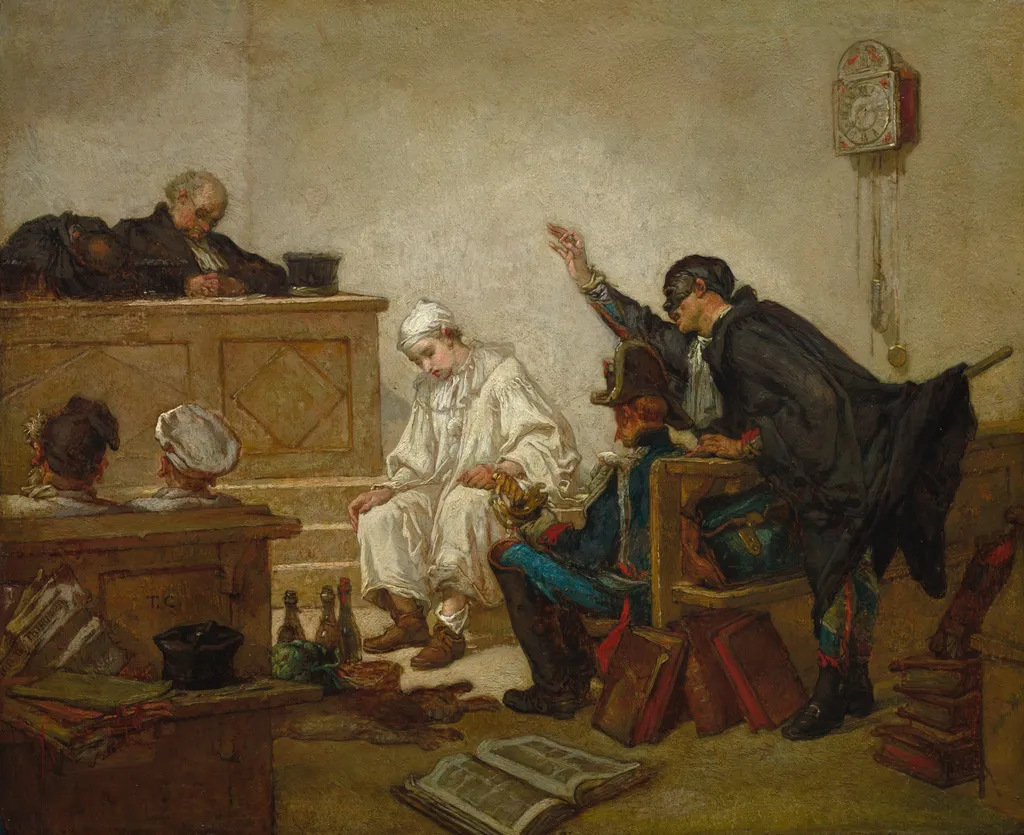
Pierrot in Criminal Court is an unspecified painting by the Realist artist Thomas Couture. It dates from 1867 and is held in the collection of the Cleveland Museum of Art.
About this work
Overview
Thomas Couture’s 1867 canvas *Pierrot in Criminal Court* presents a chaotic judicial interior populated by a disheveled defendant in a white costume reminiscent of the theatrical Pierrot. The figure slumps in a chair while a stern judge in black gestures toward him, surrounded by onlookers and scattered objects that convey the disorder of the proceedings.
Subject & Meaning
The central character’s Pierrot‑like attire links the work to the commedia dell’arte tradition, suggesting a theatricality to the legal drama. By placing a clownish figure in a solemn courtroom, Couture hints at the absurdity and vulnerability inherent in the judicial process, inviting viewers to contemplate the thin line between performance and punishment.
Technique & Style
Executed with the Realist emphasis on unidealized contemporary scenes, the painting employs thick, impasto brushwork that gives texture to fabrics, wood, and clutter. The rough application creates a sense of immediacy, while the muted palette and stark lighting reinforce the gritty atmosphere of a 19th‑century French courtroom.
History & Provenance
Created during Couture’s mature period, the work reflects his role as a leading history painter and teacher. It entered the collection of the Cleveland Museum of Art, where it remains on view. Among Couture’s many pupils were figures such as Édouard Manet and Pierre Puvis de Chavannes, who carried forward his realist sensibilities.
Own this work as a print
Artist & collection

Artist
Thomas Couture (French pronunciation: ; 21 December 1815 – 30 March 1879) was a French history painter and teacher.