Artwork
Allemand's French squadron in pursuit of a British conovy, 1805
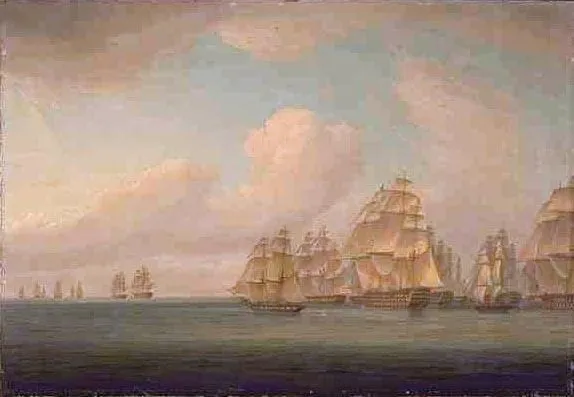
Allemand's French squadron in pursuit of a British conovy, 1805 is an unspecified painting by the British Romanticist artist Thomas Whitcombe. It is held in the collection of the National Library of Australia.
About this work
Overview
The painting belongs to a body of work produced by British artists who sought to record maritime history with precision and narrative clarity.
Painted around 1850 by Thomas Whitcombe, this work depicts a naval chase from 1805 involving a French squadron under Admiral Allemand pursuing a British merchant convoy. Though created decades after the event, it reflects Whitcombe’s long-standing interest in documenting naval conflicts of the Napoleonic era. The painting belongs to a body of work produced by British artists who sought to record maritime history with precision and narrative clarity.
Subject & Meaning
The scene captures a moment of strategic tension: French warships close in on a tightly grouped British convoy, likely attempting to disrupt supply lines. The composition emphasizes pursuit over combat, highlighting the vulnerability of merchant vessels against organized naval forces. It does not glorify violence but instead conveys the operational realities of naval warfare during a period of intense maritime competition between Britain and France.
Technique & Style
Whitcombe employs careful attention to ship detail and atmospheric perspective to convey depth and movement. The clouds and sea are rendered with muted tones, allowing the sails and hulls to stand out through subtle contrasts. Light falls unevenly across the scene, suggesting time of day and weather conditions without resorting to dramatic chiaroscuro. His style is observational rather than romanticized, prioritizing accuracy in vessel design and seamanship.
History & Provenance
The painting was created long after the 1805 event, likely as part of Whitcombe’s broader project to illustrate key naval episodes from the French Revolutionary and Napoleonic Wars. It was probably commissioned or produced for private or institutional collectors interested in naval history. Whitcombe exhibited regularly at the Royal Academy, and this work aligns with his documented interest in preserving the visual record of British maritime engagements.
Context
In 1805, France sought to weaken Britain’s global trade by targeting convoys, while Britain relied on naval superiority to protect its commerce. This pursuit occurred during a broader campaign of economic warfare, preceding the Battle of Trafalgar. Whitcombe’s depiction reflects contemporary British awareness of these threats, even if rendered decades later, when public memory of the wars remained vivid through printed accounts and veteran testimony.
Legacy
Whitcombe’s work contributes to a genre of British marine painting that valued historical fidelity over theatricality. Though less celebrated than contemporaries like J.M.W. Turner, his paintings serve as valuable visual archives of naval tactics, ship design, and maritime conditions. This piece remains a reference for historians studying the logistics and pressures of naval commerce warfare in the early 19th century.
Artist & collection
Artist
Thomas Whitcombe (c. 19 May 1763 – c. 1824) was an English painter who specialised in marine art. Among his work are over 150 actions the Royal Navy participated in during the French Revolutionary and Napoleonic Wars,…

 The British Fleet Forming a Line off Algiers
 Shipping in a Calm
 Shipping
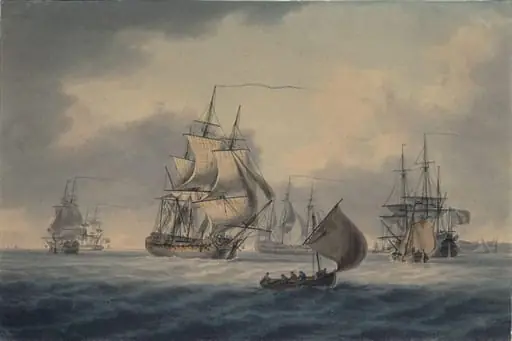 Shipping
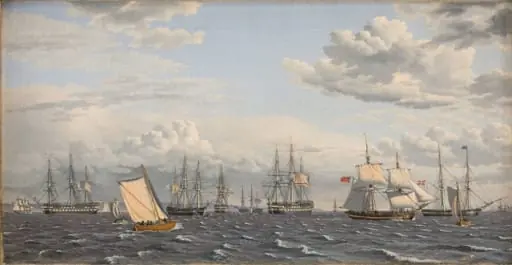 A Russian Fleet at Anchor near Elsinore
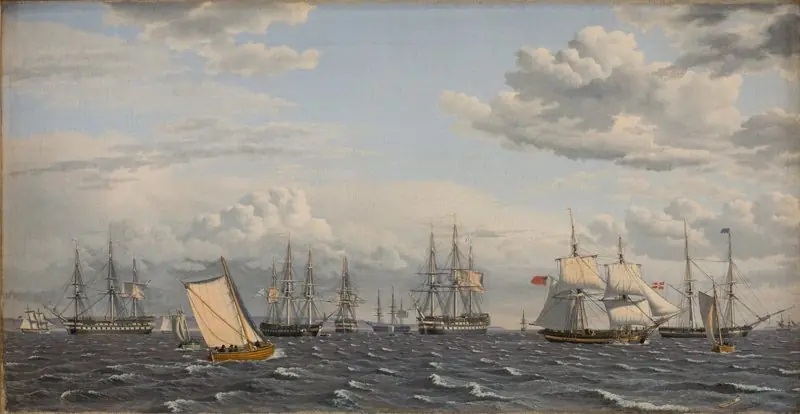 A Russian Fleet at Anchor near Elsinore
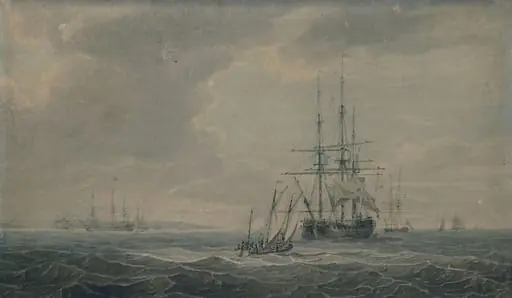 Shipping
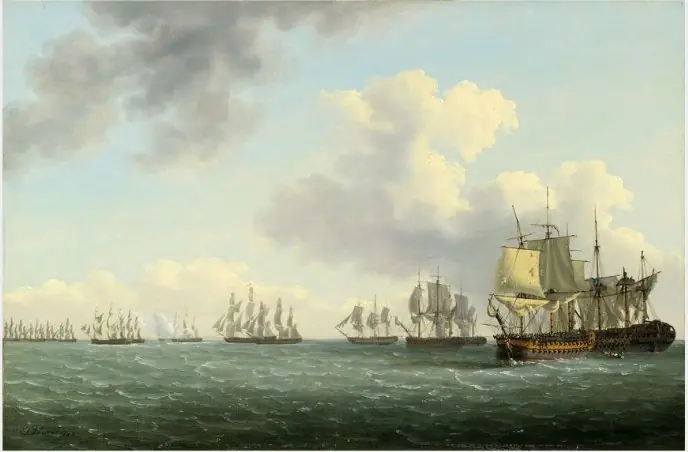 'The Robust' Taking Possession of 'The Hoche'
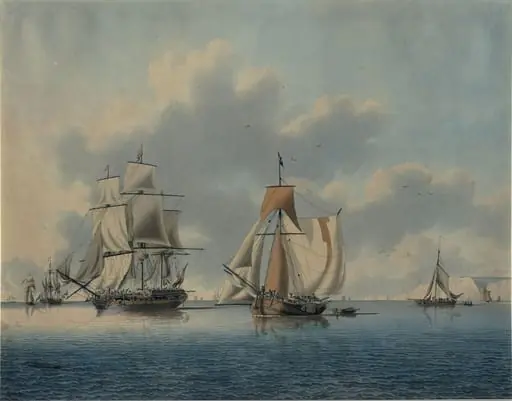 A frigate and Dutch fishing boats off the Isle of Wight
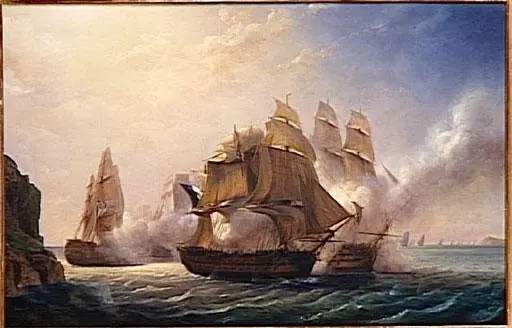 Combat du vaisseau francais le Romulus contre trois vaisseaux anglais à l'entrée de la rade de Toulon. 13 février 1814