Artwork
Queen Zenobia Addressing Her Soldiers
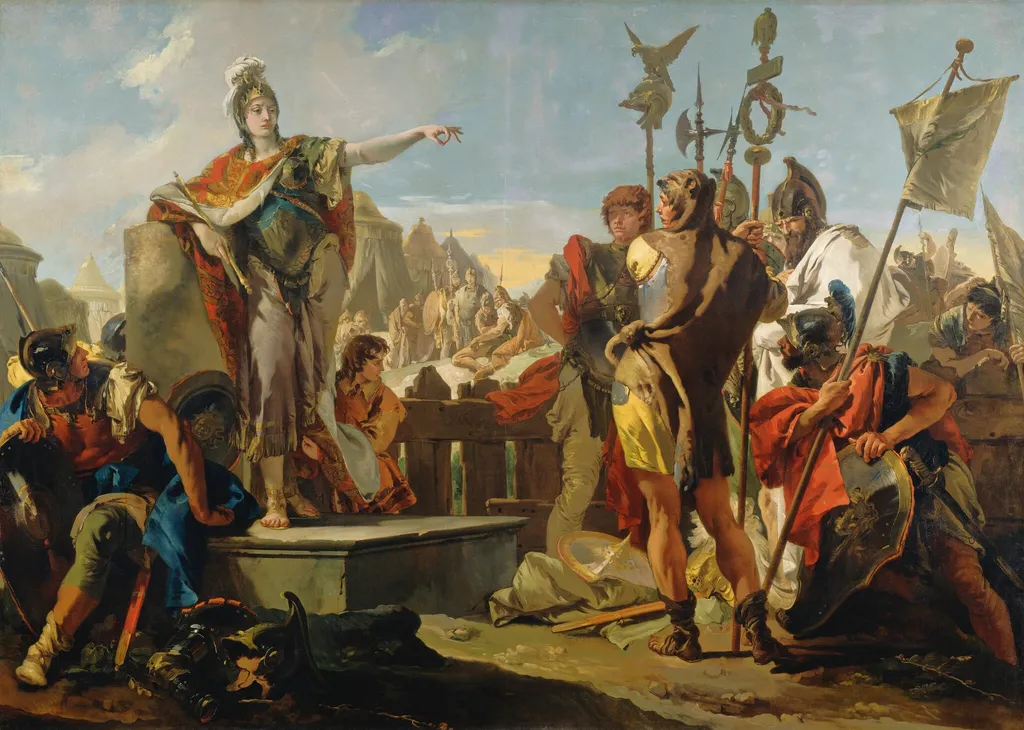
Queen Zenobia Addressing Her Soldiers is an oil painting by the Baroque artist Giovanni Battista Tiepolo. It dates from 1728 and is held in the collection of the National Gallery of Art.
About this work
Overview
Created in 1728, *Queen Zenobia Addressing Her Soldiers* is an oil on canvas work by Giovanni Battista Tiepolo. Executed in the Rococo idiom, the painting presents a vivid historical scene in which the Syrian queen stands atop a platform, gesturing toward a distant conflict while her armed followers listen attentively.
Subject & Meaning
The composition captures a moment of leadership: Zenobia, dressed in flowing robes, rallies her troops before battle. Her outstretched arm and the intense expressions of the soldiers convey determination and collective resolve, reflecting the 18th‑century fascination with heroic narratives drawn from antiquity.
Technique & Style
Tiepolo employs a luminous palette and pronounced chiaroscuro to focus attention on the central figure. The brushwork is fluid, characteristic of Rococo’s decorative elegance, while the dramatic lighting and airy atmosphere lend the scene a theatrical quality that heightens emotional impact.
History & Provenance
The painting belongs to the prolific output of Tiepolo, a leading artist of the Venetian school who worked throughout Italy, Germany, and Spain. Though its early ownership records are sparse, the work has remained within European collections, illustrating the artist’s wide appeal during his lifetime.
Context
In the early 1700s, European art increasingly turned to grand historical subjects, merging Baroque dynamism with Rococo’s lighter touch. Tiepolo’s depiction of Zenobia aligns with this trend, offering a narrative that combines classical heroism with the period’s taste for elaborate, staged compositions.
Own this work as a print
Artist & collection

Artist
Giovanni Battista Tiepolo, also known as Giambattista Tiepolo, was an Italian painter and printmaker from the Republic of Venice who painted in the Rococo style, considered an important member of the 18th-century Venetian school.