Artwork
Christ and the Adulteress
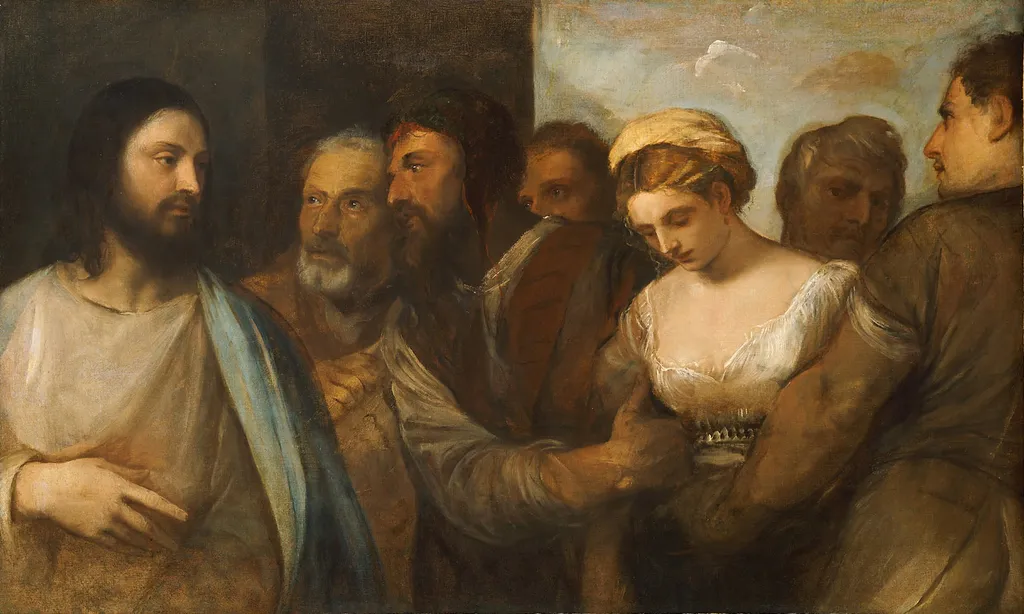
Christ and the Adulteress is an oil painting by the High Renaissance artist Titian. It dates from 1520 and is held in the collection of the Kunsthistorisches Museum.
About this work
This painting shows Jesus in a quiet moment with a crowd around him. The scene is about a woman caught in adultery, a story from the Bible.
Titian painted this around 1520 using oil paints. It hangs in Vienna’s Kunsthistorisches Museum today.
The tension between judgment and mercy is the heart of this story. It asks what forgiveness really looks like.
Look up Titian next.
Overview
Titian’s oil painting, dated to around 1520, portrays the biblical episode of the woman accused of adultery. Executed in the early Venetian Renaissance, the work is part of the collection of the Kunsthistorisches Museum in Vienna. The composition centers on Christ surrounded by onlookers, capturing a moment of moral deliberation.
Subject & Meaning
The scene draws from the Gospel narrative in which a woman caught in adultery is brought before Jesus. The surrounding figures represent the accusers and the public, while Christ’s calm demeanor underscores the tension between legal judgment and compassionate forgiveness, inviting contemplation of mercy as a theological principle.
Technique & Style
Titian employs oil on canvas with his characteristic rich coloration and subtle modeling of flesh. The painter’s use of chiaroscuro creates depth, while the loose brushwork in the background suggests a bustling crowd without detracting from the central figures. The palette balances warm earth tones with cooler shadows, enhancing the emotional tenor.
History & Provenance
Created in the early 1520s, the work entered the Habsburg imperial collection before being transferred to the Kunsthistorisches Museum, where it remains on display. Documentation traces its ownership through the Austrian court, confirming its presence in the museum’s holdings since the 19th century.
Context
The painting reflects the Counter-Reformation’s emphasis on moral instruction through biblical scenes. Titian’s treatment aligns with contemporary Venetian interest in humanist themes, presenting a narrative that engages viewers in ethical reflection. The work also exemplifies the period’s shift toward more intimate, psychologically charged religious imagery.
Artist & collection

Artist
Tiziano Vecellio (Italian: ; c. 1488/1490 – 27 August 1576), Latinized as Titianus, hence known in English as Titian ( TISH-ən), was an Italian Renaissance painter. The most important artist of Renaissance Venetian…