Artwork
Paris and Helena Surprised by Menelaus
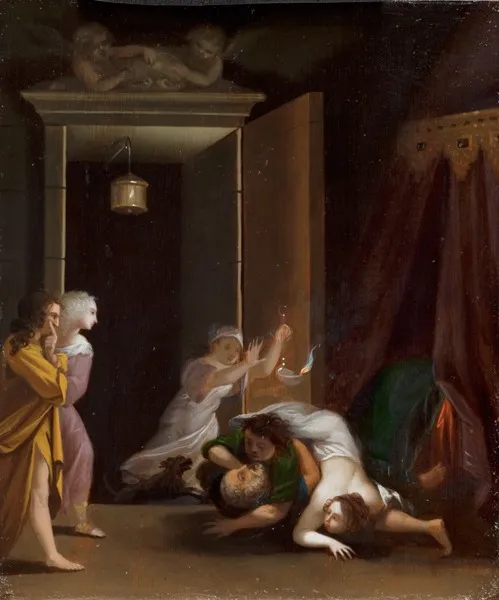
Paris and Helena Surprised by Menelaus is an oil painting by the Dutch Golden Age artist Toussaint Gelton. It dates from 1662 and is held in the collection of the Rosenborg Castle.
About this work
Overview
Created in 1662, *Paris and Helena Surprised by Menelaus* is an oil on canvas by Dutch painter Toussaint Gelton. Executed during the height of the Dutch Golden Age, the work presents a nocturnal interior in which six figures enact a moment from the Trojan myth, foregrounding the drama of Helen’s encounter with Paris and Menelaus.
Subject & Meaning
The composition captures the instant when Menelaus discovers his wife Helen with Paris. A sword‑bearing figure looms over a reclining couple, while another man pulls Helen away, and a torch‑bearing presence flickers in the background. The scene conveys themes of betrayal, conflict, and the tragic consequences that mythic narratives ascribed to the fall of Troy.
Technique & Style
A deep red curtain and a stone niche with a hanging pot frame the action, while the interplay of illumination and darkness creates a palpable tension.
Gelton employs strong chiaroscuro, allowing light to isolate the central figures against a shadowed backdrop. A deep red curtain and a stone niche with a hanging pot frame the action, while the interplay of illumination and darkness creates a palpable tension. The handling of light recalls the refined modeling of Gerrit Dou, while the compositional clarity reflects the influence of Cornelis van Poelenburgh.
History & Provenance
Trained in The Hague and a member of the Confrerie Pictura, Gelton later served as court painter to King Christian V of Denmark and worked in Sweden. The painting eventually entered a European private collection before being acquired by its present museum, where it remains on display as part of the Dutch Golden Age holdings.
Context
In the mid‑17th century, Dutch artists frequently turned to classical antiquity for subject matter, aligning with a broader European fascination with mythological themes. Gelton’s choice of a Trojan episode reflects this trend, while his Dutch training infuses the work with a meticulous attention to detail and a subdued palette characteristic of his national school.
Artist & collection
Artist
Toussaint Gelton (1630 – 1680) was a Dutch painter known for his work buying paintings in 1658 for the Swedish king Charles X Gustav and the family of Swedish noble Magnus Gabriel de la Gardie.