Artwork
Astasahasrika Prajnaparamita
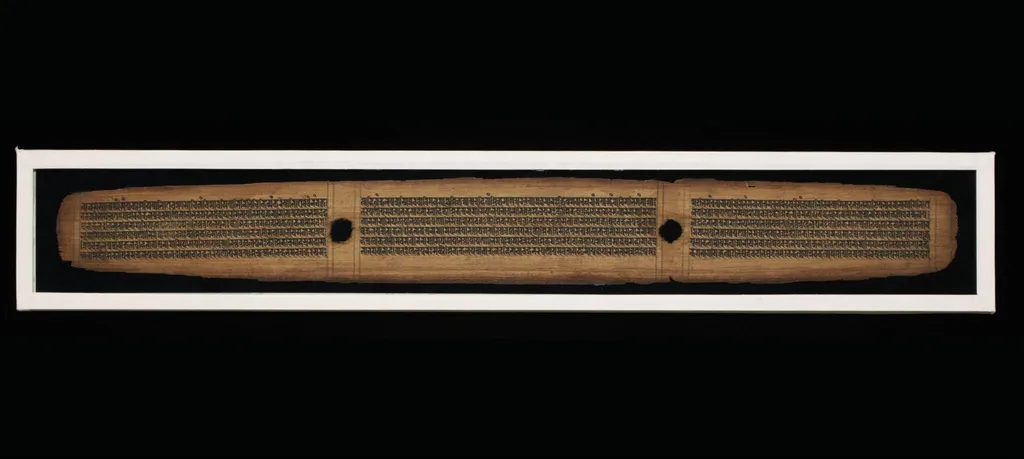
Astasahasrika Prajnaparamita is a paint painting by the Byzantine icon painting artist Unknown. It dates from 1112 and is held in the collection of the Victoria and Albert Museum.
About this work
Overview
This artwork is a single folio from a manuscript of the Astasahasrika Prajnaparamita, a Buddhist scripture, dated to 1112. Executed in ink and gouache on palm leaf, it features a distinctive, elongated wooden form with intricate markings.
Subject & Meaning
The central image depicts a long, narrow, light-brown wooden object with numerous closely spaced black lines, suggestive of text or symbols. A small, round hole is positioned at its center. The subject's identity and specific symbolic meaning within the broader manuscript context are not immediately clear from this folio alone.
Technique & Style
The artist utilized ink for the detailed, densely packed lines on the wooden object and gouache for the light-brown hue of the wood. The dark background, likely gouache, provides stark contrast, highlighting the wooden form. The rough edge on the left suggests the natural boundary of the palm leaf.
History & Provenance
Created in 1112, the folio's early history is undocumented. It was later acquired from Mr. T. Harris of Roehampton, London, before entering its current collection.
Context
Manuscripts of the Astasahasrika Prajnaparamita, a key Mahayana Buddhist text, were often illustrated with scenes or symbols relevant to the scripture. This folio's image, however, does not clearly illustrate a known narrative from the text, leaving its interpretive context somewhat ambiguous.
Legacy
As part of a larger manuscript, this folio contributes to the understanding of medieval Buddhist manuscript illumination. Its unique image invites further scholarly investigation into its symbolism and the artistic practices of its time.
Artist & collection

 Domestic Scene
 Giacomo and Cardinal Marco, investing Andrea, Abbot of San Zeno, with his Benefice
 The Nymph of Fontainebleau
 Portrait of a Woman
 Madonna and Child with Saints in the Enclosed Garden
 Venus and Minerva
 Family Group of Four on Sofa
 Wall painting from Room H of the Villa of P. Fannius Synistor at Boscoreale
 Text, Folio 28 (verso), from a Manuscript of the Perfection of Wisdom in Eight Thousand Lines (Ashtasahasrika Prajnaparamita-sutra)
 Text, Folio 60 (verso), from a Manuscript of the Perfection of Wisdom in Eight Thousand Lines (Ashtasahasrika Prajnaparamita-sutra)
 Text, Folio 31 (recto), from a Manuscript of the Perfection of Wisdom in Eight Thousand Lines (Ashtasahasrika Prajnaparamita-sutra)
 Text, Folio 55 (verso), from a Manuscript of the Perfection of Wisdom in Eight Thousand Lines (Ashtasahasrika Prajnaparamita-sutra)
 Text, folio 180 (verso), from a Manuscript of the Perfection of Wisdom in Eight Thousand Lines (Ashtasahasrika Prajnaparamita-sutra)
 Text, Folio 19 (verso), from a Manuscript of the Perfection of Wisdom in Eight Thousand Lines (Ashtasahasrika Prajnaparamita-sutra)
 Text, Folio 84 (verso), from a Manuscript of the Perfection of Wisdom in Eight Thousand Lines (Ashtasahasrika Prajnaparamita-sutra)
 Text, folio 181 (recto), from a Manuscript of the Perfection of Wisdom in Eight Thousand Lines (Ashtasahasrika Prajnaparamita-sutra)
 Text, Folio 78 (verso), from a Manuscript of the Perfection of Wisdom in Eight Thousand Lines (Ashtasahasrika Prajnaparamita-sutra)
 Text, folio 42 (recto), from a Manuscript of the Perfection of Wisdom in Eight Thousand Lines (Ashtasahasrika Prajnaparamita-sutra)