Artwork
Barbierszene
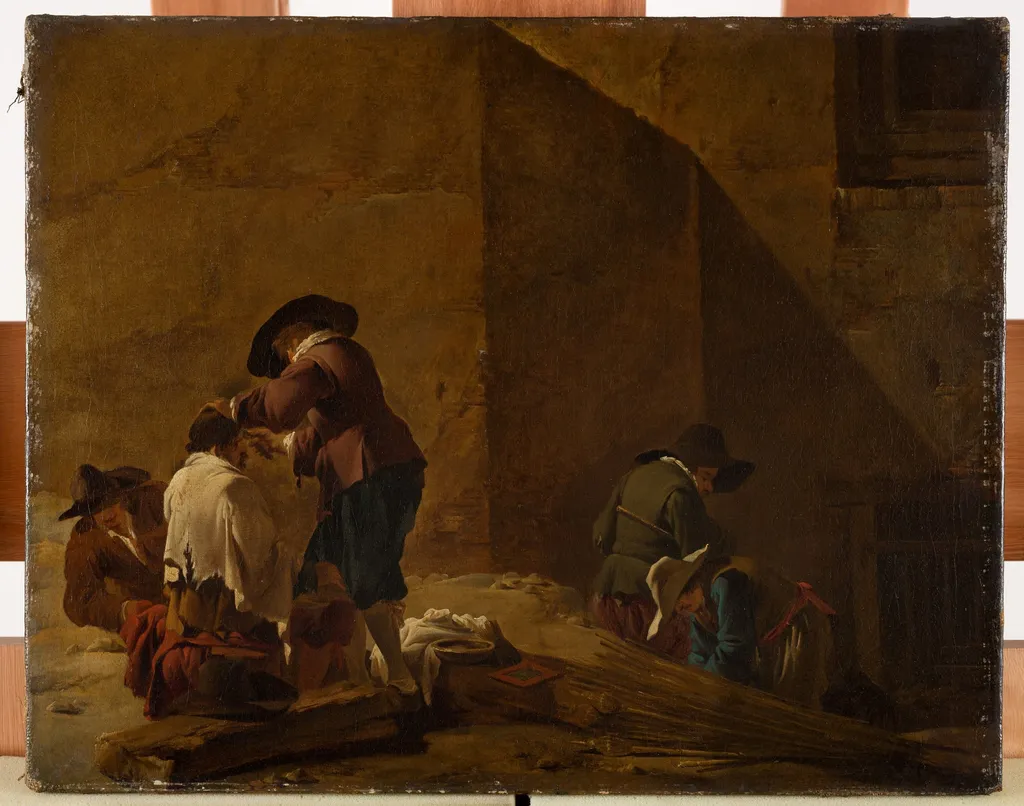
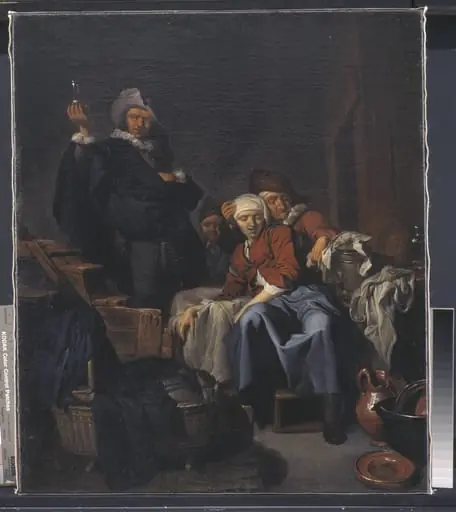
Barbierszene is a drawing by Unknown. It dates from 1650 and is held in the collection of the Art Collection of the University Göttingen. This drawing depicts a quiet interior scene with five figures in a dim, rocky chamber.
About this work
Overview
The composition centers on a man assisting another with what appears to be a haircut, while a woman kneels nearby.
This drawing depicts a quiet interior scene with five figures in a dim, rocky chamber. The composition centers on a man assisting another with what appears to be a haircut, while a woman kneels nearby. A seated figure reads, and a child rests on the floor. Sparse furnishings—tools, fabric scraps, and rough stone walls—suggest a modest, utilitarian space. The atmosphere is intimate, avoiding theatricality in favor of unremarkable daily activity.
Subject & Meaning
The scene captures an ordinary moment of personal care, likely a haircut performed in a domestic or laboring environment. The focused gestures and subdued lighting emphasize routine rather than ceremony. The presence of a child and a reader implies a shared, uneventful space where work and rest coexist. The subject resists narrative grandeur, instead valuing the dignity of mundane, unrecorded labor.
Technique & Style
The artist uses subtle tonal contrasts to suggest dim lighting and textured stone surfaces. Lines are restrained, with careful attention to the folds of fabric, the angle of a bent back, and the positioning of hands. Details like scattered tools and loose strands of hair are rendered with precision but without embellishment. The style favors observation over dramatization, aligning with a tradition of quiet, domestic realism.
History & Provenance
The drawing’s origin and creator remain undocumented. Its survival suggests it was preserved as a study or personal sketch rather than a finished work. No known exhibition history or collector lineage accompanies it. The absence of signatures or inscriptions leaves its context ambiguous, though its subject matter aligns with 17th- to 19th-century European drawings of laboring classes.
Context
In an era when art often celebrated myth, religion, or nobility, this drawing stands as a quiet counterpoint. Similar scenes appear in the work of Dutch and Flemish draftsmen who recorded everyday life with unembellished detail. The focus on grooming, a private act, reflects broader interest in the routines of non-elite populations, often overlooked in formal art of the period.
Legacy
Though not widely known, the drawing contributes to a quieter strand of artistic documentation—observing the small, unglamorous acts of daily life. It invites comparison with other drawings of hairdressing, tailoring, or domestic labor, offering insight into how artists recorded the physicality of ordinary work. Its endurance lies in its unassuming authenticity.
Artist & collection
Museum
Art Collection of the University Göttingen
Continue through works from the same source collection.
 Domestic Scene
 Giacomo and Cardinal Marco, investing Andrea, Abbot of San Zeno, with his Benefice
 The Nymph of Fontainebleau
 Portrait of a Woman
 Madonna and Child with Saints in the Enclosed Garden
 Venus and Minerva
 Family Group of Four on Sofa
 Wall painting from Room H of the Villa of P. Fannius Synistor at Boscoreale