Artwork
bark painting, painting, working
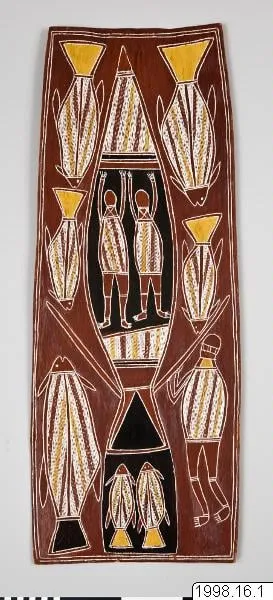
bark painting, painting, working is a paint painting by Unknown. It dates from 1850 and is held in the collection of the ethnographic museum.
About this work
Overview
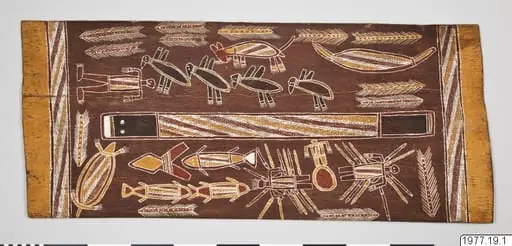
This bark painting depicts a tall, round‑headed figure flanked by two smaller figures, each outlined in vivid red against an unadorned background. The composition derives from a Yolŋu narrative concerning the Moon‑man Kabal and his sons, rendered in the characteristic minimalism of Arnhem Land bark art.
Subject & Meaning
The central figure represents Kabal, the Moon‑man, while the diminutive companions are his sons, Palmanga and Karpal. According to the story, the sons disobeyed Kabal’s instruction to hunt whistling ducks, prompting a punitive response that the painting records as a moral episode within Yolŋu oral tradition.
Technique & Style
Executed on a prepared bark surface, the work employs a restrained palette limited to red outlines and a plain field, a hallmark of early Yolŋu bark painting. The figures are rendered in silhouette, emphasizing narrative clarity over decorative detail.
History & Provenance
The scene portrayed originates from an ancient Yolŋu tale set on Japapara Island, located south of Milingimbi Island in Arnhem Land, where Kabal and his family were said to have camped. The painting is part of a collection that documents traditional Yolŋu storytelling through visual art.
Context
Yolŋu bark paintings often serve as visual records of law, kinship, and cosmology. This piece aligns with that function, illustrating a specific episode that reinforces communal values about obedience and the consequences of defiance within Yolŋu society.
Artist & collection
 Domestic Scene
 Giacomo and Cardinal Marco, investing Andrea, Abbot of San Zeno, with his Benefice
 The Nymph of Fontainebleau
 Portrait of a Woman
 Madonna and Child with Saints in the Enclosed Garden
 Venus and Minerva
 Family Group of Four on Sofa
 Wall painting from Room H of the Villa of P. Fannius Synistor at Boscoreale